
Most PIXEL holders are measuring the wrong thing.
They watch the chart like it’s a medical report. If price moves up, the project is healthy. If price keeps bleeding, the diagnosis feels obvious. Weak token, weak future, move on.
I used to think that too because, honestly, crypto trains you to think that way. Price becomes shorthand for truth. It feels efficient. Why spend time understanding behavior when the market has already voted?
But PIXEL made me question that.
Because I do not think its real test is happening on the chart.
I think it is happening on a quiet Tuesday, when nobody is talking about it.
No major announcement. No Binance listing rumor. No “huge partnership” thread. Just normal players logging in, checking crops, managing land, talking to guild members, doing the same small actions they did yesterday.
That is where the future of Pixel is actually being decided.
Not in headlines. In habits.
And that difference matters more than most investors realize.
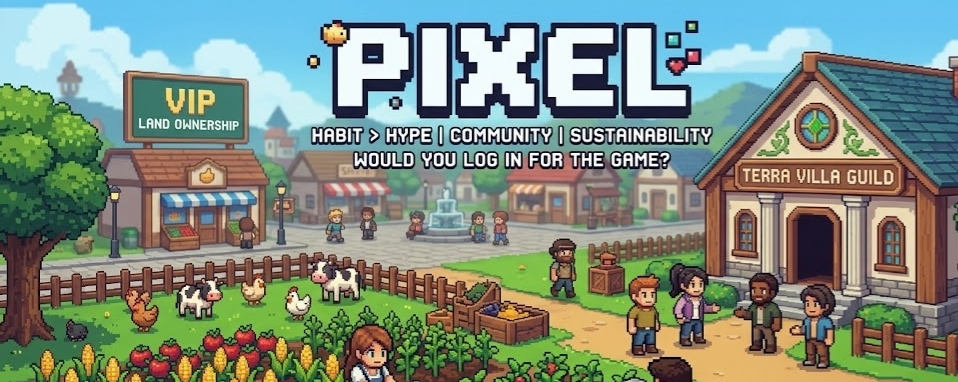
Pixels, the game behind PIXEL, is not trying to be the loudest project in crypto. It is a browser-based farming and social game built around simple loops. Farming, quests, land ownership, crafting, pets, guilds, progression. From the outside, it almost looks too ordinary.
That might be its advantage.
Most Web3 games are obsessed with looking important. They build complexity and call it innovation. More systems, more tokens, more strategies, more optimization paths. It looks impressive on paper, but most of the time it creates the same result: exhaustion.
People stop playing because they feel like they are managing spreadsheets instead of enjoying a world.
Complexity attracts attention. Simplicity keeps it.
That is the first thing many people miss about Pixel.
It is not competing with the most advanced games.
It is competing with routine.
And routine is one of the strongest forces in product design.
People do not stay because something is revolutionary. They stay because returning feels easier than leaving. Open the game. Do the daily loop. Progress a little. Close it. Repeat tomorrow.
It sounds boring.
Good.
Boring is where retention lives.
The strongest digital products are often boring from the outside. Nobody writes dramatic essays about checking notifications or opening an app they use every morning. But those quiet returns create something stronger than hype. They create behavior.
Behavior repeated long enough becomes identity.
And identity is stronger than rewards.
This is where most crypto gaming projects fail.
They think token incentives create loyalty.
They do not.
Rewards can create traffic. They can create attention. They can even create temporary growth. But if a player is only there because the math works, they are not staying. They are waiting.
The moment rewards shrink, they disappear.
That is not retention.
That is delayed churn.
Tourists are loud. Communities are quiet.
Pixel’s real challenge is turning tourists into residents.
That requires something deeper than token emissions. It requires emotional switching costs.
Guilds matter because people build social patterns around them. Land ownership matters because people protect what feels like theirs. VIP access matters because exclusivity changes perception. Even repetitive farming loops matter because repetition creates attachment.
Leaving should feel expensive, even when money is not the reason.
Not painful. Just enough that stopping feels like breaking a familiar pattern.
That is what sustainable GameFi should look like.
Not maximum extraction. Minimum friction.
There is a big difference.
The old play-to-earn model taught users to ask one question first: how much can I make?
That question destroys more projects than people admit.
Because once earnings become the main reason to stay, everything else becomes secondary. Community becomes optional. Gameplay becomes decoration. The token becomes the product.
That model does not scale. It only delays collapse.
The stronger question is harder and less exciting:
Would I still come back if the answer was less?
That question tells you whether a project has real gravity.
Pixel is trying to live inside that question.
Not perfectly. Not safely. But clearly.
And that is why the price conversation gets complicated.
Yes, PIXEL being far below its highs matters. A token falling that much damages trust, even if the product underneath still functions. People lose belief faster than they lose curiosity. Nobody likes spending time inside an economy that feels permanently weaker than yesterday.
Belief is part of utility.
A token does not need constant upside, but it does need credibility. Players need to believe the system will still matter next month. Otherwise every action feels temporary, and temporary systems never build deep loyalty.
This is the dangerous middle stage for Pixel.
It is not early enough for pure hype. It is not mature enough for complete trust. It sits in that uncomfortable zone where execution matters more than narrative.
And execution is harder than storytelling.
Can the economy survive without constant excitement?
Can daily users remain users when rewards are smaller and expectations are lower?
Can the system create enough value through participation, not just speculation?
These are boring questions.
They are also the only questions that matter.
Crypto loves dramatic moments because they are easy to screenshot. Pumps, listings, partnerships, all of it looks like progress. But most strong products are not built in dramatic moments. They are built in repetition.
Quiet systems win slowly.
That is hard for markets to price.
Price reacts fast to attention. It reacts slowly to habits.
A token can pump before fundamentals improve. It can collapse before loyalty actually breaks. The chart is useful, but it is not the whole truth. Sometimes it is just the loudest part.
I think a lot of PIXEL holders are listening to the loudest part.
They keep asking when price will prove the project is alive.
Maybe the better question is whether players are proving it first.
Because if users keep returning on ordinary days, value can rebuild. Slowly, painfully, but honestly.
If they do not, no token structure can save it.
That is why I think Pixel does not prove its future through headlines.
Headlines are temporary.
Token pumps are temporary.
Even strong narratives are temporary.
Routine is harder to fake.
The future of Web3 gaming probably belongs to projects that stop feeling like Web3 projects at all. Just normal parts of life. Something you check between other habits. Something ordinary enough to survive after the excitement disappears.
That sounds less glamorous than most people want.
But maybe that is the real upgrade.
Not bigger promises. Smaller repeated actions.
Not another headline.
Another thousand ordinary days.
And if PIXEL rewards disappeared tomorrow, how many players would still log in?
That answer matters more than the chart ever will.
