
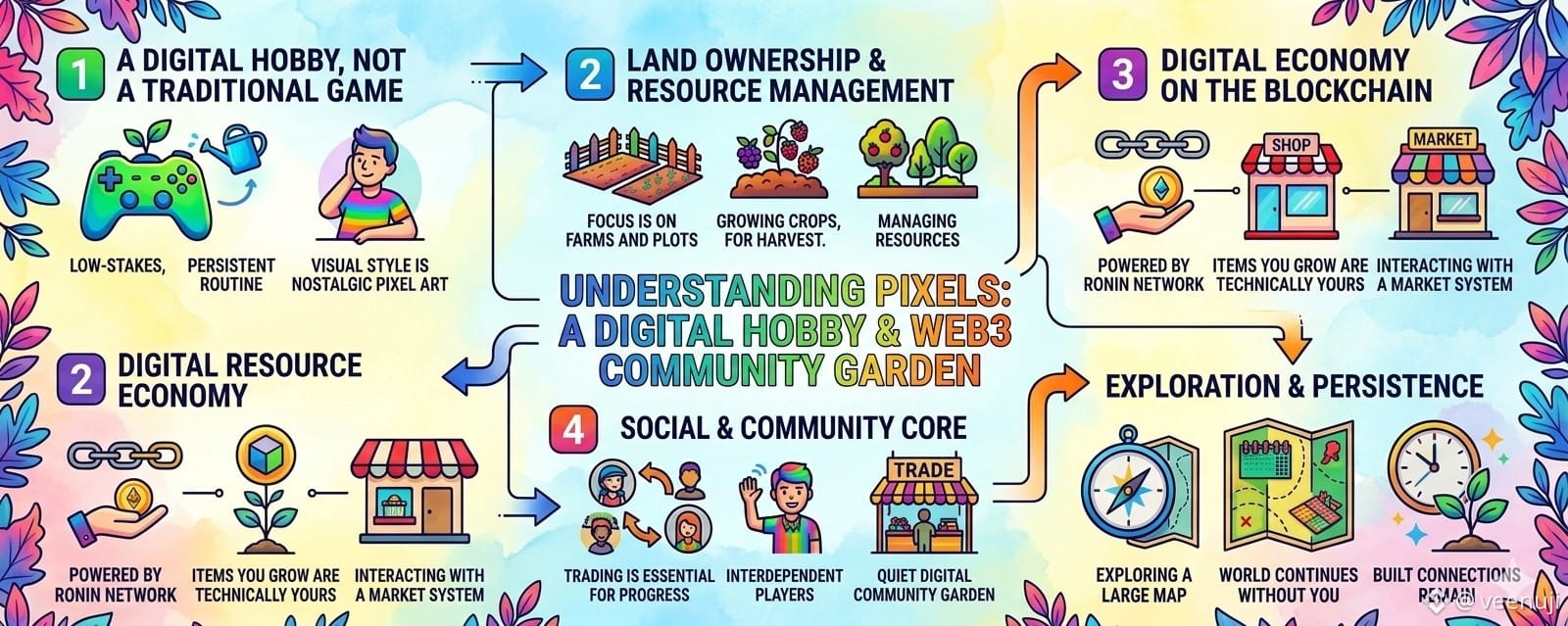
I’ve been spending some time looking into @Pixels Pixels lately. It’s one of those games that doesn’t really demand your attention, yet it seems to occupy a lot of space in the background of people’s daily routines. It’s built on the Ronin Network, which is essentially just the infrastructure underneath, but the game itself feels more like a digital hobby than a traditional game.
When you first land in the world, the visual style strikes you. It’s pixel art—very nostalgic, very clean. It feels like something you might have played on a handheld console twenty years ago, but with more people walking around. You can usually tell, within a few minutes of logging in, that the focus isn’t on winning or beating someone else. It’s mostly about land. You have these plots, you plant crops, you wait for them to grow, and you harvest them.
It’s simple, almost to a fault.
But that’s where things get interesting, I think. Because the game is built on a blockchain, every little thing you grow or build is technically yours. You aren’t just playing in a sandbox; you’re technically interacting with an economy. Most games, when you plant a virtual seed, it just exists within the code of the developer’s server. Here, there’s a sense that the output has a life outside the game window. It’s a subtle shift, but it changes how you approach the tasks. You aren’t just playing; you’re managing resources.
I spent a few hours just walking between the different plots, watching how other players move. There’s a strange, quiet rhythm to it. People are mostly just going about their business. They’re watering berries, chopping wood, or finding spots to refine their materials. It’s not like those high-energy games where everyone is trying to dominate a leaderboard or shouting in a chat window. It’s more like a digital community garden. You see someone working on their land, you pass them, maybe you say hello, or maybe you just keep moving.
It becomes obvious after a while that the social aspect is actually the core of it, even if the mechanics are just about farming. You have to trade with others to get what you need to progress. If you’re stuck on a specific craft, you look for someone who has the item. The market isn't hidden in some deep menu; it’s part of the fabric of the game. You realize that you’re dependent on the people around you, even if you never actually speak to them. That reliance creates a unique kind of social pressure, or maybe just a social weight. You’re not entirely alone, even when you’re doing your own thing on your own plot.
The exploration part is interesting, too. The map is bigger than it looks at first. You stumble upon these little corners of the world that feel abandoned or, conversely, over-crowded. It makes you wonder about the people who own the land. Are they treating it like a business? Are they just having fun? You can’t really tell, but the difference in how the plots are decorated or organized gives you a glimpse into their priorities. Some are efficient, lined up perfectly. Others are messy, just chaotic arrangements of whatever they found.
The question changes from "how do I level up" to "what am I trying to build here?"
It’s easy to get lost in the weeds of the "web3" terminology—tokens, wallets, chains, all that stuff. And if you lean too hard into that, you lose the point of the game. If you only look at the numbers, the farming becomes a job. If you only look at the game, the economy seems invisible. The sweet spot, if there is one, is somewhere in the middle. It’s that feeling of doing something productive, even if the product is just a digital pixel on a screen.
I noticed that I started checking my crops even when I wasn’t really "playing." It’s a weird habit. You check the time, you think about your digital farm, you wonder if your stuff is ready to harvest. It bleeds into your real day. It’s not necessarily addictive in the way big games are, where they pull you in with flashing lights and loud noises. It’s more like a lingering thought. You just check in, do your tasks, and step away. It’s very low-stakes, and yet it has this strange persistence.
There’s also the element of time. Everything in the game moves at its own pace. You can’t rush the crops. You can’t force the market to move faster. You just have to sit with the waiting. In a world where everything is usually instant—news, messages, deliveries—there’s something almost grounding about a game that forces you to wait for a plant to grow. It forces a pause. You’re not constantly clicking; you’re just observing.
I think that’s why people stick around. It’s not because they’re chasing a high, but because they’ve built a little corner for themselves. They’ve invested time into their avatar, into their inventory, into their spot on the map. Even if the game were to change tomorrow, that connection to the work you’ve put in remains. It’s a very different relationship than the one I have with most games. In those, I’m a guest. Here, it feels like I’m a tenant.
I wonder what happens when more people join, or when the economy shifts. Does the community become more guarded? Does it become more competitive? Right now, it’s mostly helpful. People share information, they point out where to find things, they aren’t trying to sabotage each other. Maybe because there’s enough room for everyone, or maybe because we’re all just trying to figure out how to farm efficiently.
It’s funny, looking at it now, how much of my time I’ve spent just moving a character back and forth across a screen. It doesn’t sound like much when I describe it out loud. But there’s a quality to the silence of it. The sound design is soft, the colors are muted, and the world just keeps turning, with or without me.
It makes me think about how we spend our digital lives. We spend so much time scrolling, consuming, reacting to things that disappear as soon as we look away. Pixels feels different because it’s persistent. You leave a tree there, and it’s still there when you come back. You plant a seed, and it follows the rules of the world. It’s a small, predictable reality in a space that’s usually anything but.
Maybe that’s the real draw. A place where you can just be, and things grow if you look after them. It isn’t about being the best or the fastest. It’s just about being there, consistently, and letting the game take its own course. I find myself coming back to it, not because I have to, but because it’s become a quiet part of my day, like walking a path I know well, where the scenery is always the same, but somehow, it’s always just a little bit different every time I pass through it...
