
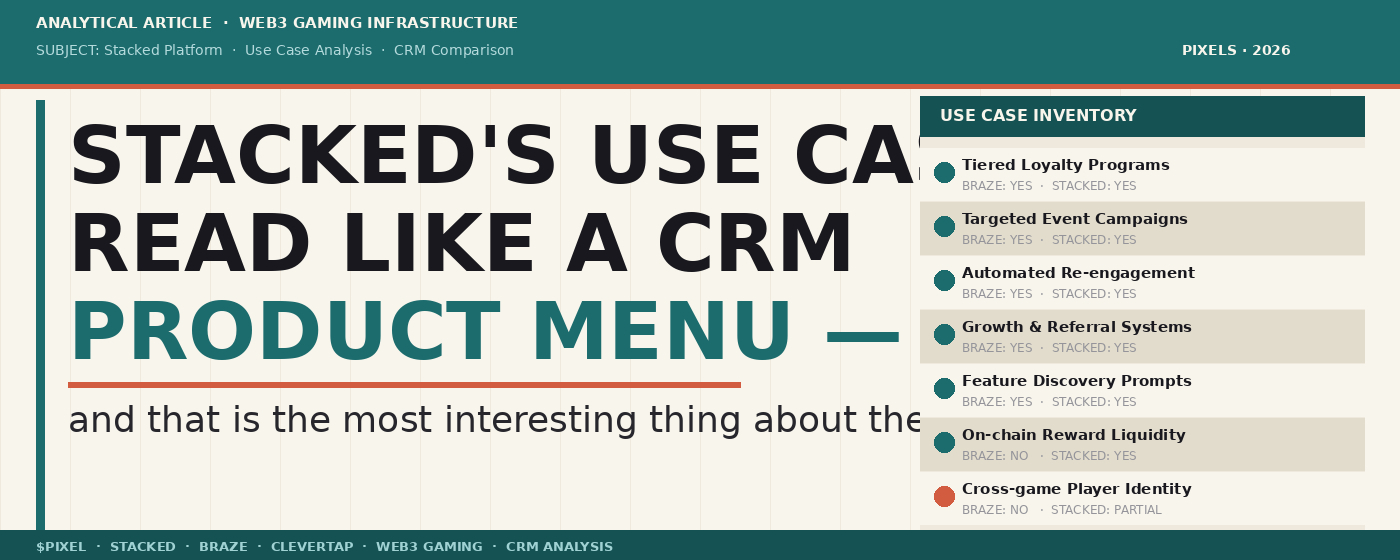
There is a particular experience that comes from reading Stacked's documented use cases with a browser tab open to any mid-market marketing automation vendor, and it is the experience of recognising almost everything on the list. Tiered loyalty programs, targeted event campaigns, automated re-engagement flows, growth and referral systems, feature discovery prompts. The vocabulary is familiar. The workflow stages are familiar. The problems being solved are familiar. A product manager who had spent three years inside a Braze or CleverTap implementation would read Stacked's use case documentation and find nothing that required explanation. The mechanics are the same. The outcomes being promised are the same. The customer being addressed is recognisably the same customer.
I want to stay with that observation rather than use it as a dismissal, because the recognition cuts both ways. Either Stacked is offering nothing that a conventional marketing stack could not deliver, which would make the Web3 layer decorative rather than functional, or the Web3 layer is adding something genuine to mechanics that look familiar on the surface but behave differently underneath. Neither reading is obviously wrong, and reaching for a quick resolution would miss the more interesting question underneath.
To think through what a conventional marketing automation platform actually does at each stage, the workflow is roughly as follows. A studio integrates an SDK or API. The platform ingests behavioural signals from the player, segments the audience according to defined criteria, and triggers a campaign or reward event when a player enters a defined segment. The player receives a push notification, an in-app message, a discount, or a loyalty point. The studio observes the response rate, iterates on the segment definition or the reward value, and runs the next campaign. The loop is closed inside the platform's analytics dashboard, which the studio uses to optimise toward whatever outcome metric it has defined. This is a well-understood industrial process with decades of tooling behind it, and Braze and CleverTap and their equivalents have invested considerable engineering effort into making it fast, precise, and reliable.
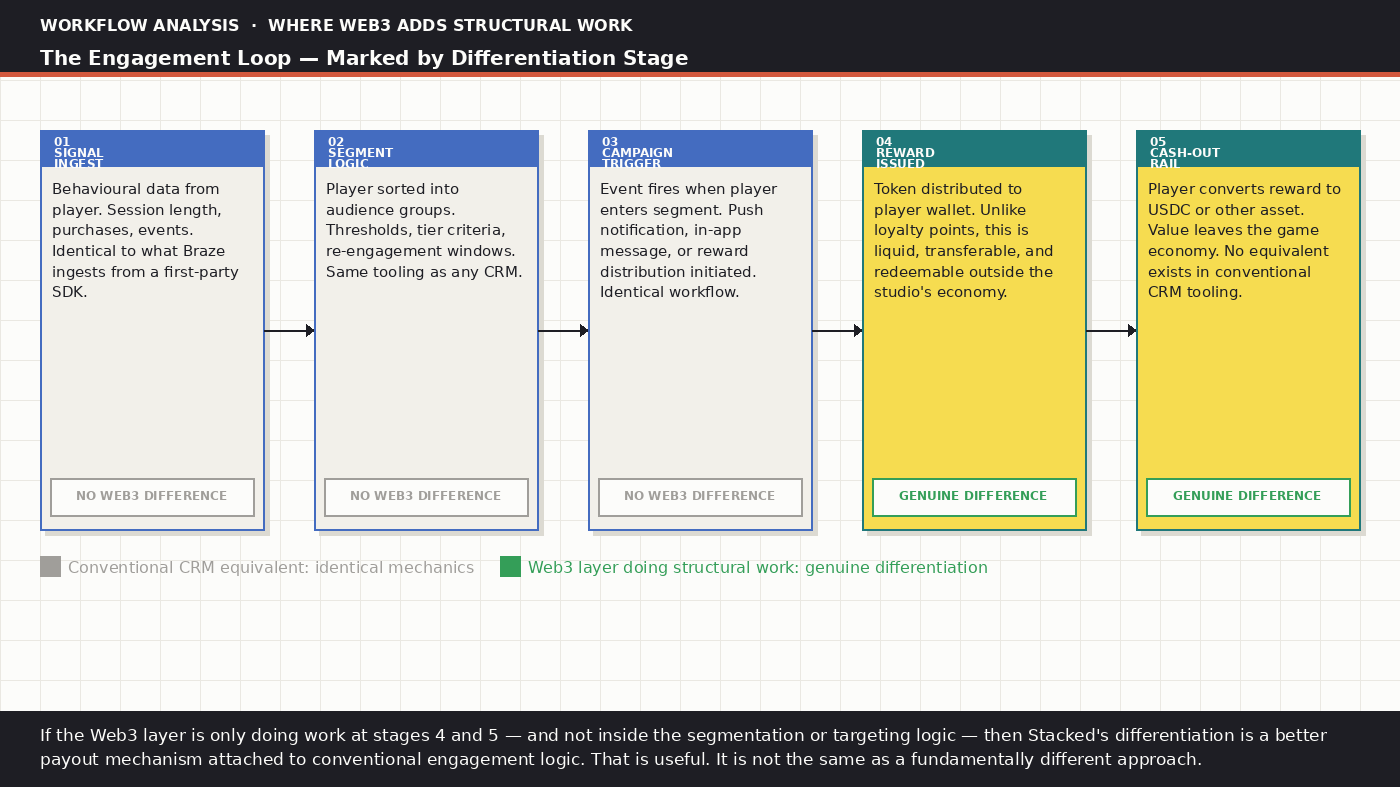
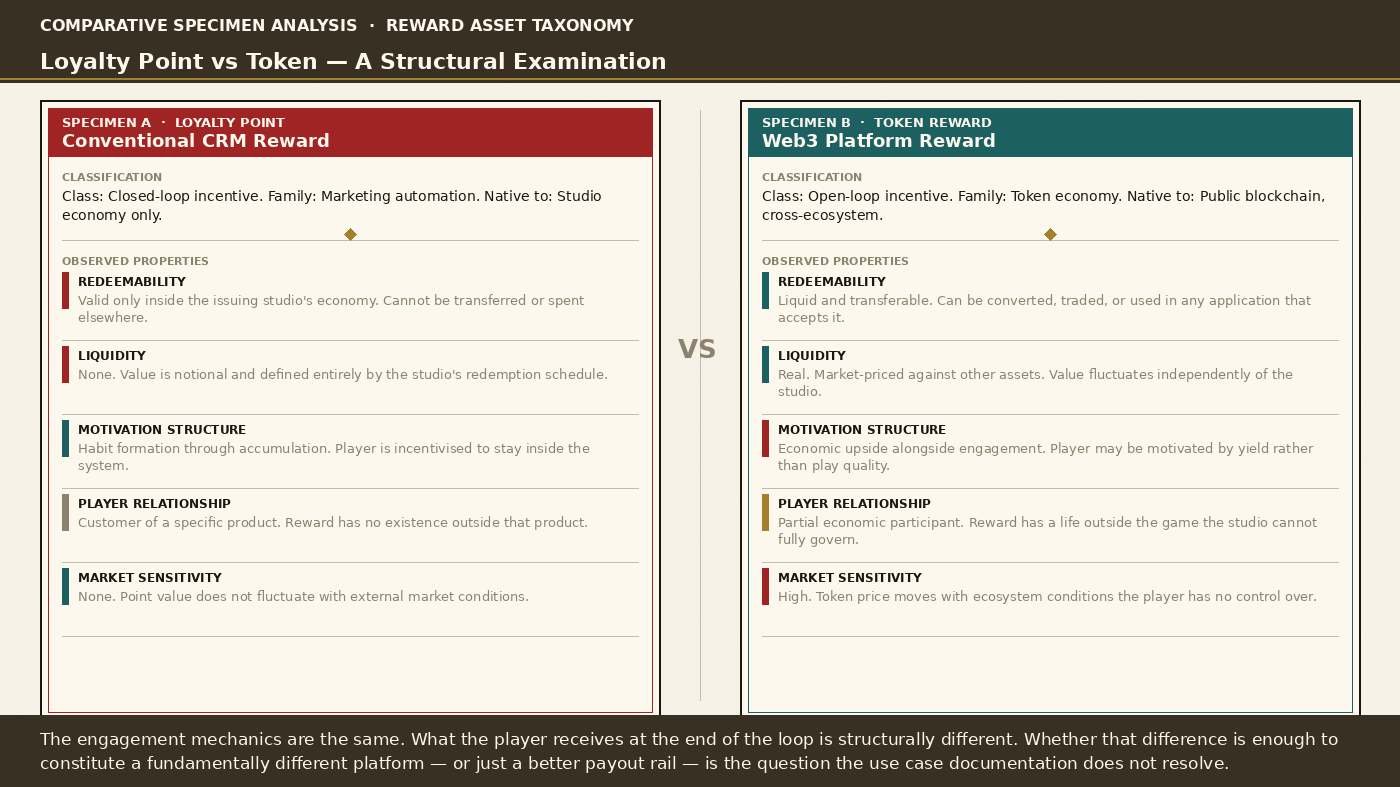
Now consider what changes when the reward in that workflow is a token rather than a loyalty point. At the triggering stage, nothing changes. The behavioural signal is the same, the segmentation logic is the same, and the campaign event fires in the same way. What changes is what the player receives and what they can do with it. A loyalty point inside a conventional system is redeemable inside the system that issued it. It has no existence outside the studio's economy, no liquidity, and no transferability. A token on a public blockchain is liquid, transferable, and convertible into other assets. The player who receives it can hold it, sell it, use it in other applications, or ignore it. The reward has a life outside the game in a way that a loyalty point structurally cannot.
That difference is real and should not be minimised. It changes the player's relationship to the reward in ways that matter for engagement design. A reward that can be converted into real purchasing power creates a different motivational structure than one that can only be spent inside the studio's own store. Whether that motivational structure produces better long-term engagement or more economically motivated short-term behaviour is an empirical question the sector has not settled cleanly, and the evidence from earlier play-to-earn cycles is genuinely mixed. But the structural difference is there, and it is not something a Braze integration can replicate.
The harder question is whether that difference explains the engagement mechanics Stacked is documenting, or whether it is a separate feature that sits alongside those mechanics rather than inside them. A tiered loyalty program in Stacked works the same way as a tiered loyalty program in any CRM. Players accumulate activity, cross thresholds, and unlock higher tiers with better rewards. The tier logic, the threshold design, and the campaign triggering are identical. What is different is the denomination of the reward at the end of the chain. If the Web3 layer is only doing work at the cash-out rail and not inside the engagement mechanics themselves, then Stacked's actual differentiation is narrower than its use case documentation implies. It is a better payout mechanism attached to conventional engagement logic, which is a useful thing to be but not the same thing as a fundamentally different approach to player engagement.
There is a version of the Web3 layer that would represent a genuine mechanical difference. If on-chain player identity allowed studios to build engagement logic that referenced a player's behaviour across every game they had played, not just behaviour inside the current title, then the segmentation and targeting capabilities would exceed anything a conventional CRM could offer. The reward history, reputation score, and cross-game behavioural record that Pixels' reputation system is attempting to build would give studios a player model with a depth that first-party data alone cannot produce. That is a use case where the Web3 layer is doing structural work inside the engagement mechanics, not just at the payout stage.
Whether Stacked's documented use cases are actually drawing on that capability, or whether they are currently running on the same first-party behavioural signals that any conventional SDK would capture, is something I cannot determine from the documentation alone. The use cases as described do not require cross-game identity to function. They require the same data inputs that Braze already ingests. If the cross-game layer is not yet informing the segmentation logic in practice, then the engagement mechanics are conventional and the differentiation is in the denomination of the reward.
This is not a damaging conclusion for Stacked necessarily. A better cash-out rail is a genuine product improvement for a sector where reward liquidity has historically been poor or nonexistent. Studios that want to offer players real economic upside without building their own token infrastructure have limited options, and a platform that handles the blockchain layer while delivering familiar CRM-style campaign tooling is addressing a real market need. The question is whether that is the product being described, or whether the Web3 framing is carrying more weight than the mechanics currently justify.
What I keep returning to is whether the studios integrating Stacked are choosing it because the engagement mechanics are differentiated, or because the cash-out rail is, and whether those two reasons imply different things about the platform's long-term position in a market where conventional marketing automation vendors are not standing still.