
I didn't think about Stacked as a business model for a long time.
I thought about it as a feature. Something the Pixels team built to solve an internal problem and then decided to open up to other studios. A natural extension of existing work. Logical, maybe even inevitable given what they had already built. But still essentially a product decision rather than a strategic one.
That reading changed slowly.
It changed when I started thinking about what kind of problem Stacked actually solves and who else in the world has that problem right now.
Every game studio that has ever tried to add blockchain elements to their game has run into the same wall at roughly the same moment. Not the technical wall. Not the wallet onboarding wall. Those are real but they're solvable with enough engineering time. The wall I'm talking about is subtler and more fundamental.
They don't know how to design a reward economy that doesn't destroy itself.
That problem sounds simple from the outside. Just don't emit too many tokens. Add sinks. Balance supply and demand. The frameworks exist. The whitepapers are full of them. And yet the failure rate of Web3 game economies remains extraordinary. Projects with serious teams, serious funding, and serious technical execution have launched economies that collapsed within months despite following every framework correctly on paper.
Because the framework problem isn't really a framework problem.
It's a calibration problem. And calibration requires data that you can only get from running a live economy under real adversarial conditions long enough to understand what genuine engagement actually looks like versus what extraction looks like versus what the early warning signals of economic deterioration feel like before they show up in the charts.
That data takes years to accumulate. Most studios don't have years. They have a launch window, a token sale, and a community that expects results faster than any economy can realistically mature.
Pixels has the data. That's the thing most people haven't fully processed.
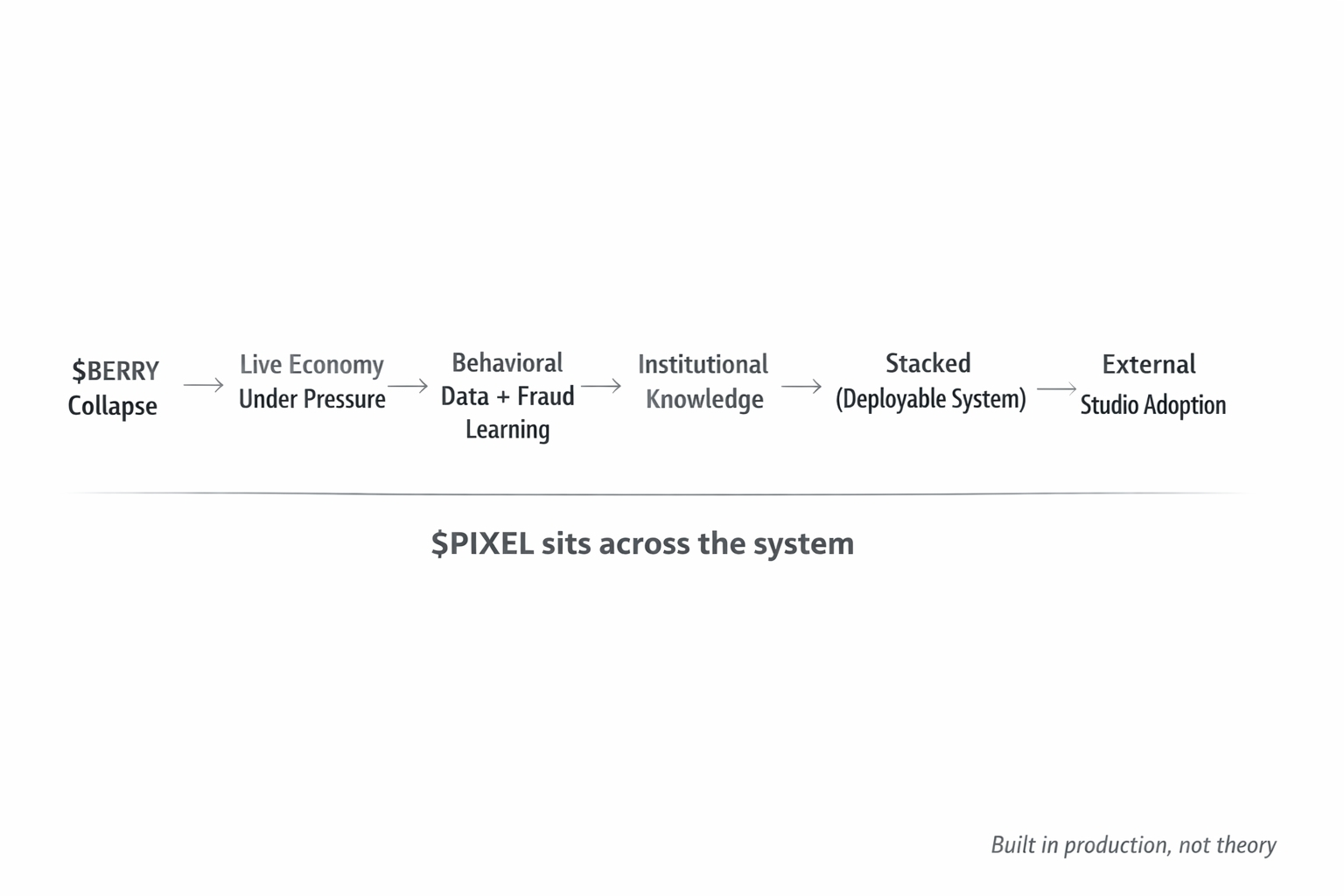
Not because they planned to accumulate it. Because they had no choice. Surviving the $BERRY collapse, rebuilding the economy while it was still running, watching fraud patterns evolve in real time and building responses to them, measuring which reward interventions actually changed player behavior versus which ones just temporarily inflated metrics — all of that produced something more valuable than a working game.
It produced institutional knowledge about how Web3 game economies actually behave under pressure.
Stacked is what happens when you try to turn that institutional knowledge into infrastructure someone else can use.
And that reframe — from product to infrastructure, from feature to institutional knowledge made deployable — is where the business model story gets genuinely interesting.
Because if Stacked is actually what it appears to be, the addressable market isn't other Web3 games that want a quest board. The addressable market is every game studio that wants to add meaningful ownership and rewards to their game without destroying their economy in the process. That market is enormous. And the number of teams that have the specific kind of hard-won knowledge required to serve it well is extremely small.
Most of them failed. Their knowledge is a post-mortem, not a product.
Pixels failed partially, survived, and built the product. That is a different position entirely.
I keep thinking about what that means for $PIXEL specifically and I keep arriving at the same uncomfortable gap.
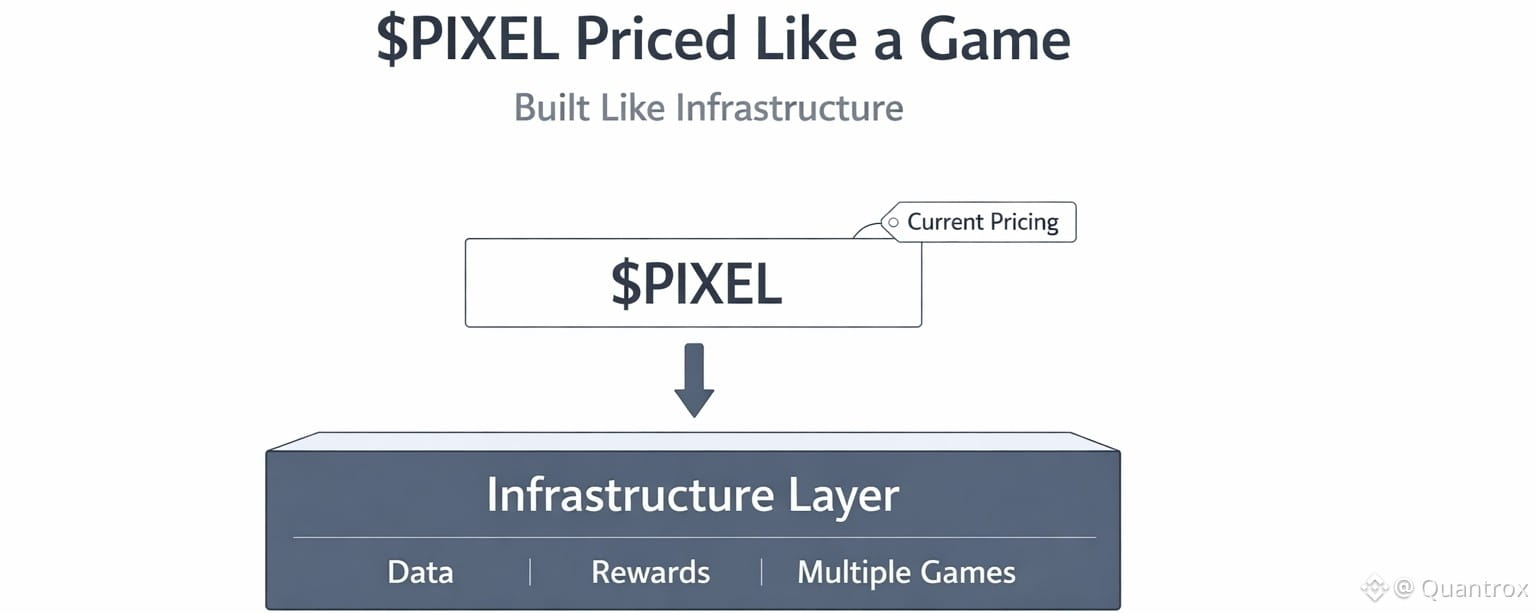
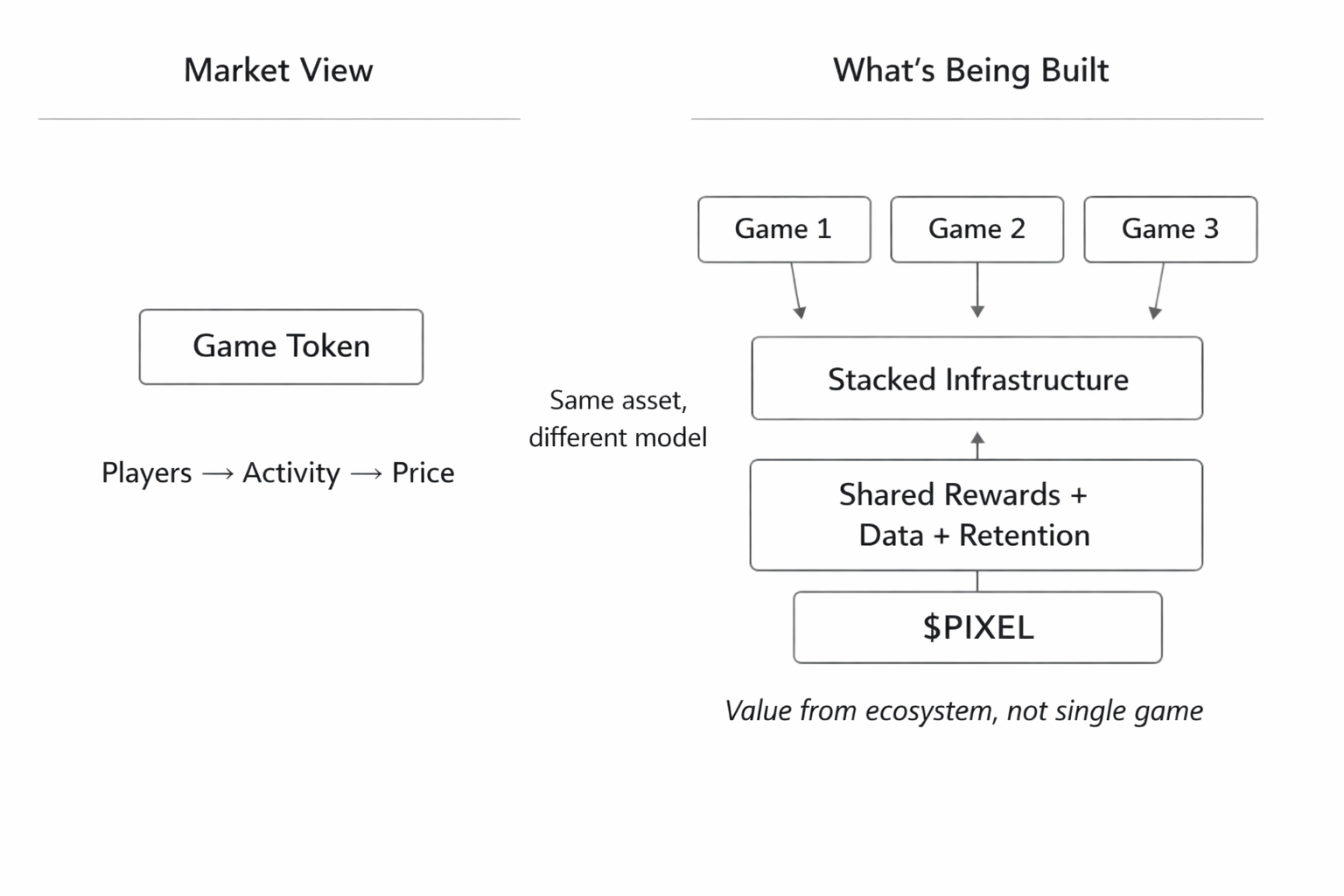
The token is currently priced as a game token. Something whose value tracks player count, transaction volume, and broader GameFi sentiment. Those things matter. They influence price in the short term in very direct ways. I'm not dismissing them.
But if Stacked achieves meaningful external studio adoption — if the institutional knowledge really does translate into infrastructure that other studios pay to use — then $PIXEL's value stops being purely a function of how many people are farming inside Pixels on any given day.
It starts being a function of how many games are running on the shared rewards layer that PIXEL sits inside.
Those are very different calculations. And right now the market is using the first one to price an asset that might eventually need the second one to value it accurately.
That gap between what something is currently priced as and what it might eventually need to be priced as — that's usually where the most interesting asymmetries live in early stage ecosystems.
I'm not certain Stacked gets there. External studio adoption requires things that great infrastructure alone doesn't guarantee. Sales cycles. Integration costs. Organizational inertia inside studios that have existing systems they're reluctant to replace. Those friction points are real and they have defeated better products than this one before.
But the knowledge underneath Stacked is real. The 200 million rewards processed are real. The $25 million in revenue is real. The fraud resistance built under actual adversarial conditions is real.
And PIXEL is the token sitting inside all of it while the market is still pricing it like it's just a farming game.
That might be exactly right. Or it might be the most interesting mispricing in Web3 gaming right now.
I genuinely don't know which one it is.
But I haven't been able to stop thinking about it.