
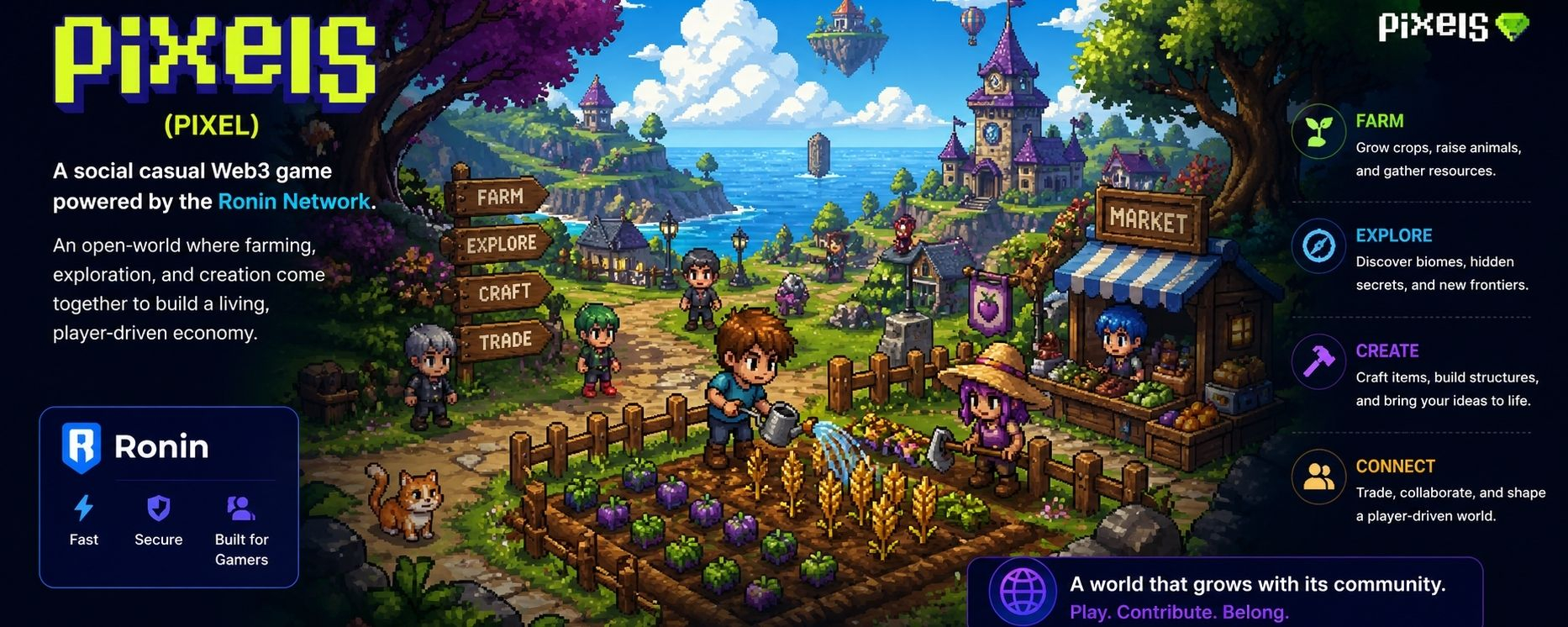

I’ve been watching projects like Pixels (PIXEL) with a kind of quiet patience that only comes after seeing too many systems rise fast and disappear just as quickly. I’m looking at it the way someone watches a town being built, not on opening day when everything feels new, but weeks later when routines start forming and the excitement fades into ordinary behavior. I’m waiting to understand whether what’s happening inside this world is something people can live with day after day, not just something they visit when the mood feels right. Over time, I’ve learned that the real strength of a system isn’t revealed in its announcements or its early growth, but in the small, repeated actions people are willing to take when no one is watching. That’s where the truth usually hides.
What keeps pulling me back to observe Pixels isn’t any single mechanic, but the way it seems to respect the idea that meaningful systems grow from repetition. There’s something almost humble about building around farming, gathering, crafting—activities that don’t try to impress you immediately but slowly make sense the longer you stay with them. I’ve seen so many crypto projects chase attention by trying to feel exciting every second, as if constant stimulation is the only way to keep people engaged. But people don’t live their lives that way. Most of what we do every day is routine. We wake up, we work, we return to familiar tasks, and over time those small actions shape something bigger than themselves. Pixels, in its own quiet way, seems to understand that rhythm.
I find myself thinking a lot about time when I look at systems like this. Not time in the sense of charts or cycles, but time as something people invest. When a system respects your time—when it gives your effort weight and doesn’t rush you—it starts to feel less like a machine and more like a place. That distinction matters more than most people realize. I’ve watched economies break because they treated time as something to exploit rather than something to honor. When rewards come too easily, they lose meaning. When progress feels disconnected from effort, people eventually notice, even if they can’t explain why. Pixels seems to be experimenting with the idea that effort should feel steady, visible, and proportional. That’s not flashy, but it’s deeply human.
Another thought that keeps circling in my mind is how environments shape behavior. In many Web3 systems I’ve watched, the world itself feels secondary, almost decorative, as if the real focus is always on the token rather than the place people inhabit. But here, there’s a sense that movement, location, and space are meant to matter. That small detail changes everything. When resources exist somewhere instead of everywhere, when actions require time instead of instant clicks, the system begins to feel grounded. It starts to resemble the way real environments function, where effort connects places and progress comes from moving through space, not skipping across it. That grounding gives weight to activity, and weight gives meaning to outcomes.
I also can’t ignore how much infrastructure shapes the feeling of a system, even when most users never think about it. I’ve seen promising ideas struggle simply because the foundation beneath them couldn’t support consistent interaction. When you build on technology designed for speed and frequency, you invite routine. You make it easier for small actions to happen naturally, without hesitation. And routine is where familiarity grows. Familiarity turns strangers into regulars, and regulars are what keep systems alive long after the initial crowd fades away. That’s something I’ve learned the hard way after watching too many crowded launches turn into empty spaces.
At the heart of everything, I keep returning to the question of coordination. Not the technical kind, but the human kind. Can people fall into shared rhythms without feeling forced? Can they return to the same environment because it feels comfortable rather than because it feels profitable? I’ve seen what happens when profit becomes the only reason to participate—people stay only as long as the numbers work in their favor. The moment the numbers change, they disappear. But when people return because they enjoy the rhythm itself, something deeper begins to form. It becomes less about extracting value and more about building continuity. Pixels feels like it’s quietly testing that possibility.
There’s also a certain maturity in designing systems that don’t rush people. Most of the crypto world has been obsessed with speed—faster launches, faster gains, faster exits. But speed often leaves very little behind once the movement stops. Slower systems, the ones that ask people to show up again and again, have a better chance of leaving something meaningful in their wake. I sense that Pixels is trying to slow things down just enough to let habits form. Habits might sound simple, but they’re incredibly powerful. Once something becomes part of a daily rhythm, it stops feeling like effort and starts feeling like presence.
What makes me keep watching isn’t excitement—it’s curiosity mixed with a kind of cautious respect. I’m not assuming success, and I’m not looking for perfection. I’m simply observing whether the structure holds its shape when attention shifts elsewhere. Will people still return when the headlines stop mentioning it? Will the routines still feel worthwhile when the novelty fades? Those are the moments that separate temporary systems from lasting ones. I’ve learned that durability rarely announces itself loudly. It grows quietly, through small decisions that make sense not just today, but months and years down the line.
As time passes, I find myself less interested in whether Pixels becomes popular and more interested in whether it becomes dependable. Popularity is loud and short-lived; dependability is quiet and lasting. If this system continues to build around patience, routine, and grounded effort, it may slowly evolve into something people trust without even realizing it. And trust, once formed, becomes the strongest foundation any digital world can stand on. That’s what I’m really watching for—not hype, not growth charts, but the subtle feeling that a structure is settling into place, becoming stable enough for people to return to without needing a reason every time.