

I’m watching Pixels more closely now, because at first it looked like a simple farming game I could open whenever I had free time.
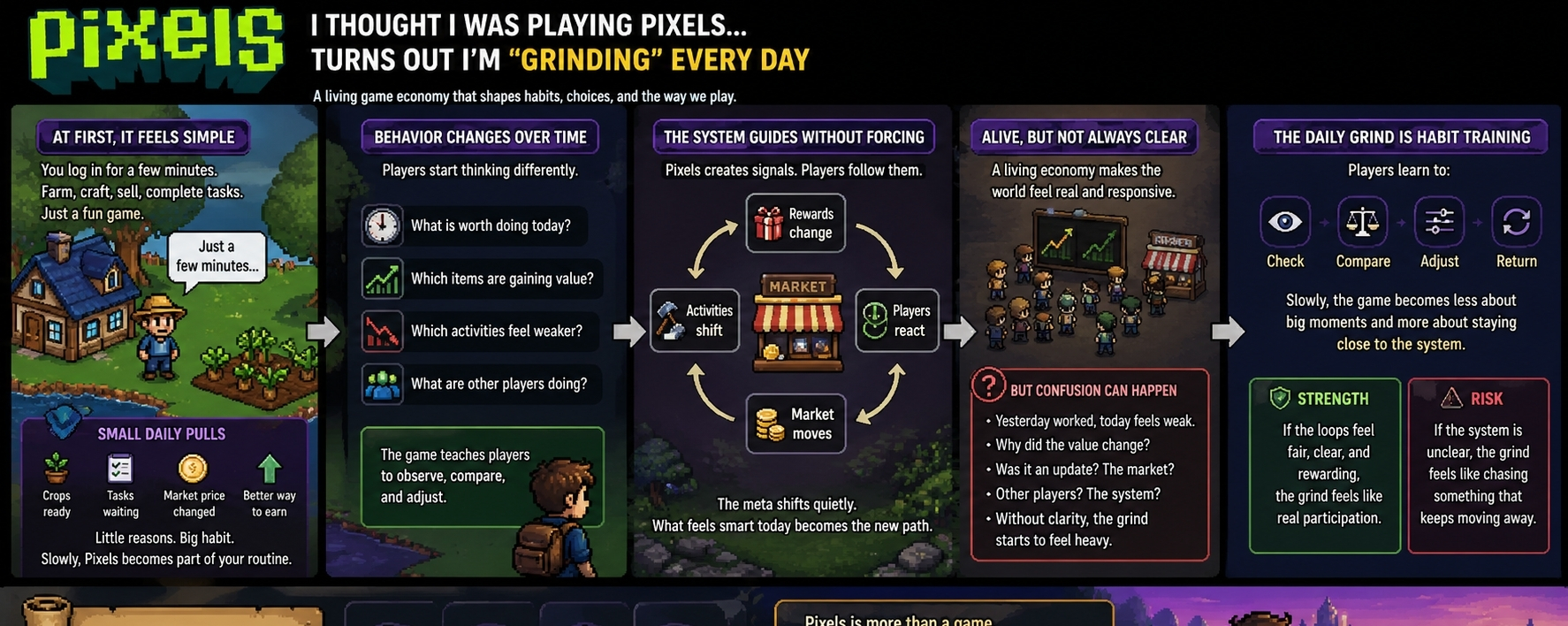
But the longer I look at the project, the more I realize it is built around small daily pulls.
A crop is ready.
A task is waiting.
A resource needs collecting.
A market price has changed.
Someone in the community has found a better way to earn.
None of this feels aggressive at first. It feels normal. It feels like gameplay. But slowly, Pixels starts becoming part of the player’s routine.
That is what makes the project interesting. Pixels is not only trying to entertain people for a short session. It is trying to build a living game economy where habits, rewards, land, crafting, trading, and timing all connect.
Every small action has a place inside a bigger loop.
At the start, most players probably treat Pixels casually. They farm a little, craft something, sell something, check a few tasks, and maybe talk with other players.
But over time, the way they think begins to change.
They start asking what is worth doing today.
They start watching which items are gaining value.
They start noticing which activities feel weaker than before.
They start paying attention to what other players are doing.
That is where Pixels becomes more than a simple game. The project does not need to force players into one path. It just creates enough signals for players to start adjusting on their own.
If one activity becomes more useful, people move toward it.
If one item becomes important, the market reacts.
If a reward changes, behavior follows.
If a strategy spreads, the meta shifts quietly.
This is why Pixels can feel alive. The world is not just sitting there waiting for players. The players are part of the movement.
Their habits shape demand.
Their choices affect prices.
Their routines create pressure.
Their reactions change what other players see as valuable.
That is powerful, but it also creates a real challenge for the project.
When a system keeps moving, players need to understand why it is moving.
If yesterday’s routine suddenly feels weaker, people can get confused.
If rewards shift too quietly, trust can become shaky.
If the best strategy changes too often, the grind starts feeling less like progress and more like guessing.
This is where Pixels has to be careful. A living economy needs change, but a loyal player base needs clarity.
Players can accept effort when the reason makes sense.
They can accept slow progress when the rules feel fair.
They can accept adjustment when the system feels honest.
But if the game keeps asking for daily attention while the logic feels hidden, the experience can become tiring.
The daily grind in Pixels is not just about repeating tasks. It is about how the project trains attention over time.
Players learn to check.
They learn to compare.
They learn to adjust.
They learn to return.
And slowly, the game becomes less about one big moment and more about staying close to the system.
That is both the strength and the risk of Pixels.
If these loops feel fair, readable, and rewarding, the grind can feel like real participation.
But if the project becomes too hard to understand, the same grind can feel like chasing something that keeps moving away.
So the real focus is not only whether Pixels is fun today.
The bigger question is whether the project can turn daily behavior into long-term trust.
Because Pixels is not just building a game people play.It is building a system that quietly teaches people why they keep coming back.