
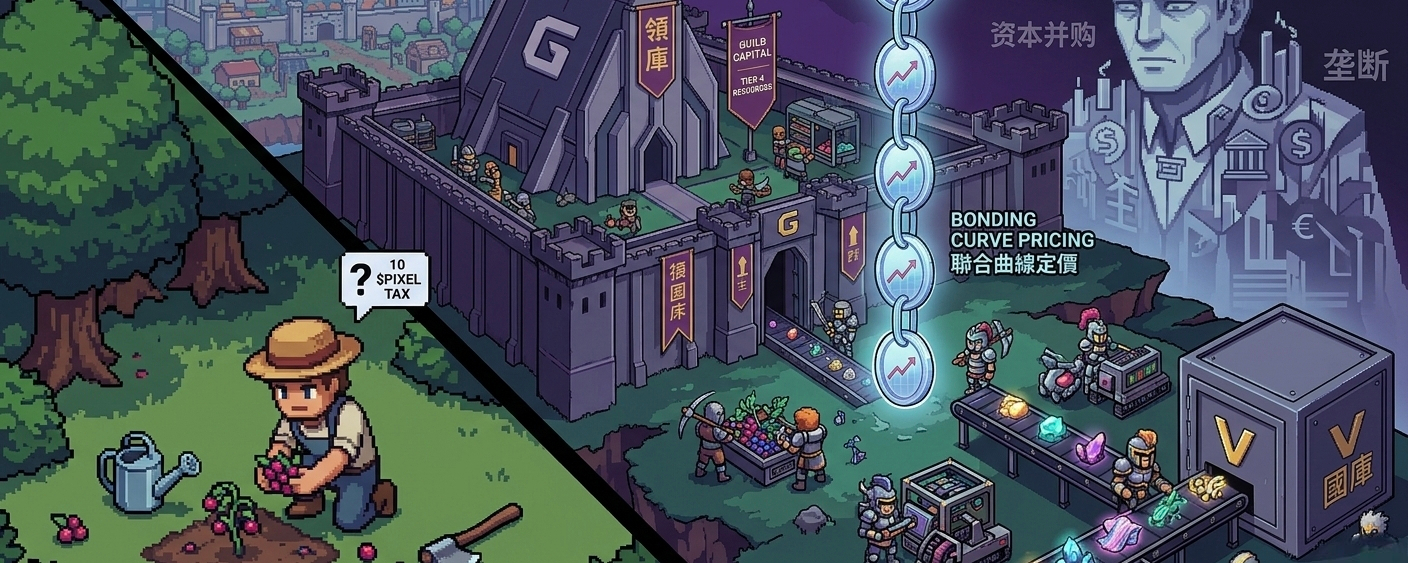

Since @Pixels entering Chapter 2, which fully introduced the Guilds system and the NFT-based resource tiering mechanism, my focus has shifted away from how retail traders are 'scooping' profits on the task board. On the surface, the Guild system allows players to band together for support, upgrading facilities and sharing high-tier resources, while recruitment slogans in various communities echo loudly, resembling a thriving Web3 cooperative; however, if you dissect this system using a corporate equity structure and subsidiary profit distribution model, you'll find that there's no real 'decentralized sharing' here. Essentially, it's a highly stratified 'cyber feudal lord system' and a cold exercise in 'capital acquisition.'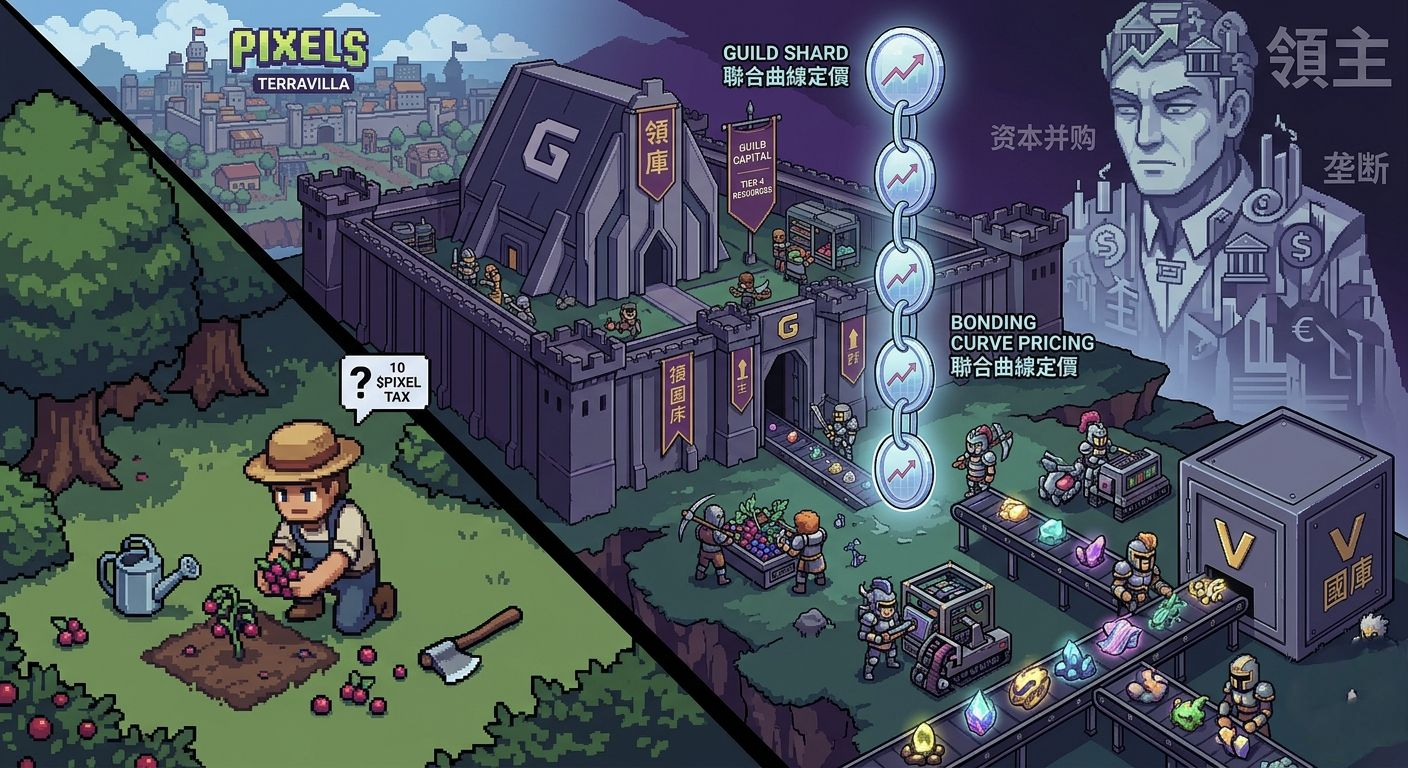
As someone used to dissecting equity structures, governance systems, and cash flow operations, I didn’t follow the crowd in the group to hype which guild's Shard would skyrocket; instead, I directly pulled the treasury fund circulation rates of the top 20 guilds, the tax rates on NFT land, and the output concentration of Tier 3/4 high-tier resources for an in-depth simulation. After calculating, I found that this 'guild-land-player' three-layer nested structure is even more tightly knit than traditional corporate conglomerates in the real world.
'Class folding' and the absolute right to rent land capital.
The biggest dark line in Chapter 2 of Pixels is that it has completely locked free players (Free-to-Play) out of the upward mobility path. The system forcibly divides resources into multiple Tiers, while the truly high-value high-tier materials are rigidly bound to high-level NFT land.
Let's look at a set of real measurement data regarding 'digital sharecroppers':
The beautified 'profit-sharing agreement': When a landless player enters a high-level land to gather timber or minerals, the landowner (lord) can set a resource tax ranging from 1% to 20%. Players think they only incur the marginal costs of time and energy, but in reality, the lord is engaging in 'risk-free siphoning'. Assuming a fully upgraded forest produces 1000 units of T3 timber daily, with a 10% tax rate set by the lord, this means he collects 100 units of pure passive income daily. And what about the working players? They not only bear the costs of energy depletion but also the risks of price fluctuations for these materials on the Marketplace. From a business logic perspective, this is akin to a parent company forcefully charging high 'brand licensing fees' to its edge business lines that have no bargaining power.
The forced tribute of labor value: In the past, players worked directly for the system; now, players work for lords who own the means of production (NFT land). The system restricts resource output in public areas, forcing players to depend on land capital. In this model, most of the true purchasing power $PIXEL is continuously funneled upward from the hands of grassroots players to upper-tier NFT holders.
The Ponzi pricing of guild Shards and the dilution of 'equity'.
If the land system is about rent collection, then the guild system (Guilds) is a blatant Web3 funding game. The Shards introduced by the officials use a Bonding Curve pricing model, which is arguably the most confusing 'financial derivative' in the entire game.
The 'subpar equity' draped in social clothing: Players must purchase the guild's Shard to gain access to advanced facilities. But note, this Shard has no actual Voting Rights and does not enjoy profit-sharing from the guild treasury; it is merely a ticket. Under the Bonding Curve algorithm, prices rise exponentially. The 10th player to join the guild might spend only a tiny amount of $PIXEL, while the 100th might pay dozens of times more than the former.
What’s this called in capital operations? It’s called using latecomers' funds to provide paper profits for the early founding team. The heads of those guilds (often also major landowners) not only enjoy the resource taxes brought by players but also watch the price of their issued Shards rise. Latecomers are essentially buying a constantly depreciating 'work qualification' at a high premium; they are not just sharecroppers but also 'exit liquidity providers'.
Vertical integration of the supply chain and the plunder of 'pricing power'.
I further tracked the order book depth of specific high-tier base materials (like advanced timber and specific dyes) in the secondary market and found a very typical 'trust' trend:
Artificial liquidity depletion: Top guilds don’t need to sell raw materials on the market for $PIXEL. Instead, they use treasury funds to 'sweep the market' and 'stockpile', vertically integrating specific supply chains. By controlling the circulation of certain key middleware in the market, they can easily manipulate the implicit costs of high-tier items on the task board.$币安人生
Retail players, when faced with task board bottlenecks, find that either they cannot buy materials on the market, or the prices are outrageously high, ultimately being forced to give up high-profit orders or obediently join large guilds and accept their internal pricing and exploitation. This has deviated from a simple game supply-demand relationship and has become a 'dimensional strike' utilized by capital giants leveraging their monopoly position.
Conclusion: Finding the breaking point of 'false prosperity'.
My current judgment is: Don't be fooled by the daily hot discussions in various guild groups about upgrade paths; what truly determines whether the Pixels economy can soft land is the pressure limit of the underlying ecosystem. I no longer focus on daily active users (DAU), a metric easily manipulated by scripts, but instead fixate on two core indicators: the actual turnover rate of guild Shards (if there’s no new capital entering to buy high-priced Shards, when will the bubble on the left side of the curve burst?); and the Gini coefficient among the top 5% of wallet addresses.$PIXEL If wealth excessively concentrates at the top lords, deflation at the grassroots level will be inevitable.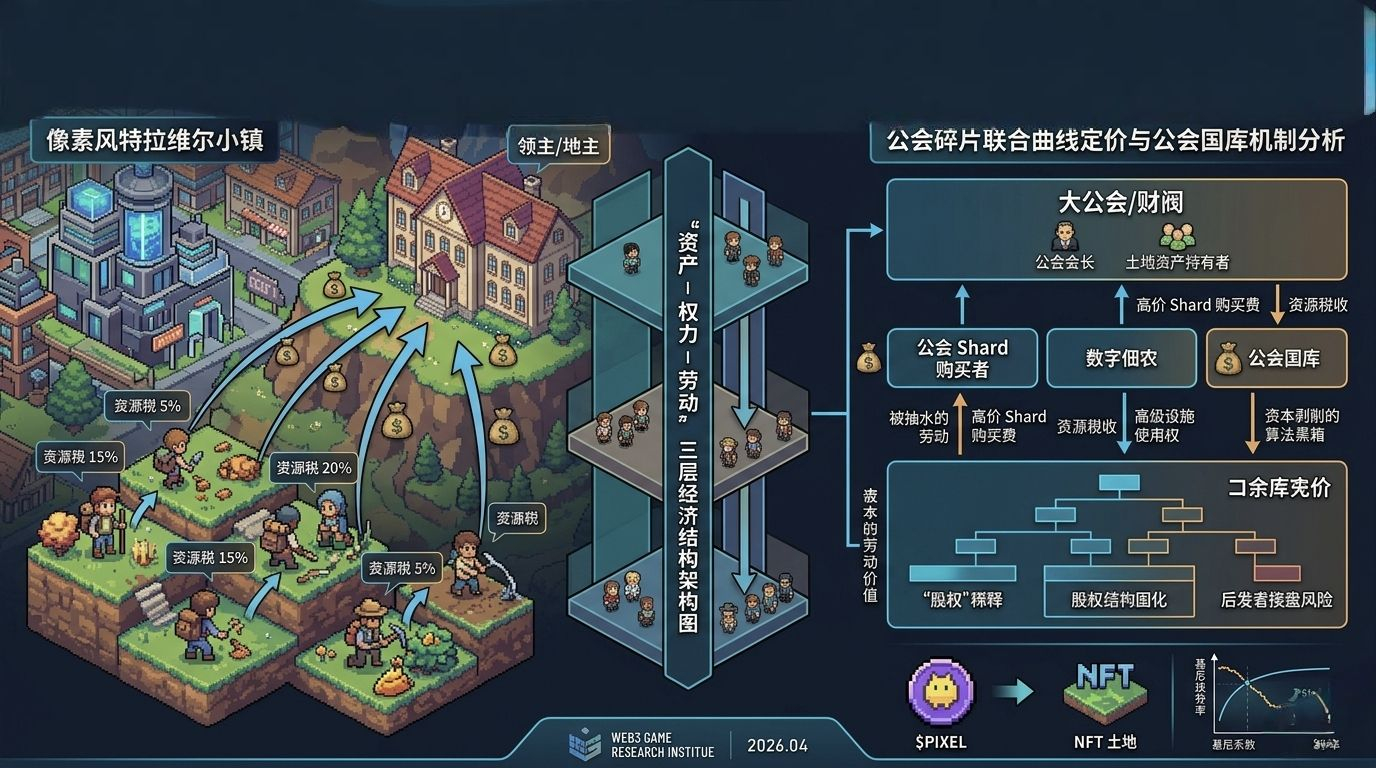
Writing this isn’t to short Pixels. Running complex land economics, tax systems, and Ponzi-like equity financing so bluntly on a pixelated farm through smart contracts is a fascinating 'downgrade simulation' of real capital operations. But what I hope for more is that creators in Web3 awaken from this brutal 'zero-sum game'—if the so-called on-chain gaming assets exist only to allow a select few to more efficiently and discreetly harvest the surplus labor value of the majority, then we have merely changed servers and reinvented the 'sweatshop'.#pixel