
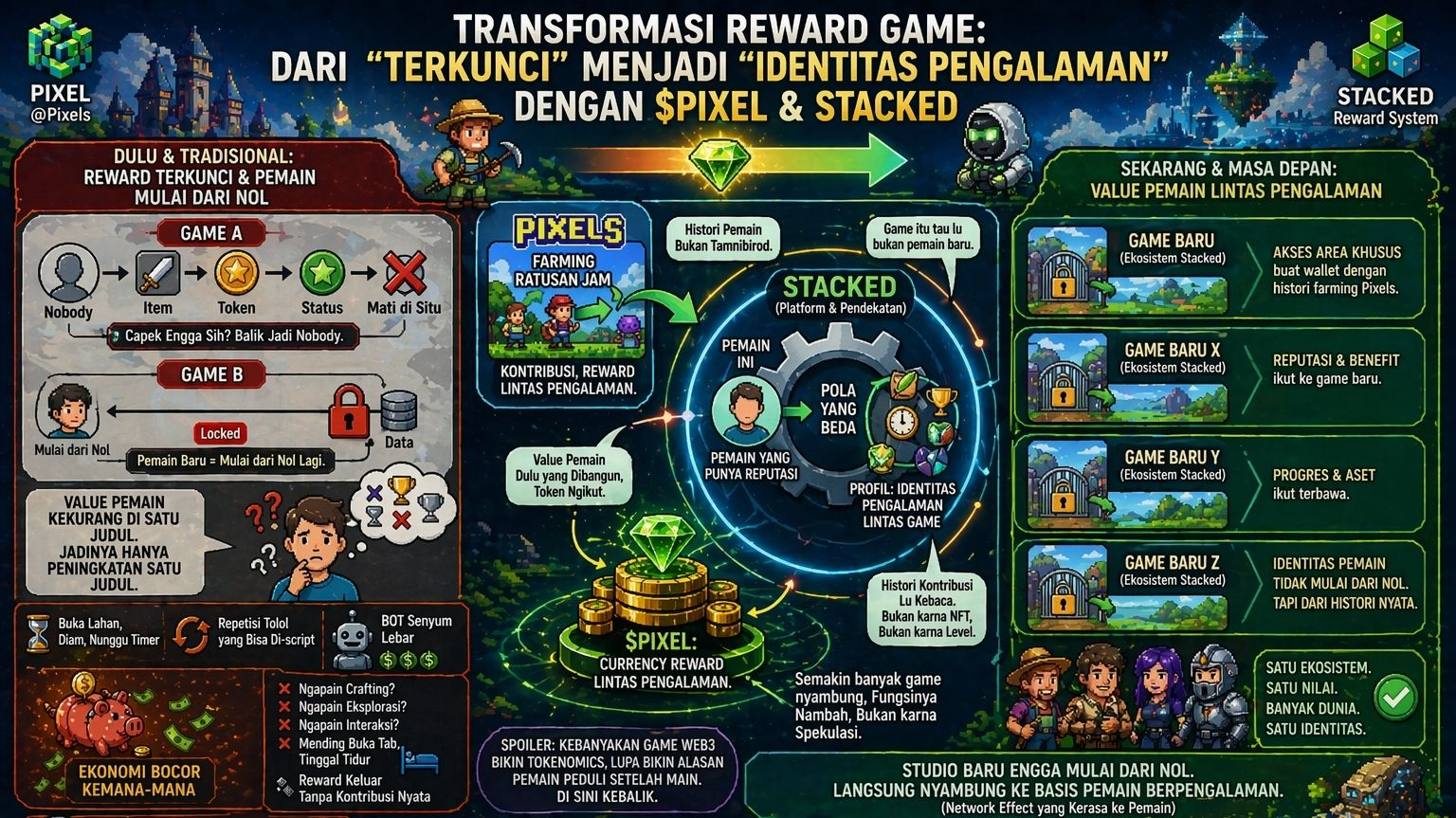
At first glance, the world in Pixels seems crowded. The map feels alive, activity is everywhere, and movement never seems to stop. But upon closer inspection, a troubling question arises: is this truly bustling with players, or does it just appear that way?
Density doesn't always equate to participation.
In many spots, the map is indeed full—characters are moving, resources are being gathered, and activity is ongoing. However, the interactions that feel 'alive' are actually minimal. There aren't many conversations, not much coordination, and not a lot of decisions that genuinely seem like the result of players actively thinking. Everything is in motion, but it doesn't always feel 'animated'.
This leads to one possibility that's hard to ignore: part of that activity doesn't come from players who are genuinely engaged, but rather from the system, automated patterns, or behavior that's been overly optimized.
In a reward-based ecosystem, this isn't strange at all.
When the system provides clear and predictable incentives, players (or even scripts/automation) will follow the most efficient path. The result is high quantity activity, but low quality interaction.
The map gets full, but not because many players are truly 'playing'.
This phenomenon changes how we view the metric of 'busy'. If success is measured only by the amount of activity or map density, then systems like this may seem very successful. But looking from a deeper engagement perspective—social interaction, strategic decisions, activity variation—the picture can be different.
This is where adaptive reward systems become relevant.
If rewards just follow a fixed pattern, players will keep repeating the same moves. But if rewards start to shift based on conditions, the system can 'force' variation. Overloaded activities can have their incentives reduced, while quieter areas or roles can be boosted.
The goal isn't to reduce activity, but to restore the quality of interaction.
However, this isn't an instant fix.
If most of the activity is driven by efficiency (or even automation), then a small change in rewards might not cut it. The system really needs to grasp the difference between 'active' and 'engaged'.
Active means there's action.
Engaged means there's decision-making.
Without decision-making, activity just becomes a routine.
And at this point, the real challenge arises: how to make players not just present, but also thinking?
One answer lies in designing systems that give real consequences for choices. Not just rewards that change, but outcomes that feel different depending on how players interact with the world.
When choices start to have an impact, players will begin to pay attention. As attention increases, interactions become more meaningful. And when that happens, 'busyness' is no longer just a visual—it becomes something truly felt.
For now, the phenomenon of a full map but minimal interaction can be seen as a transitional phase. The system is shifting from an old model to something more complex.
The question is no longer whether the map is full or not.
But who's really in there—and how many of them are actually playing.