
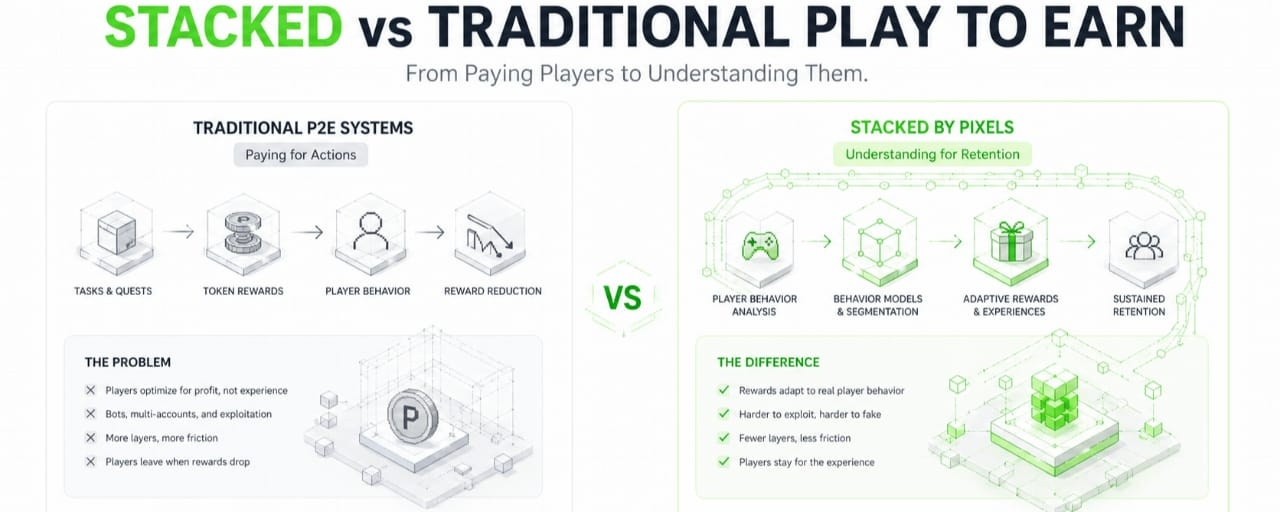
I’ve seen this pattern repeatedly: the industry keeps reinventing ways to “reward players.” The labels change, the systems get more complex, dashboards become more polished, but the underlying behavior loop stays the same. Players enter for financial gain, stay out of habit for a while, and eventually leave once rewards lose appeal. The cycle just repeats, only with increasing sophistication.
The core issue doesn’t seem to be insufficient incentives—it may actually be the opposite: an overload of tokens, quests, and optimization paths. Instead of playing, users end up analyzing and optimizing, effectively treating gameplay like a productivity system. The system then reacts with tighter reward structures, sinks, and restrictions, creating an ongoing back-and-forth escalation.
Traditional Play-to-Earn models assume that enough monetary reward will ensure retention. While logical on paper, this breaks down in practice because when money is the main motivator, behavior naturally shifts toward maximizing profit rather than engagement. This leads to bots, multi-account farming, and a split between “farmers” and players who eventually disengage.
Developers attempt to counter this with mechanics like daily quests, energy limits, cooldowns, and NFT requirements. But each added layer introduces friction, making the experience feel less like play and more like managing an account that resembles work.
What stands out is how player behavior becomes most revealing when rewards decline. That’s when the system’s real retention strength is tested, not during high-incentive phases.
From my perspective, Pixels’ Stacked system is attempting a different approach. Rather than simply increasing rewards or adding more tokens, it seems focused on interpreting player behavior more deeply and adjusting rewards dynamically based on that behavior. Instead of directly paying actions, it observes how players behave under less direct pressure.
While this may sound familiar—since traditional gaming already uses cohort analysis, retention curves, and behavioral segmentation—the difference is that on-chain systems have historically reduced this to a simple “farm more, earn more” logic, effectively a distorted form of merit-based rewards.
Stacked appears to be trying to move beyond that. Not all behaviors are treated equally, and rewards are not uniform. The aim seems to be distinguishing genuine engagement from pure optimization, not through identity verification, but through behavioral patterns.
In theory, this shifts the system from a predictable linear reward model into a behavior-responsive one that is harder to game or optimize.
However, this creates its own problem: as systems become more adaptive, players will also adapt. Farmers will simulate human-like behavior, bots will evolve, and the same cycle of optimization will likely re-emerge at a higher level of complexity.
Ultimately, whitepapers can emphasize AI-driven personalization and behavioral intelligence, but the key question remains unchanged: will players still stay when financial incentives are unclear? Do they log in because they want to, or because they feel they must?
Stacked doesn’t seem like a final solution, but more like an experiment that is more carefully structured than earlier models. It acknowledges that the challenge is not just token design, but human behavior itself—which is far harder to predict or control.
There is still a tension between optimizing retention and avoiding systems that feel manipulative. If pushed too far, it risks becoming another form of behavioral extraction, just more sophisticated than before.
It’s still early to judge. Stacked is only one layer in a larger evolving system, and the real outcome will only become clear over time as player behavior stabilizes or shifts.