


I keep thinking most people look at Pixels through a very small window. They see a farming game, token rewards, daily loops, maybe a temporary trend if they are skeptical. That reading is understandable, but narrow. It feels like judging a shopping mall by the parking lot and never walking inside.
You can count cars and still miss the business.
When people talk about endgames in this space, they usually mean token price, exchange listings, user spikes, maybe a headline partnership. Those are visible outcomes, not necessarily endgames. Real endgames are quieter than that. They sit underneath behavior and only become obvious after enough time has passed.
That may be where Pixels is more interesting than it first appears.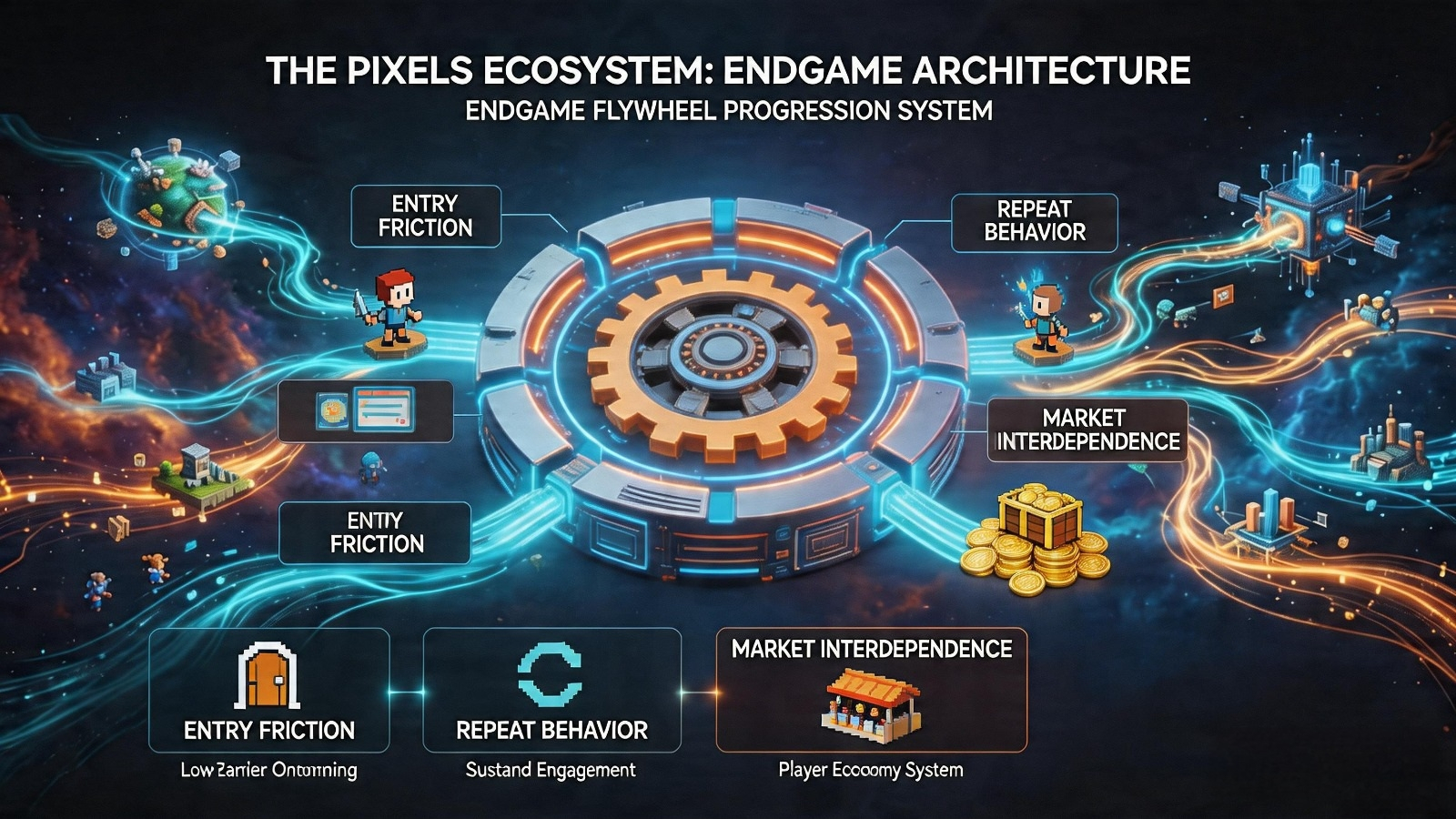
On the surface, Pixels is approachable by design. Plant crops, gather materials, craft items, trade goods, improve land, return later. The loops are familiar enough that users do not need a manual to begin. In my experience, that matters more than many builders admit. Complexity often gets praised by insiders and abandoned by everyone else.
Pixels seems to understand that entry friction is expensive.
A simple start does something powerful. It widens the funnel without needing speeches. Someone can try the game, understand the first few tasks quickly, and feel progress before confusion arrives. Most products lose people in the gap between curiosity and competence.
Pixels appears built to shorten that gap.
But easy entry is only the first layer. If that were the whole story, it would be forgettable.
Underneath the visible farming loop is a system teaching repeat behavior. Timers create return points. Land upgrades create unfinished goals. Resource shortages create planning. Markets create price awareness. Crafting creates interdependence. Familiar names make the world feel inhabited.
None of these pieces are dramatic alone.
Together they create texture.
That texture matters because users rarely stay for features in isolation. They stay when actions begin connecting across days. A crop planted now matters later. A tool bought today saves effort tomorrow. Materials saved this week may matter when prices move next week. Separate moments start feeling like one continuous position.
That is when retention becomes stronger than novelty.
I think this is where many observers miss the larger endgame. They assume Pixels is trying to maximize farming rewards or short-term engagement. Maybe some of that exists, but the deeper move seems different. It may be trying to own habitual economic attention.
That phrase sounds abstract, but it is simple.
If users check in regularly, make decisions regularly, trade regularly, compare progress regularly, and care about maintaining momentum, then Pixels is not only hosting gameplay. It is hosting routine mindshare.
Routine mindshare is valuable.
Very valuable.
In normal business terms, products pay heavily for repeated visits. Retail wants repeat customers. Apps want daily opens. Marketplaces want recurring buyers and sellers. Media wants habitual readers. Once a habit forms, acquisition costs can fall because users generate their own return traffic.
Pixels may be building that inside a game environment.
I have seen many crypto products chase attention with incentives, then panic when incentives weaken. The users were renting the experience. Once rent rose or payouts fell, traffic moved elsewhere. Bought activity often looks like real demand until the bill arrives.
Pixels seems to be betting on something sturdier.
Not just paying people to appear, but giving them enough continuity that appearing becomes normal.
That changes behavior in subtle ways. A user who only wants rewards thinks about exits first. What can I earn today. When should I sell. Where is the next better yield. A user with routine position thinks differently. Should I expand land. Save materials. Upgrade tools. Time sales better. Protect momentum.
Those are different psychologies.
One drains systems quickly.
The other can sustain them longer.
There are risks, of course. Routine can become chore if updates slow. Efficient players can widen gaps if progression advantages stack too hard. Markets can thin out if casual users feel late. It is still unclear how Pixels balances accessibility with depth over long periods.
No live economy solves that once and forever.
Users adapt, optimize, coordinate, and compress edges faster than designers expect. Every successful loop attracts people trying to exploit it. Every soft imbalance hardens under scale.
Still, I think the broader direction is what matters.
If Pixels keeps making simple entry lead into deeper routine, then its endgame may be larger than a successful game token or a popular farming title. It may become an onboarding layer for digital ownership habits, light trading habits, progression habits, and persistent online identity habits.
That sounds ambitious because it is.
But big outcomes often hide inside ordinary behaviors repeated enough times.
The wider industry keeps chasing giant launches, cinematic moments, and viral spikes. Those things can matter. Yet many durable businesses were built more quietly, through systems people returned to without being reminded.
That pattern shows up everywhere.
Sometimes the company that wins is not the one with the loudest first impression, but the one that becomes part of someone’s weekly rhythm.
So when I hear people reduce Pixels to farming, I think they are describing the surface and missing the machine underneath.
Because the biggest endgames rarely look big while they are being built.
