
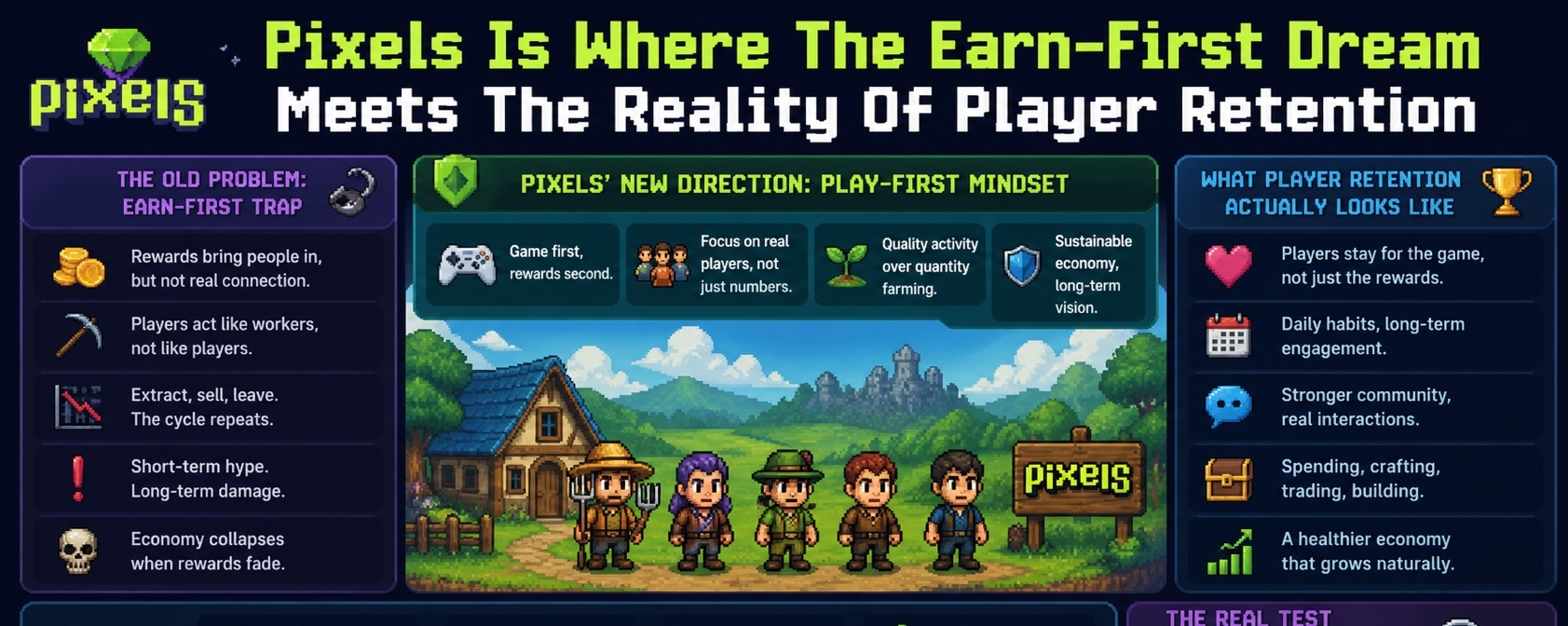
Pixels feels interesting, but not in the clean marketing way people usually say it.
I have seen too many Web3 games sell the same dream, recycle the same reward loops, attract the same farming crowd, then slowly fade once the easy money stops feeling easy. Pixels is worth watching because it seems to understand that the old model was tired, noisy, and full of friction from the start.
The project is not just fighting for users now. That part already happened. Pixels had attention, activity, and a real moment in the market. The harder part is what comes after that, when the hype cools down and the game has to prove people are still there for more than rewards.
That is where most crypto games break.
Not immediately.
Slowly.
You see the same pattern again and again. Rewards bring people in, the numbers look good, everyone posts about growth, and then the economy starts grinding under its own weight. Players stop acting like players. They become workers. They calculate, claim, extract, and move on.
I do not blame them for that.
The system taught them to behave that way.
If earning is the main reason to play, then people will treat the game like a job. They will look for the fastest route, the best output, and the cleanest exit. They will not care about the world, the land, the daily rhythm, or the social layer unless those things matter beyond the payout.
Pixels seems to be trying to move away from that trap.
That does not mean it is safe.
It just means the project is at least asking the right question now : how do you build a game economy that does not collapse the moment users stop farming?
That question matters more than any clean slogan.
The old Web3 gaming model was simple, and honestly exhausting. Pay users first, hope they become loyal later. But that rarely works. Money can create movement, but it does not always create attachment. It can fill dashboards, but it cannot fake real care forever.
Pixels has to prove the opposite.
It has to show that people can come for the game, stay for the experience, and only then treat rewards as part of the system instead of the whole reason to be there. That is a much harder road, and it is not as loud. It does not produce instant hype every week. It is slower. Messier. More honest.
But here’s the thing.
A quieter model can still fail.
Play-first sounds better than earn-first, but it puts more pressure on the actual game. The farming, the land, the quests, the progression, the social activity, the daily loop — all of it has to feel like it belongs. If the experience feels empty, no reward redesign will save it.
I’m looking for the moment this actually breaks, or proves it can hold.
Because token economies always look smarter when written down than they feel in real usage. The real stress comes when rewards are lower, attention is weaker, and users have no reason to pretend. That is when you find out whether a project has players or just wallets passing through.
Pixels still has that test ahead.
I like that it seems more disciplined now. Less fantasy, more economy. Less free-money noise, more focus on quality activity. That is a better direction than the usual GameFi recycling machine.
But I have also learned not to overpraise direction.
Direction is cheap.
Execution is the grind.
Pixels needs to keep real players engaged without drowning the economy in rewards. It needs to make activity feel meaningful without turning everything into another farming checklist. It needs to protect its token system without making the game feel dry. That balance is difficult, and most projects never find it.
The part I’m watching closely is whether Pixels can separate actual players from short-term extractors. Because those two groups look similar on the surface. Both log in. Both click. Both move through the game. But only one group gives the project a future.
And that is where the whole thing gets uncomfortable.
Crypto loves user numbers, but not all users are useful. Some users bring life. Some bring pressure. Some only show up when the reward math makes sense. Pixels has to build for the first group without being drained by the second.
That is easier to say than to do.
Still, Pixels has something many dead GameFi projects never had : a chance to learn while still alive. That matters. A lot of projects only realize the economy is broken when there is no community left to rebuild with.
Pixels is not there yet.
It still has attention. It still has identity. It still has a world people recognize. Now it needs depth. It needs habits. It needs people who come back because the game gives them a reason beyond extraction.
For me, that is the real watch.
Not whether Pixels can create another reward campaign.
Not whether it can create another short burst of activity.
I’m watching whether it can turn tired Web3 gaming behavior into something more stable, something less desperate, something that feels like people are actually playing instead of just grinding the next claim.
Maybe Pixels gets there.
Maybe it does not.
But if it wants to survive, it has to prove one very simple thing : when the earning noise gets quieter, will anyone still want to stay?