
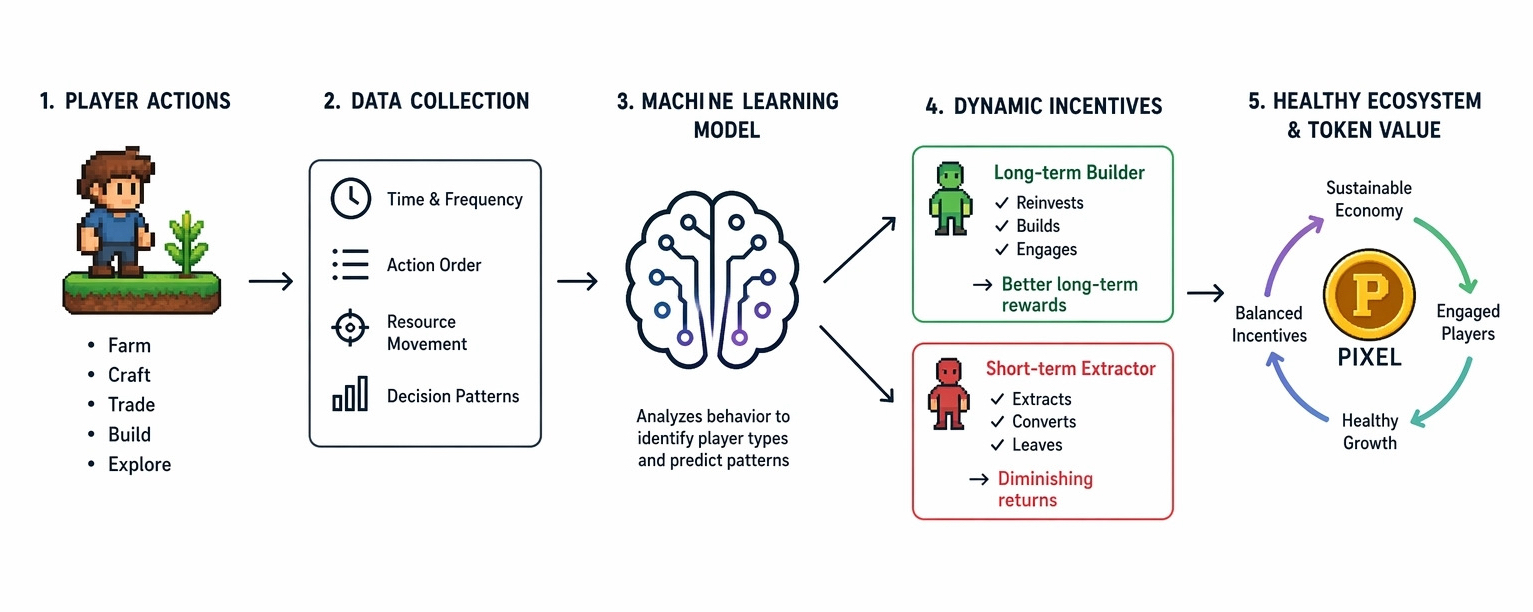
Something stayed in my head after a session last Thursday, and it came from a decision that did not even feel important when I made it. I chose one route over another inside @Pixels simply because it looked a little cleaner in the moment. It seemed efficient, almost obvious. I did not think twice. But a few sessions later I realized something odd that choice had quietly narrowed what made sense for me to do next. Not in a dramatic way, nothing broke, but certain alternatives that would have felt reasonable before now felt awkward or costly. And what kept bothering me was not that I had made a bad move. It was that I had not recognized the move as limiting anything at all when I made it.
That started changing how I thought about decisions inside #pixel. Most of the time I tend to treat decisions as isolated. You make a move, it produces some outcome, then you evaluate whether it was good or bad. Simple enough. But what if some choices matter less because of what they produce immediately and more because they quietly shape what remains possible afterward? That feels like a very different kind of pressure. It is not really about rewards in the obvious sense. It is about whether certain “good” decisions can gradually reduce flexibility without you noticing.
And once I started thinking about it like that, I began seeing traces of it in places I had ignored before. Sometimes a path looks optimal not because it opens opportunity, but because it narrows attention around one route that keeps reinforcing itself. You stay on it because leaving feels costly. That is different from ordinary commitment. It starts feeling more like lock-in. And the strange thing is, lock-in can grow out of perfectly rational decisions. No mistake required.
That was the part that made me pause.
Because we often talk about optimization as if more efficiency naturally means better positioning. But I started wondering whether there are moments where optimizing too hard in one direction can quietly make a system feel smaller over time. Not because the game restricts you explicitly, but because your own choices begin restricting your alternatives.
And that made me look at $PIXEL differently too.
People usually frame the token through acceleration or utility, but I kept wondering whether part of its deeper relevance may show up around preserving optionality. Not in some grand technical sense. In a practical sense. Sometimes maybe the value is not in pushing one path further, but in keeping enough flexibility that several paths still remain viable. That feels very different from standard demand narratives.
Because demand shaped by preserving options behaves differently from demand shaped by maximizing output.
One is about extraction.
The other is about adaptability.
And those are not the same thing.
I think what made this idea feel real to me is that reduced flexibility often does not feel costly when it happens. It usually feels efficient. That is why it is hard to notice. The cost appears later, when something changes and you realize your choices have become narrower than they used to be. And that kind of cost can be more subtle than anything visible on a balance sheet or token chart.
I have seen versions of this outside games too. In markets, people often think of good positioning as maximizing upside, but sometimes the strongest positioning comes from avoiding commitments that remove too many future choices. Optionality has value even when it does not produce immediate return. Maybe especially then. And I keep wondering whether some version of that logic exists inside @Pixels more than people recognize.
Because maybe part of what looks like ordinary progression is really players managing path dependence without describing it that way.
That possibility feels much stranger than most GameFi discussions suggest.
And honestly a little uncomfortable too.
Because if experienced players understand these lock-in dynamics better than newer players, that could create hidden asymmetries that do not show up through obvious advantages. A newer player may optimize each immediate step. A veteran may care more about whether those steps preserve reversibility. Those are very different ways of engaging the same system, and outcomes could separate quietly because of that difference.
There is tension in the idea too, which is probably why it keeps staying with me. If players overvalue optionality, they may hesitate too much. Decision-making slows. Nothing compounds. But if players ignore lock-in effects entirely, they may optimize themselves into rigid paths that become fragile later. Somewhere between overcommitting and preserving too much flexibility may be where stronger positioning lives.
And maybe that balance matters more than people realize.
Another thing that keeps pulling me back is how invisible this would be in normal analysis. User numbers would not show it. Token usage alone may not show it. Even activity metrics might miss it. Yet behavior could still be shaped by it. Players may keep returning not only because rewards exist, but because maintaining flexibility inside the system quietly matters to them.
That creates a different kind of stickiness.
Less about chasing upside.
More about not wanting to lose room to maneuver.
Maybe I am overthinking one small Thursday decision.
That possibility is there.
But I keep returning to the same question.
When players make economic choices in #pixel, are they only optimizing what they gain now… or are they also, often without realizing it, deciding how many futures remain open afterward?
Because if the second matters even a little, then maybe one of the deeper stories around @Pixels is not really about progression at all.
Maybe it is about whether digital economies quietly reward those who avoid turning good decisions into traps.
And I did not expect to find that question hiding in a farming game.
Which is probably why it keeps staying with me.