
I didn’t understand Pixels the first time I saw it.
It looked too simple. A small pixel world where people farm, gather materials, build things, and walk around chatting. Nothing loud. Nothing dramatic. But the longer I looked at it, the more it felt like something else.
Not just a game. Not just crypto either.
Something in between.
Most older Web3 games followed the same path. They attracted people with rewards first, gameplay second. Tokens were exciting in the beginning, but many systems had one problem. More value was leaving than staying.
People came to earn, not to belong.
So when rewards slowed down, many players disappeared too. That revealed a bigger issue. If the strongest reason to play is money, then attention becomes temporary.
Pixels feels like a response to that mistake.
Built on Ronin Network, it focuses more on routine, progression, ownership, and community. The world feels softer than most crypto projects. Less pressure. Less noise. More daily life.
And that matters.
Because when a system feels calm, people stay longer.
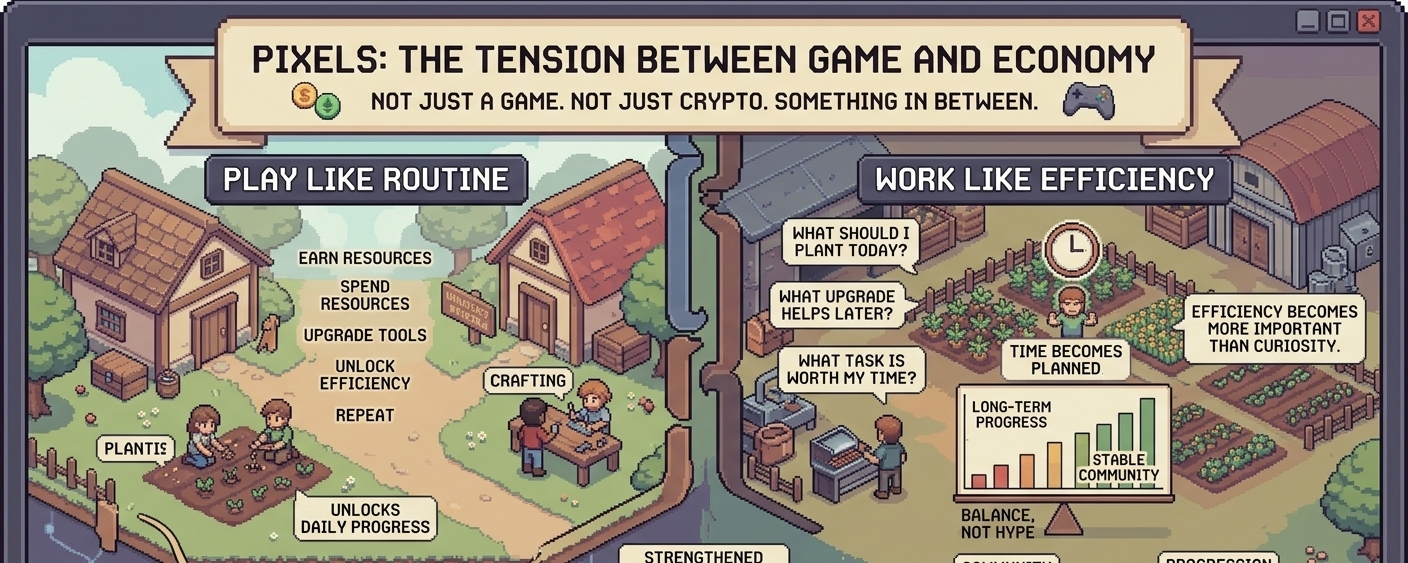
Players here often think differently than normal gamers. They do not only ask what is fun right now. They ask what should I plant today, what should I craft, what upgrade helps later, what task is worth my time.
That sounds small, but it changes behavior.
Time becomes planned.
A few minutes of play turns into a habit. Logging in becomes part of a rhythm. You are not just passing time anymore. You are managing it.
The economy behind it is simple in theory. Earn resources. Spend resources. Upgrade tools. Unlock better efficiency. Repeat. If that loop is balanced well, the world keeps moving. If rewards become too easy, inflation grows. If costs feel too heavy, people lose interest.
So the real challenge is balance, not hype.
But the most interesting part may be deeper than tokens.
Pixels quietly rewards consistency more than intensity. The best players are not always the smartest or richest. Often they are the most patient. The ones who return daily. The ones who understand systems slowly.
That says a lot about modern digital life.
Many platforms today reward attention. Some reward skill. Systems like this reward routine.
There are benefits to that. It creates loyalty, stable communities, and long-term progress.
But there is also a risk.
When everything has value, play can start feeling like work in colorful clothing. Some people stop exploring because efficiency becomes more important than curiosity.
That is the tension inside Pixels.
Is it a game with an economy
Or an economy dressed like a game
Maybe both.
It is not a perfect system. But it is trying something more honest than many projects before it. It understands that people do not stay because of rewards alone.
They stay because a world becomes part of their routine.
And that might be the strongest currency of all.
