
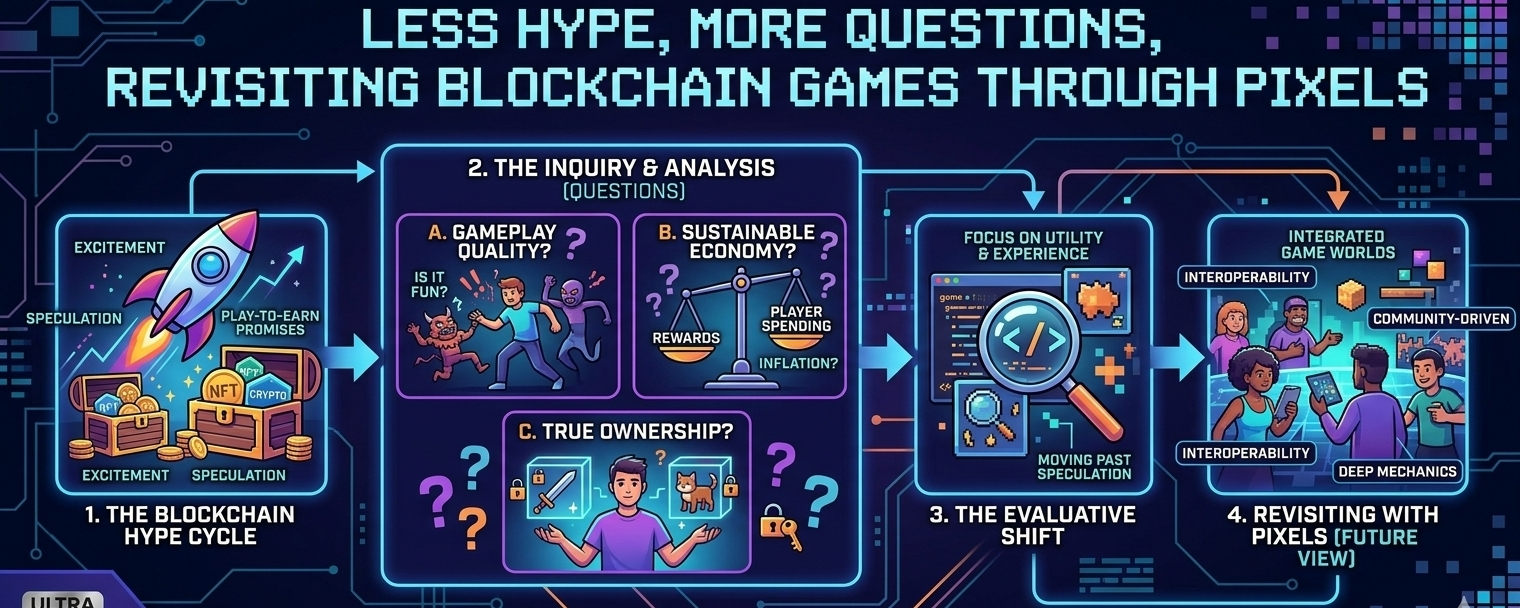
I don’t remember exactly when the excitement started to fade.
There was a time, early cycles, first exposures, when everything in crypto felt like a doorway. New primitives, new language, new possibilities. You could stay up all night reading whitepapers and still feel like you were only scratching the surface of something important.
Now it’s quieter.
Not because things stopped happening. If anything, there is more activity than ever. But it all feels familiar.
DeFi had its moment. Then NFTs. Then GameFi. Then AI integrations. Then RWAs. Each wave arrived with the same rhythm, early curiosity, explosive attention, a flood of capital, and then, gradually, the realization that most of it was not built to last.
You start recognizing the patterns.
And maybe that is why it is harder now to feel anything when a new project appears. Not cynicism exactly, just distance.
So when I first came across Pixels, I did not feel excitement. Just a brief pause.
Which, at this point, is something.
A Familiar Idea, Slightly Rearranged
On the surface, Pixels does not try to reinvent the wheel.
It is a social, open world farming game. You gather resources, grow crops, craft items. There is land ownership, NFTs, in game economies, the usual ingredients we have seen across multiple cycles of blockchain gaming.
It runs on Ronin, which is not new, but at least comes with some history. This is the same ecosystem that powered Axie Infinity, for better or worse.
So nothing here screams novelty.
And yet, there is something slightly different in how it positions itself.
Pixels does not lead with earning. It leans into being a game first. A casual one. Something closer to a farming simulator than a financial instrument.
That alone feels like a quiet shift.
Because if you have been around long enough, you remember how the earlier play to earn experiments went. The mechanics were often secondary. The gameplay, repetitive. The economy, fragile.
People were not really playing.
They were extracting.
The Problem It Is Trying to Solve
If there is a real question behind Pixels, it might be this.
Can blockchain games exist where people would still play them if the tokens disappeared?
It sounds simple, but it is one of the hardest problems in this space.
Traditional games work because they are intrinsically engaging. The reward is the experience itself. Blockchain games, historically, inverted that. The reward became external, tokens, NFTs, speculation, and the gameplay became a means to an end.
Pixels seems to be trying to rebalance that equation.
The idea is subtle, create a world where players farm, explore, socialize, not because they are optimizing yield, but because the loop itself is satisfying. The blockchain layer sits underneath, enabling ownership and trade, but not dominating the experience.
At least in theory.
And there are signs it is working, to some extent. The game has seen meaningful activity, helped by accessibility and low friction.
But numbers in crypto are tricky.
They always are.
Where It Starts to Feel Fragile
Because the moment you introduce ownership and tokens, behavior changes.
Even if a game is designed to be fun first, the presence of extractable value inevitably shapes how people interact with it. Players optimize. Systems get gamed. Economies get stressed.
Pixels uses dual currencies and builds an ecosystem where resources, land, and items all carry value.
That structure is not inherently flawed, but it creates tension.
If rewards are too high, you attract extractive behavior. If rewards are too low, you lose engagement.
There is no stable equilibrium, only a moving target.
And we have seen this before.
In earlier cycles, entire gaming ecosystems collapsed under the weight of their own incentives. The moment new users slowed down, the economics unraveled.
Pixels might be aware of this. It talks about sustainability, about balancing reward and effort.
But awareness does not guarantee outcomes.
Adoption Is Not the Same as Retention
It is easy to onboard users in crypto, especially when there is even a hint of earning potential.
What is harder is keeping them when the novelty wears off.
Pixels lowers the barrier to entry. It is browser based, relatively simple, and does not demand deep crypto knowledge. That helps. It removes friction that killed many earlier projects.
But retention depends on something deeper.
Is the game actually enjoyable over time?
Not just for a week, not just during a campaign or incentive period, but months later, when there is no external reason to stay.
That is where most projects quietly fail.
And it is not something you can measure immediately.
The Token Question
Then there is the token itself.
PIXEL functions as both utility and governance. It is used for minting NFTs, accessing premium features, joining guilds, and eventually participating in governance decisions.
On paper, that makes sense.
But tokens in gaming always raise a deeper question.
Is the token supporting the game, or is the game supporting the token?
The distinction matters.
Because once a token becomes tradable, volatile, and speculative, as most do, the incentives shift again.
Price history reflects that volatility, sharp rises, sharp declines, the familiar cycle.
That volatility is not unusual. It is almost expected.
But it creates a psychological layer around the game. Players are not just thinking about crops and crafting. They are thinking about price.
When to sell, when to hold, whether it is worth it.
And that changes the experience.
It is hard to stay immersed in a world when you are constantly aware of its market value.
Trust, and the Shadow of History
There is also the broader context.
Ronin carries both credibility and baggage. It proved that blockchain games can reach massive audiences. It also showed how fragile those ecosystems can be.
Trust in crypto is not just about code. It is about memory.
People remember what happened in previous cycles. Even if they do not say it out loud, it shapes how they approach new projects.
So Pixels does not exist in isolation.
It inherits both the promise and the skepticism of everything that came before it.
Why It Still Makes Me Pause
Despite all of this, I cannot dismiss it entirely.
There is something quietly interesting about a project that does not feel like it is trying too hard to impress.
It does not promise to change the world. It does not position itself as a financial revolution disguised as a game.
It just exists, as a place, a loop, a system people can step into.
And maybe that is enough to at least pay attention.
Not because it will succeed.
But because it is asking a slightly better question than most.
Sitting With the Uncertainty
I do not know if Pixels will last.
Maybe it finds a balance that others could not. Maybe it becomes another example of how hard that balance is.
The truth is, after enough cycles, you stop looking for certainty.
You look for signals.
Small ones, subtle ones, the kinds that do not show up in charts or announcements.
Pixels is not a clear signal.
But it is not noise either.
And sometimes, in a space that constantly demands conviction, just sitting with that ambiguity feels like the most honest position to take.
