
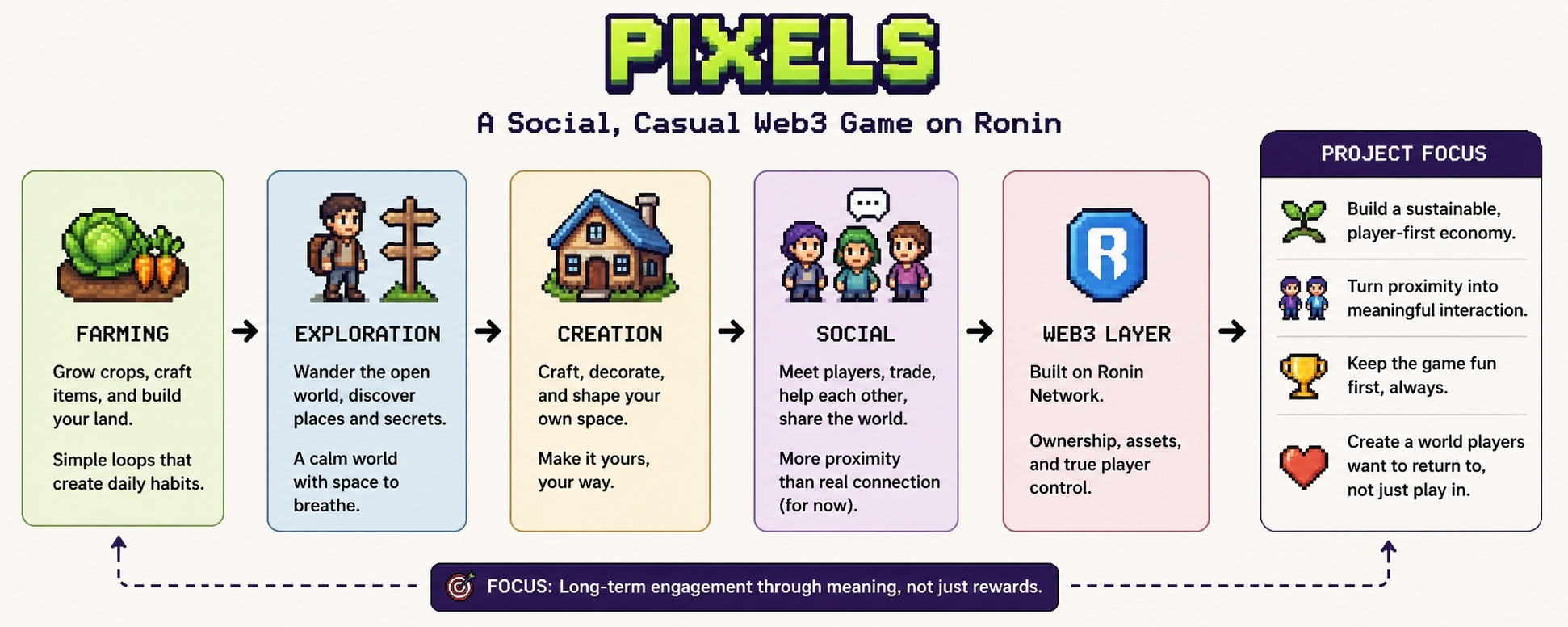

I’ve spent enough time inside Pixels to stop seeing it as just a game and start noticing it more like a habit—something you return to without thinking too hard about why.
At first, it’s easy to like. There’s no pressure, no noise, nothing trying to grab your attention every second. You log in, tend to your crops, walk around a bit, maybe run into a few players doing the same thing. It feels calm in a way that most games don’t even try to be anymore. That calmness does a lot of the heavy lifting early on.
But after a while, that same calm starts to feel a little empty.
Not in a dramatic way. Nothing breaks. Nothing pushes you away. It’s more like you start noticing how little actually changes from one session to the next. You’re doing things, but you’re not always sure what they’re adding up to. The progress is there—you can see it—but it doesn’t always feel like it belongs to anything bigger.
And then there’s the social side, which looks alive until you pay closer attention. Players move around, stand near each other, pass by—but very little really happens between them. It feels less like a shared world and more like people quietly existing in parallel. Close, but not connected.
That’s usually the point where I start thinking about what’s really holding it together.
Because beneath all of this, there’s the layer tied to the Ronin Network. It’s not something you have to think about constantly, but it shapes how people behave whether they admit it or not. You can feel it in the way players repeat certain actions, in how they stick to what seems “worth it” instead of what feels interesting.
The game suggests a slower, more relaxed pace, but the behavior inside it doesn’t always match that. There’s this quiet push toward efficiency that sits just under the surface. It doesn’t ruin the experience, but it changes the tone of it. You stop wandering as much. You start thinking in loops.
And once you notice that shift, it’s hard to unsee.
There are moments where it almost works the way you’d hope. Someone helps you without hesitation. A space feels briefly alive, like people are actually sharing it instead of just passing through. Those moments stand out because they feel real, not designed.
But they don’t last long. Things settle back into routine pretty quickly.
What’s interesting is that nothing here feels like a failure. The game runs smoothly. People keep showing up. It does what it’s supposed to do. And in this space, that alone is rare enough to matter.
But there’s still this feeling that it’s all just holding together, not quite locking into place.
I keep coming back to how everything feels slightly disconnected. Progress exists, but doesn’t always mean much. Social features exist, but don’t really shape the experience. The world exists, but doesn’t fully pull you into it. Everything is there, just not fully meeting in the middle.
And maybe that’s the real tension.
Because you can see the version of this that could actually stick. A slower game where people genuinely interact, where time spent feels personal, where the system doesn’t quietly nudge players in a different direction than the experience itself. It’s not a wild idea. It just feels difficult to maintain.
Right now, it works well enough to keep going. The loop is stable. The world is active. Nothing is falling apart.
But it also feels like something that hasn’t been fully tested yet—like it’s still running on early momentum, still benefiting from curiosity, still avoiding the moment where people start asking themselves if they’d come back without a reason.
And I don’t think that question has a clear answer yet.