
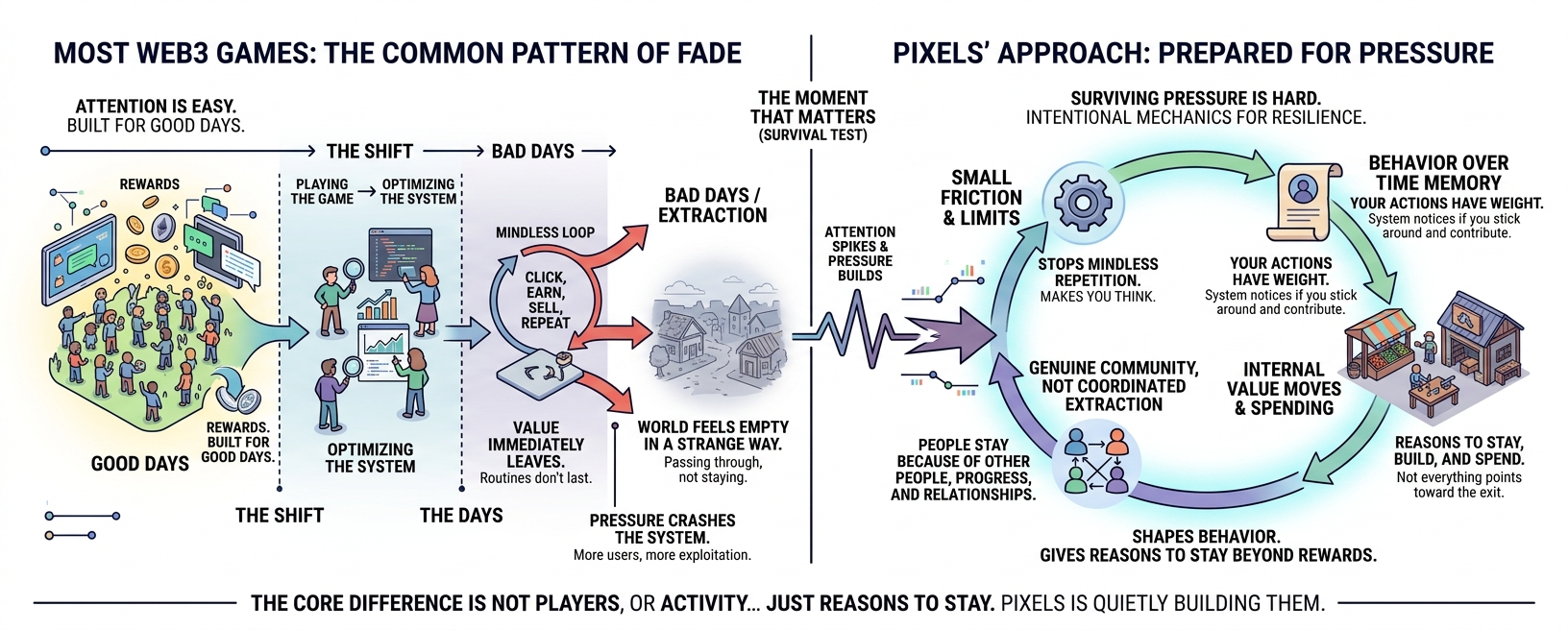

At first everything feels busy. Rewards are flowing, chats are active, timelines are full of screenshots. Then slowly, something shifts. People stop talking about the game itself and start talking about how to optimize it. Not how to enjoy it — how to drain it better. After that, it’s just a matter of time. The world is still there, but it feels empty in a strange way. Like people are passing through, not really staying.
I’ve seen that pattern enough times that I can’t unsee it.
That’s probably why Pixels keeps pulling me back in. Not because it’s loud or trying to dominate the conversation, but because it feels like it actually understands that pattern — and is trying to work around it.
A lot of projects build for the good days. Pixels feels like it’s built with the bad days in mind too.
And that matters more than people think.
Because in crypto, it’s not hard to get attention. What’s hard is surviving what comes with it. When more users show up, it doesn’t just mean more players — it means more pressure. More people testing the system, more people looking for shortcuts, more people treating the whole thing like a quick opportunity instead of a place to spend time.
That’s normal. It always happens.
The difference is whether the game is ready for that kind of behavior.
Pixels seems like it’s trying to be.
You can feel it in small ways. The game doesn’t just let you do everything endlessly. There are limits, little pauses, small bits of friction. Nothing too aggressive, but enough to make you think about what you’re doing instead of just repeating the same loop over and over.
At first, that kind of friction can feel annoying. Nobody likes being slowed down.
But then you realize — without it, everything becomes mindless.
Click. Earn. Sell. Repeat.
That loop might look active from the outside, but it doesn’t build anything. It doesn’t make you care. It just turns the game into a routine, and routines like that don’t last. People burn through them and move on.
Pixels seems like it’s trying to avoid that trap.
It’s not just about limiting actions, though. It’s about remembering them.
One thing I keep thinking about is how the game treats your behavior over time. It’s not just “you logged in today, here’s your reward.” There’s this sense that how you play actually matters. That the system notices if you stick around, if you contribute, if you’re part of the world instead of just passing through it.
That idea sounds simple, but it’s actually pretty rare in Web3.
In most games, nothing really sticks. You can show up, farm hard for a week, disappear, and come back later like nothing happened. There’s no memory. No weight to your actions. And because of that, there’s no real reason to care beyond the rewards.
Pixels feels like it’s trying to change that.
Not in a heavy or punishing way — just enough to make your time feel like it means something.
And I think that’s important, because without that feeling, everything becomes temporary. You don’t build a connection to the game. You just use it.
There’s also something interesting about how value moves inside the game. It doesn’t feel like everything is designed to immediately leave. In a lot of projects, rewards come in and go straight out. There’s no reason to keep anything inside the system, so people don’t.
Here, it feels a bit different.
There are small reasons to stay, to spend, to build things up instead of instantly cashing out. Not forced, just… encouraged. And that changes the vibe more than you’d expect. When not everything is pointing toward the exit, the world starts to feel a little more alive.
Still early, of course. That kind of balance is fragile.
The social side is another piece I keep thinking about. Games aren’t sticky just because of mechanics. People stay because of other people. Because they have something to lose if they leave — not just money, but progress, relationships, a sense of place.
Pixels seems to be leaning into that, but carefully.
Because social systems can go wrong too. If they just make farming more efficient, then nothing really changes. You just get groups of people extracting together instead of alone. That’s not community — that’s coordination.
The real question is whether people stay because they want to be there, not just because it’s profitable to be there.
That’s harder to build.
And honestly, I don’t think we’ll know the answer until things get busy. Until more users show up, more pressure builds, and the system gets tested in ways it can’t fully control.
That’s the moment that matters.
Not right now, when things are relatively calm. But later, when attention spikes again and everyone starts looking for the next thing to jump into. That’s when you find out if a game is actually holding together or just riding momentum.
Pixels feels like it’s preparing for that moment.
Not perfectly — nothing is — but intentionally.
And I respect that.
It’s easy to build something that looks good when everything is going well. It’s much harder to build something that still makes sense when things get messy. When users behave in ways you didn’t hope for. When incentives get pushed to their limits.
That’s real crypto.
So I’m not looking at Pixels as “the next big thing.” I’m way past that kind of thinking. I’m just watching how it handles the basics. How it shapes behavior. How it deals with pressure. Whether it can make people care about more than just the rewards.
Because at the end of the day, that’s what most Web3 games are missing.
Not players.
Not activity.
Just… reasons to stay.
And Pixels, quietly, seems like it’s trying to build those reasons.