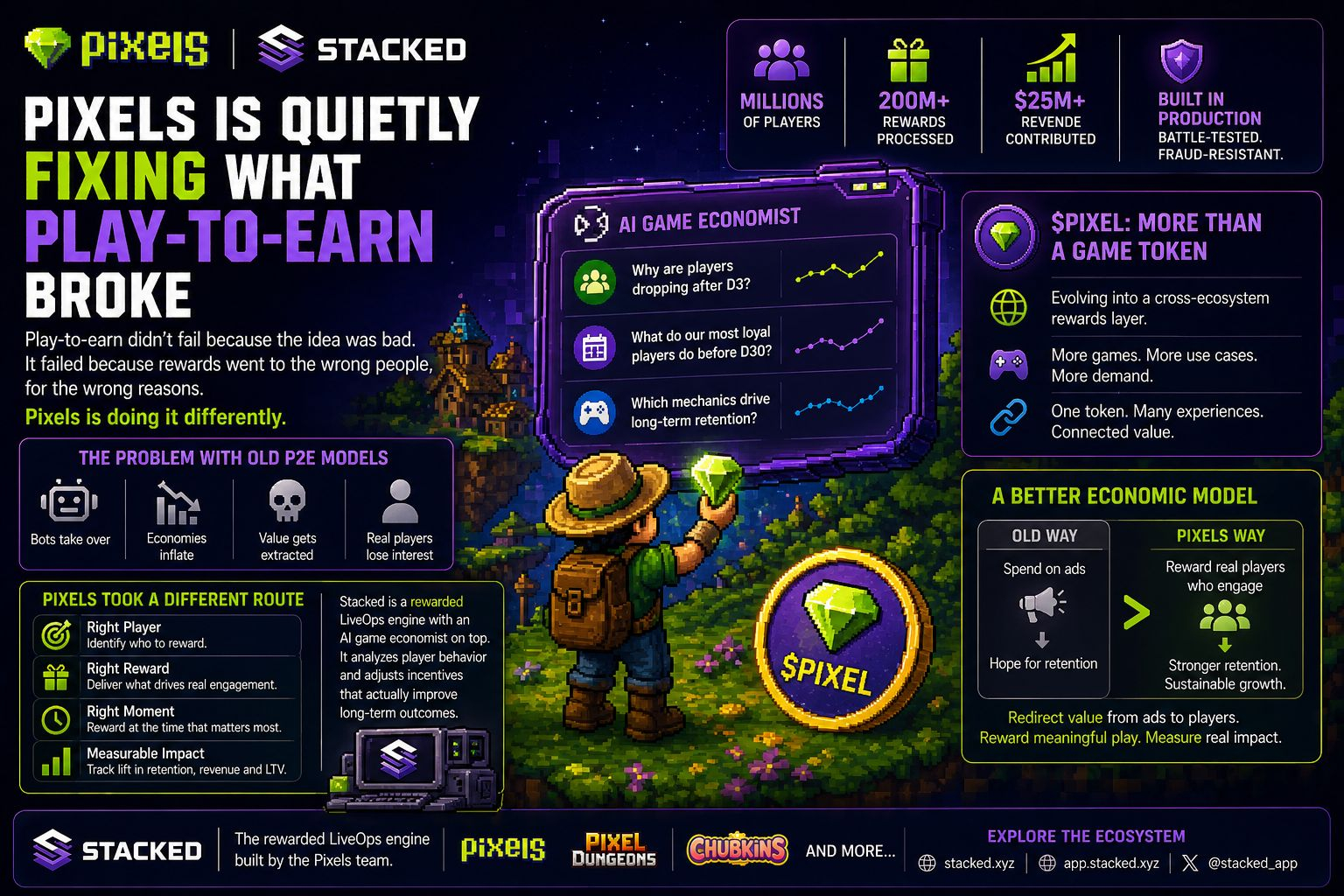
Play-to-earn didn’t collapse because rewarding players was a bad idea, it collapsed because most systems rewarded the wrong things.
For a while, the model looked unstoppable. Users flooded in, attracted by incentives and quick gains. But underneath that growth was a fragile foundation. Rewards were handed out too broadly, with little understanding of player behavior. Bots took advantage, economies inflated, and the focus shifted from playing to extracting. Eventually, the system couldn’t sustain itself.
That’s the part most people overlook the failure wasn’t in the concept, it was in the design.
@Pixels is approaching this from a completely different angle.
Instead of building around hype, it’s building around behavior. Instead of asking how do we attract more players?, it’s asking what actually keeps real players engaged over time?
That shift is where things start to change.
At the core of this evolution is Stacked, a rewarded LiveOps engine developed from years of running real economies inside the $PIXEL ecosystem. Rather than distributing rewards randomly or evenly, Stacked focuses on precision, delivering the right reward to the right player at the right moment.
This might sound simple, but it changes everything.
Because not all players are the same. Some are exploring, some are committed, some are about to leave. Traditional systems treat them equally. #pixel doesn’t. It studies behavior, identifies patterns, and adjusts incentives based on what actually drives long-term participation.
And this isn’t guesswork.
Stacked introduces an AI game economist layer that continuously analyzes player data. It looks at things most systems ignore:
Why do certain players stop showing up after a few days?
What actions separate long-term players from short-term ones?
Where is reward value being wasted without improving retention?
Instead of static reward systems, this creates a dynamic loop where incentives evolve alongside player behavior.
That’s the difference between a system that gets farmed… and one that adapts.
Another key piece is that this model has already been tested in real conditions. Pixels didn’t build Stacked in isolation, it was shaped through live experimentation across its own ecosystem, including different game modes and player types.
Millions of players have interacted with these systems. Hundreds of millions of rewards have been distributed. And importantly, it has contributed to real, measurable revenue.
That matters.
Because one of the biggest issues in Web3 gaming has always been the gap between theory and reality. Many projects promise sustainable economies but never operate long enough to prove it. Pixels took the slower route, build, test, break, fix, and repeat until the system could handle scale.
That’s where its current advantage comes from.
Then there the role of PIXEL.
At first glance, it might seem like just another in-game token. But as the ecosystem expands, its function is becoming broader. Instead of being tied to a single gameplay loop, $PIXEL is gradually positioning itself as a cross-ecosystem rewards layer.
That means its value isn’t limited to one experience. As more games and systems connect to Stacked, $PIXEL can flow between them, acting as a shared incentive layer across different environments.
This creates something most GameFi projects never achieved, continuity.
Players aren’t just earning within one isolated game. They’re participating in a larger network where value can move, adapt, and scale alongside the ecosystem.
And then there’s the bigger shift that often goes unnoticed.
Gaming studios already spend massive amounts on user acquisition, mostly through ads that don’t guarantee retention. It’s a constant cycle of paying for attention without knowing if that attention will last.
Stacked introduces a different approach.
Instead of sending that budget to ad platforms, studios can redirect it directly to players, rewarding actions that actually matter inside the game. Participation, engagement, progression, not just clicks or installs.
This changes the relationship between players and games.
Players are no longer just targets for marketing spend. They become active participants in the value loop. And because rewards are tied to real behavior, the system becomes more efficient over time instead of less.
It’s a subtle shift, but a powerful one.
Pixels isn’t trying to bring back the old version of play-to-earn. It’s not chasing the same growth tactics that led to collapse. Instead, it’s rebuilding the foundation, focusing on sustainability, data, and long-term engagement.
Less noise. More structure.
What makes it interesting is that this transformation isn’t being marketed as a revolution. It’s happening gradually, through iteration and real usage. While many projects aim for attention, Pixels is focused on function.
And in a space filled with promises, that difference stands out.
Play-to-earn broke because it rewarded activity without understanding it.
Pixels is fixing it by making rewards smarter, more targeted, and tied to real player value.
Not louder. Just better.