
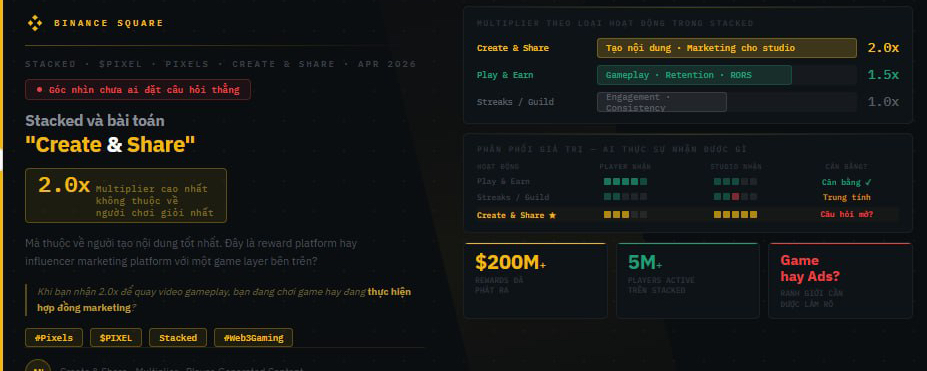
I opened the Stacked.xyz page and read about three ways to earn in the system. Play and Earn has a leverage of 1.5x. Streaks and guild bonus offer 1.0x. Create and Share, which means making highlights and writing guides, gives a juicy 2.0x.
I checked that number again. The highest multiplier in the whole system doesn’t belong to the top player. It goes to the best content creator.
This is where I think most analysis on Pixels is missing the mark, not because it's hidden but because it's too familiar. We've seen this structure before, just under different names.
In Stacked's internal documents, there's a straightforward statement: "Marketing budgets that studios used to hand to ad platforms now flow directly to players who actually show up and engage." When I read that alongside the 2.0x multiplier for Create and Share, the two started connecting in a more interesting way than I initially thought.
Pixels and Stacked are replacing paid acquisition with player-generated content. Instead of paying $15 to $30 cost per install to Facebook or Google, they pay multiplier rewards to players creating videos and guides. Players earn more than the usual Play and Earn. Studios receive marketing content without paying intermediary platforms. On the surface, this looks like a win-win.
But this is the point where I haven't seen anyone directly question this structure.
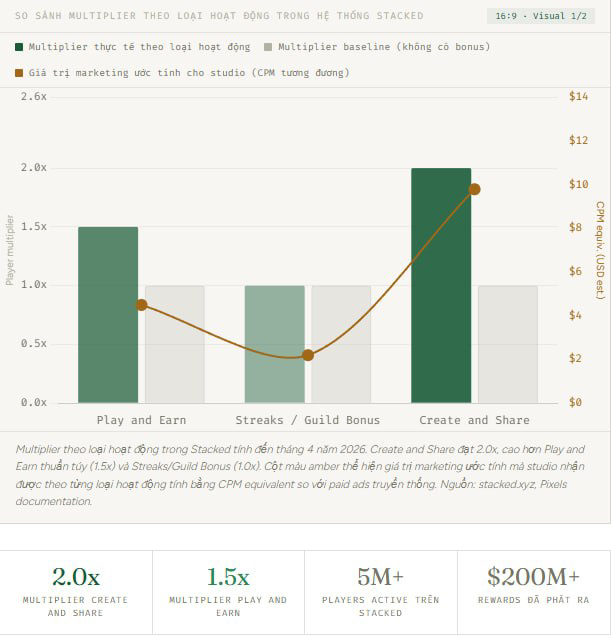
When a system pays more for content than for gameplay, it's not just creating new incentives. It's redefining who is a valuable user in that ecosystem. The best players in the traditional sense, those with the highest skills and longest playtime, become less valuable than players who can generate content that others watch and click on.
That isn't necessarily bad. It's just a shift in who the system prioritizes, and that shift isn't explicitly stated in how Stacked presents itself to users. The website says "earn rewards matched to you." The part about matched to you doesn't explain that if you create good content, you get matched more than someone who doesn't create content, even if the gameplay of both players might be the same.
I found a quote from Luke Barwikowski in the BlockchainGamer podcast that speaks very candidly about this model. He describes Stacked as "a next-generation ad network" in the whitepaper. That comparison is technically spot on. But when a system is presented to the end user as a place to earn rewards from gameplay, while in business terms it's operating like an ad network using player-generated content as ad inventory, there's a gap between those two descriptions.
The issue isn't that Stacked is doing something wrong. The issue is whether the content creators with the 2.0x multiplier are receiving enough information to understand they're participating in a marketing contract.
I need to clarify the other side of this picture because it is also real and important.
The two player stories on Stacked.xyz are not fabricated. One user profits from Pixels to open a shoe store. Another bought a motorcycle and set up a computer after working shifts with her boyfriend. This is real economic mobility coming from a gaming system, in markets where a $47 cashout can represent a significant week's wage. There's no denying that value.
And structurally, Stacked is doing exactly what it says. Instead of 65% of the acquisition budget going to Facebook and Google, most of that value goes to real players. $200 million in rewards distributed to 5 million players is the real deal. A RORS of 3:1 means the system isn't subsidizing losses through token inflation but is generating real revenue.
But this is the point where I still feel we need to look more closely. In the traditional model, when you create content on YouTube or TikTok about a game, you know you're a content creator. You can choose whether to monetize or endorse. When Stacked integrates Create and Share into the same system as Play and Earn, and frames it as "earn rewards for gaming," that boundary becomes blurrier.
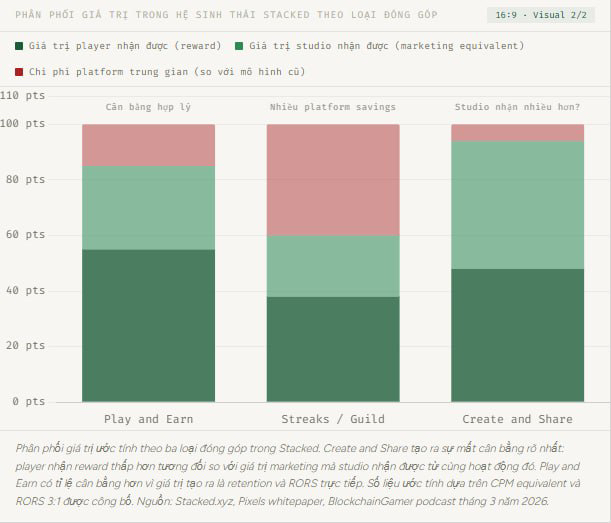 The question I haven't found a clear answer to in the documents from Pixels or Stacked is: when a player receives a 2.0x multiplier for creating a gameplay video, are they clearly informed that the video will be used in the studio's targeting campaign? Or is that content simply counted as a contribution to the ecosystem, leaving the rest open?
Stacked clearly states on the website "your personal data is not sold." That's an important and commendable commitment. But player-generated content isn't personal data in the traditional sense. It's content, and it's a very different kind of asset.
The publishing flywheel model that Pixels is building, as described in the whitepaper, is based on a loop: better games create richer player data, richer data allows for more precise targeting, and more precise targeting attracts better games into the ecosystem. Create and Share is the third layer of that flywheel that the whitepaper doesn't explicitly mention: players not only create behavioral data, they also produce acquisition content. And that acquisition content is rewarded more than any other activity in the system.
If the highest multiplier in a gaming ecosystem doesn't belong to the best players but to the best marketing content creators, then is this a game reward platform or an influencer marketing platform with a game layer on top? And does the answer to that question change how you view the long-term value of $PIXEL ?