
I didn’t go looking for Pixels with much enthusiasm. To be honest, I’ve read enough about Web3 games to feel a bit worn out by them. They often sound the same—big ideas about ownership, economies, and “the future of gaming.” So when I came across Pixels, my first instinct wasn’t excitement. It was more like… alright, what is this trying to prove?
But the more I looked into it, the more that question slowly changed into something else: what if it’s not trying to prove anything at all?
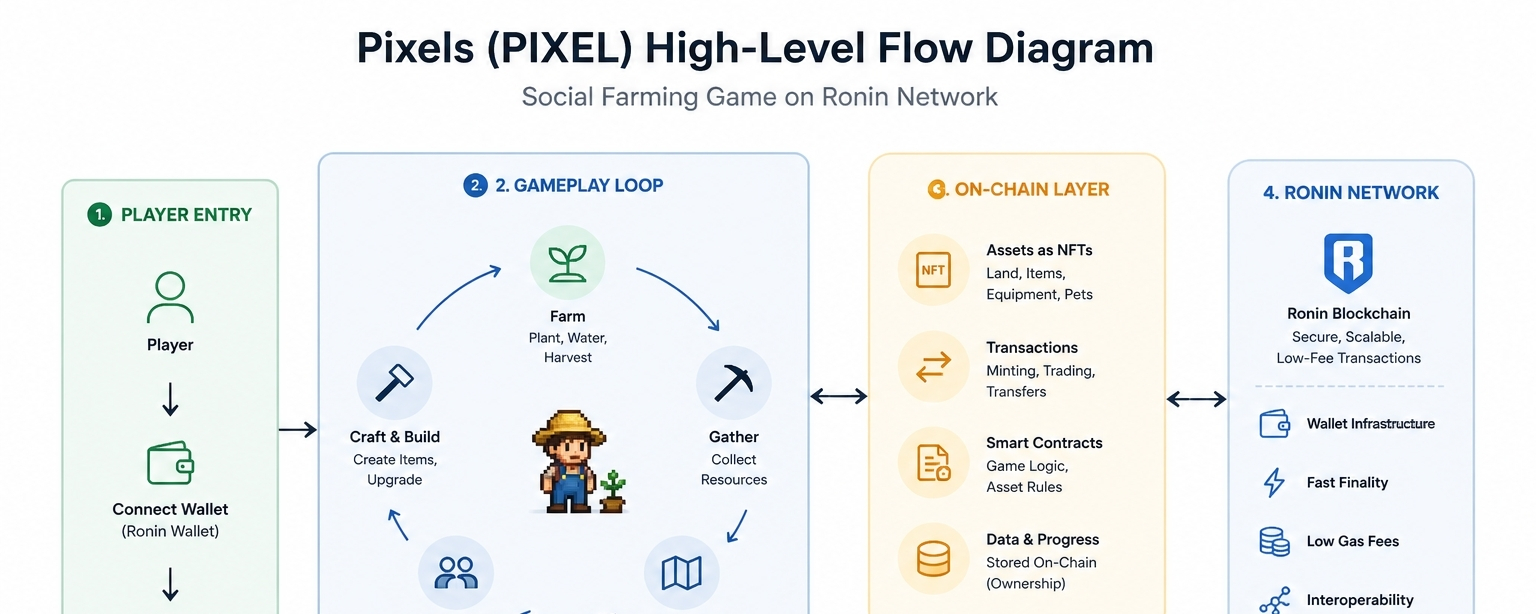
Pixels, at its core, is a farming game. You plant crops, collect resources, walk around, talk to people. That’s really it. There’s no rush, no pressure. You log in, do a few things, and leave. It feels oddly quiet. Almost like the game is intentionally staying out of your way.
And that simplicity is what caught my attention. Because underneath that very normal-looking game is something more complex—blockchain infrastructure, tokens, digital ownership. The game runs on the Ronin Network, and technically, the things you collect or build can exist beyond the game itself.
But here’s the strange part: the game doesn’t constantly remind you of that. It doesn’t push it in your face. It just… lets you play.
That’s unusual. Most Web3 games I’ve seen feel like they’re trying to convince you of something. They want you to believe in their system, their economy, their token. Pixels feels different. It feels quieter, almost like it’s saying, you can care about that if you want… but you don’t have to.
And I think that’s where it becomes interesting.
Because instead of building everything around earning or trading, Pixels leans into something slower—routine, repetition, small progress. It’s not trying to overwhelm you with features or complexity. It’s just giving you a space to exist in, even if that space feels a bit basic at times.
Still, I couldn’t ignore a lingering thought while going through it: does the blockchain part actually matter here?
If you remove that layer, you’re left with a simple farming game. And maybe that’s fine. But it also raises a quiet doubt—if the core experience doesn’t depend on the technology, then what is that technology really adding?
I don’t think Pixels fully answers that yet.
There’s also the issue of how players behave over time. Even if the game itself doesn’t push you toward profit or optimization, people tend to go there anyway—especially when something has real value attached to it. It’s almost inevitable. And when that happens, the tone of the game can shift, sometimes in ways the developers didn’t intend.
On top of that, the gameplay itself, while calming, can feel repetitive after a while. There’s a risk that once the novelty wears off, there might not be enough depth to keep people engaged long-term. And for new players, even with all the simplification, the idea of wallets and networks can still feel like an extra layer they didn’t ask for.
But despite all that, I keep coming back to one thing: Pixels feels… restrained.
It’s not loud. It’s not trying to dominate your attention or sell you a vision of the future. It just exists, quietly experimenting with how these systems might fit into something familiar.
And maybe that’s its real value—not as a breakthrough, but as a question.
Can something as complicated as blockchain just sit in the background of a game without changing its soul? Can it exist without taking over?
I don’t know yet. I don’t think anyone does.
But after spending time with Pixels, I feel less like I’ve discovered an answer and more like I’ve watched a small, careful attempt at asking the right question. And honestly, that feels a lot more real than most things I’ve read in this space.