
I think most people still think of Pixels through the lens of the version that initially caught on.
A farming game that quickly scaled.
A Web3 title that attracted a strong daily user base.
A play-to-earn cycle that seemed to work, at least for a while.
The phrase made sense in 2024, when development was the headlines.
But when you look at what they’re doing now, it doesn’t really fit.
Having pushed to one of the highest levels of user error in Web3, the focus has clearly shifted. It’s not about how many players join. It’s about what the system does to them once they’re in.
That’s where the change is coming from.
Most games don't actually make decisions.
They run loops.
A player completes something, the system reacts.
If you repeat it often enough, you get activity.
But activity is not the same as understanding.
The system doesn't know which players are worth keeping.
It doesn't know which actions lead to long-term value.
It doesn't know when the incentive chain will stop.
It just keeps going.
This is the part that Pixels seems to be rebuilding.
Not the surface loop, but the layer that decides what happens next.
Most games behave like automatons.
Pixels is trying to turn this into something selective.
And what makes it different is that it's no longer based on guesswork.
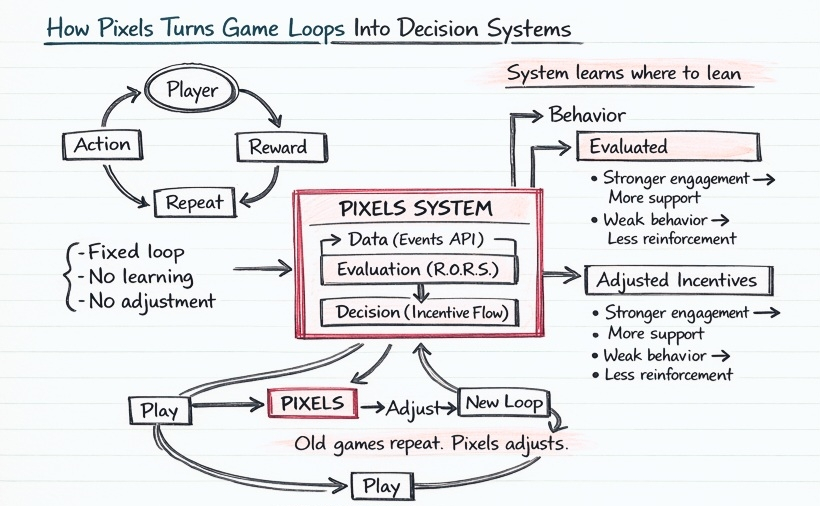
The system is starting to rely on three things working together: data to observe behavior, RORS to assess whether that behavior creates value, and to decide where incentives actually go.
You can see this in how they now develop incentives.
Instead of thinking of rewards as engagement tools, tie them to something measurable: return on reward spend.
At first glance, this seems like just another metric. But it raises a more complex question.
Did this incentive create value or not?
If not, why is it there?
Once you introduce this constraint, the system can no longer remain passive.
It has to be evaluated.
Initially, I thought the data layer would simply track.
As soon as you introduce this restriction, the system can no longer remain passive.
It has to be evaluated.
At first, I thought the data layer would only be passive.
But it does something else. It decides which behavior is important.
Through the Events API, the system doesn't just log actions. It identifies patterns over time.
Who comes back?
Who donates?
Who drops out?
Which paths lead where?
Without this, decisions are just guesswork.
But recognizing patterns is only half the battle.
The system also needs a way to act.
This is where the structure begins to change.
When $PIXEL is staked into a game, it doesn't just represent locked value. It becomes the pool from which incentives will be distributed nationwide.
This transforms staking into something more active.
It becomes a signal.
When a game attracts stakeholder engagement, it receives more incentive flow.
But if those players don't stay, don't spend, and don't contribute to the game economy, this flow doesn't remain stable.
It shifts.
Over time, capital moves toward the game, and the incentives can actually turn into loyalty and real results.
So now you have something different.
The system doesn't just reward behavior.
It redistributes based primarily on performance.
And this is where most game economies silently collapse.
Not because all the players leave at once, but because the system funds the wrong behavior for too long.
A system that can't decide who matters will ultimately find its own decline.
Pixels tries to avoid this.
By making incentives conditional, not automatic.
You can see how this creates a loop.
The system rewards behavior with data.
It evaluates results with RORS.
It incentivizes players through staking.
This changes how players behave.
And the system learns again.
This is no longer a static loop.
This is a system that makes decisions over time.
What makes this more interesting is that it doesn't stay confined to pixels.
The same logic is now implemented in a stacked format.
Instead of being limited to a single game, this system is something studios can use directly.
They're not just handing out rewards and hoping for the best.