

I used to think Pixels was trying to compete with Web2 games.
Better rewards. More ownership. Maybe a stronger economy.
But that comparison broke the moment I looked at how the system actually behaves.
Because Web2 doesn’t lose to Pixels on design.
It loses on something else.
It loses on where decisions happen.
The first time I noticed it wasn’t during gameplay.
It was after I completed something simple.
In a Web2 game, that moment is predictable. You do the task, you get the reward. The system already decided that outcome before you even touched it.
In Pixels, it didn’t feel pre-decided.
The action went through something first.
Not visible. But you can feel it in the delay, in the variation, in the way outcomes don’t line up cleanly across players.
That’s the anchor.
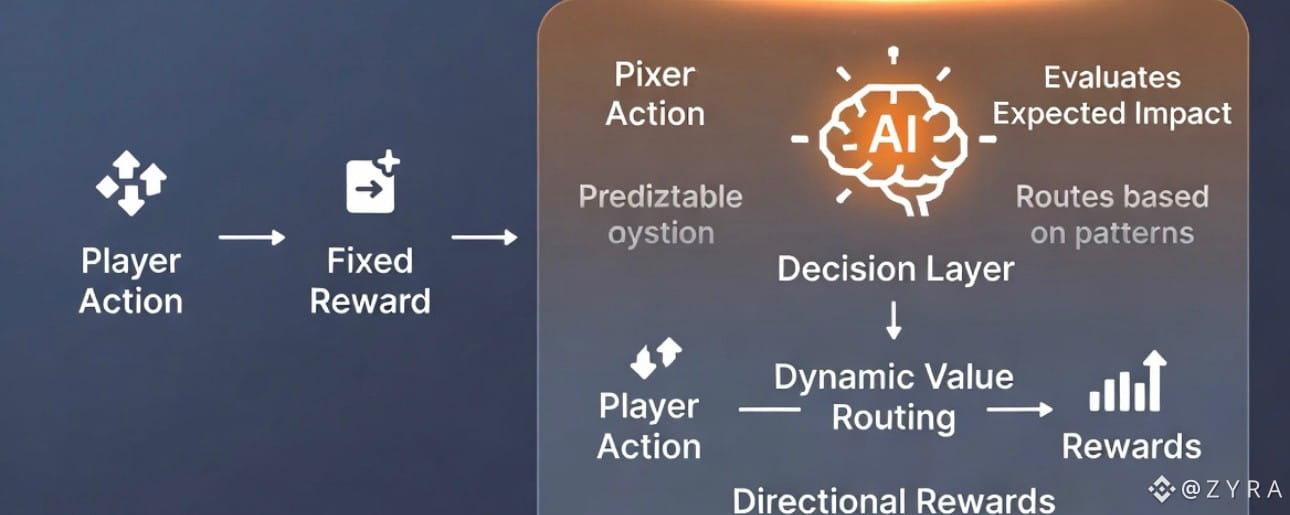
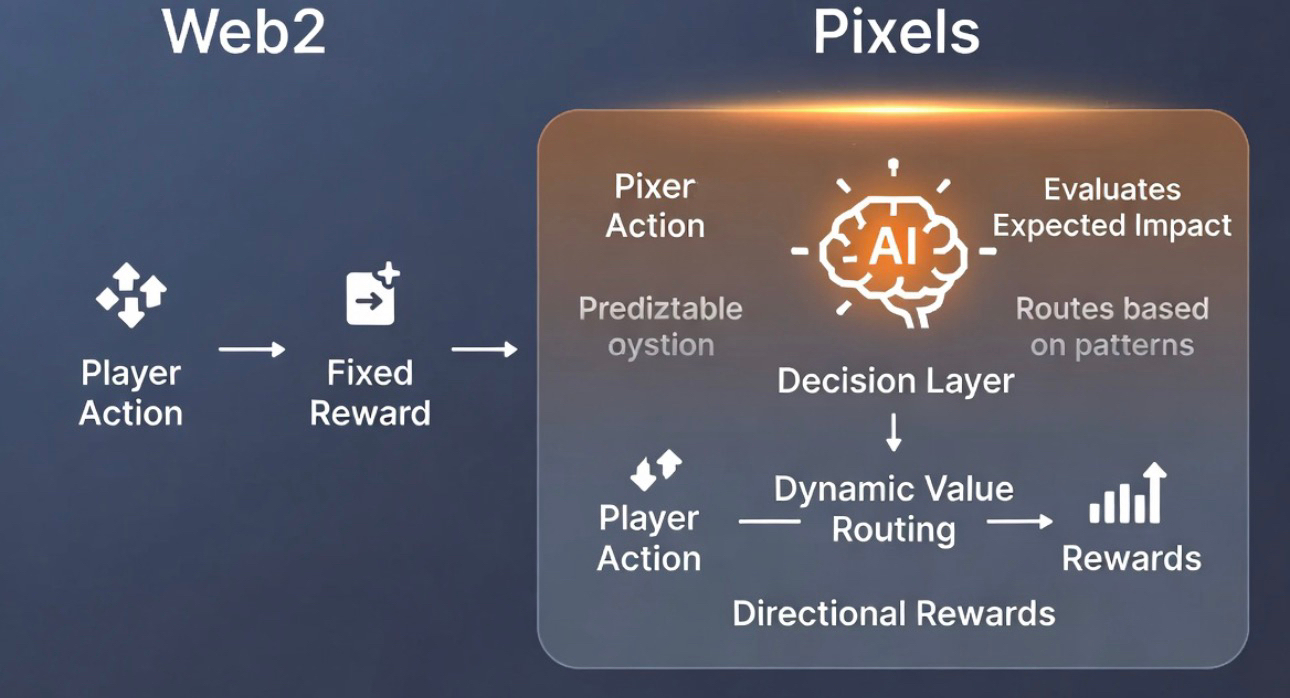 Between action and reward, there is a decision layer.
That layer is the difference between Pixels and Web2.
Web2 doesn’t need it.
Because Web2 controls everything.
It decides progression, locks value inside, and defines reward paths ahead of time. Nothing leaves the system, so mistakes are contained.
Pixels can’t do that.
The moment rewards have real value, you lose the ability to rely on fixed design.
If rewards are wrong, they don’t just feel bad.
They get extracted.
So Pixels doesn’t predefine rewards.
It evaluates where rewards should go.
Every action becomes input.
The system doesn’t ask “what is this worth?”
It asks “what happens if value is placed here?”
That’s a completely different question.
You can see it in how uneven the system feels at first.
Two players do similar things.
One gets pulled deeper into the loop.
The other doesn’t.
In Web2, that would be called inconsistency.
Here, it’s allocation.
The system is not rewarding actions.
It is routing value toward behavior it wants to reinforce.
That routing is the competitive advantage.
Not the token.
Not the quests.
Not even the economy itself.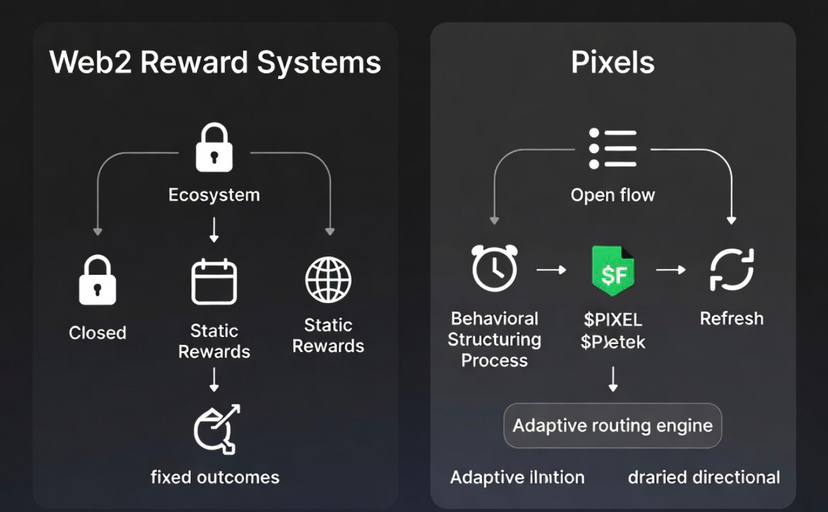
The advantage is that value is not fixed to actions.
It is assigned based on expected impact.
This is where Web2 can’t follow.
Because Web2 depends on predictability.
Players know what they’ll get.
Designers know what they’re giving.
That stability works because everything is closed.
Pixels operates in an open system.
Value leaves. Behavior optimizes. Players search for edges.
If rewards were predictable, the system would get drained.
So Pixels makes predictability expensive.
Not by hiding rewards.
By making them conditional.
The Events layer is where this becomes real.
But it’s not just tracking actions.
It’s structuring behavior.
Every action is recorded with context timing, repetition, sequence, drop-offs. Not just what happened, but how it fits into a pattern.
That pattern becomes the unit of decision.
Once behaviour is structured like that, the system can do something Web2 doesn’t attempt.
It can compare outcomes.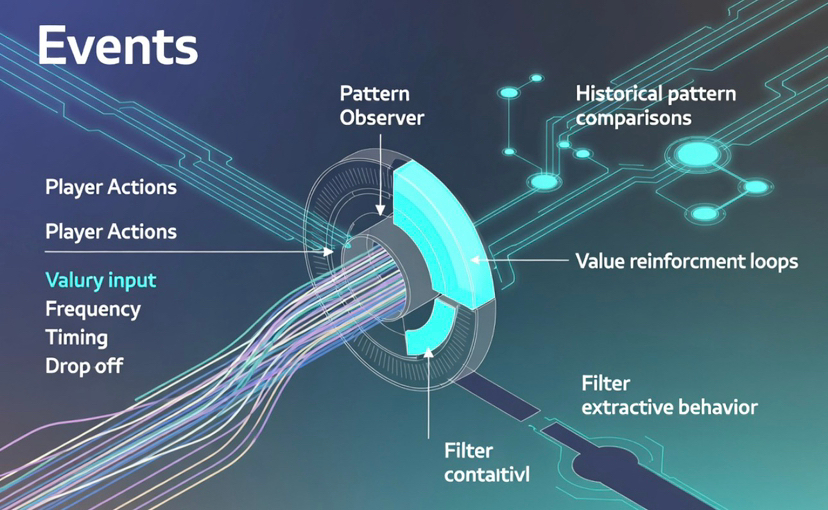
Not just “did players complete this?”
But “when value was placed in similar patterns before, what changed?”
That’s where allocation comes from.
This is why rewards feel different in Pixels.
They’re not consistent.
They’re directional.
Sometimes they push you deeper.
Sometimes they stabilize you.
Sometimes they disappear completely.
That’s not randomness.
That’s filtering.
And this is where most Web3 games fail against Web2.
They copy Web2 reward logic and add a token.
So rewards stay fixed, but now they have real value.
That creates farming loops immediately.
Players don’t engage.
They extract.
The system becomes predictable, and predictability becomes the attack surface.
Pixels removes that surface.
Because there is no fixed mapping between action and reward.
Instead, $PIXEL behaves like something being routed.
Not spent.
Not earned in a fixed way.
Directed.
Every distribution is a decision about where value should go next to shape behavior.
This is also why the system doesn’t collapse under bots in the same way.
It doesn’t eliminate them.
It deprioritizes them.
If a behavior pattern looks extractive, the system doesn’t need to block it completely.
It just stops routing value there.
That’s a different form of control.
Web2 blocks behavior directly.
Pixels controls value flow, and behavior adjusts around it.
The advantage starts compounding here.
Because every action feeds into the system.
Every allocation becomes a test.
Every outcome improves the next decision.
Web2 learns through updates.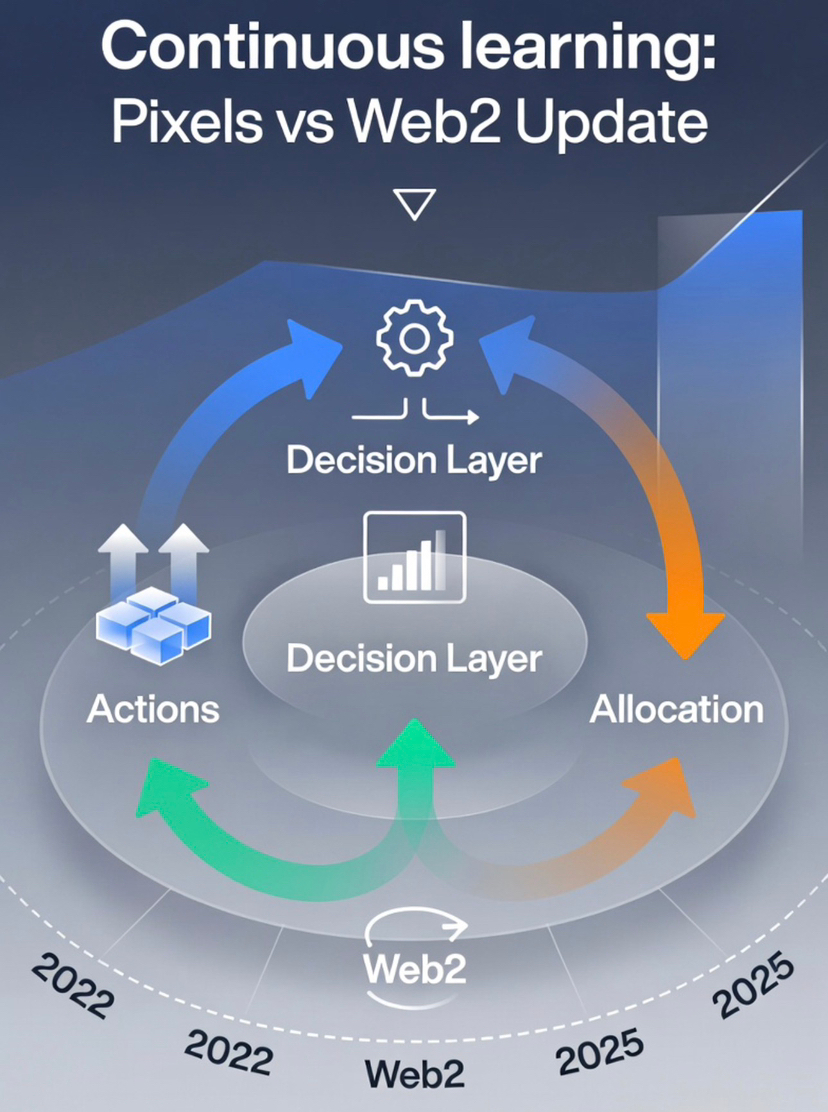
Pixels learns continuously.
And this is where the gap becomes structural.
Web2 systems are precise because they are controlled.
Pixels becomes precise over time because it adapts.
There’s also a constraint holding this together.
Decisions happen off-chain.
Outcomes settle on-chain.
That separation matters.
It keeps the system flexible while making results verifiable.
Without it, either speed or trust would break.
Once you see this, the comparison with Web2 flips.
It’s no longer about which system is more polished.
It’s about which system can respond faster to real behavior.
Web2 still wins in tight control.
Pixels is building something Web2 doesn’t attempt.
A system that stays open
but doesn’t lose direction.
That’s the competitive advantage.
Not visible in the UI.
Not obvious in the gameplay.
But sitting between every action and every reward.
A layer that decides where value should go next.