
A Pixels post earlier this year framed the project in a way I had to read twice: "Pixels is building a decentralized publishing model powered by staking, where games themselves [earn staking support]".
That sentence landed differently the second time.
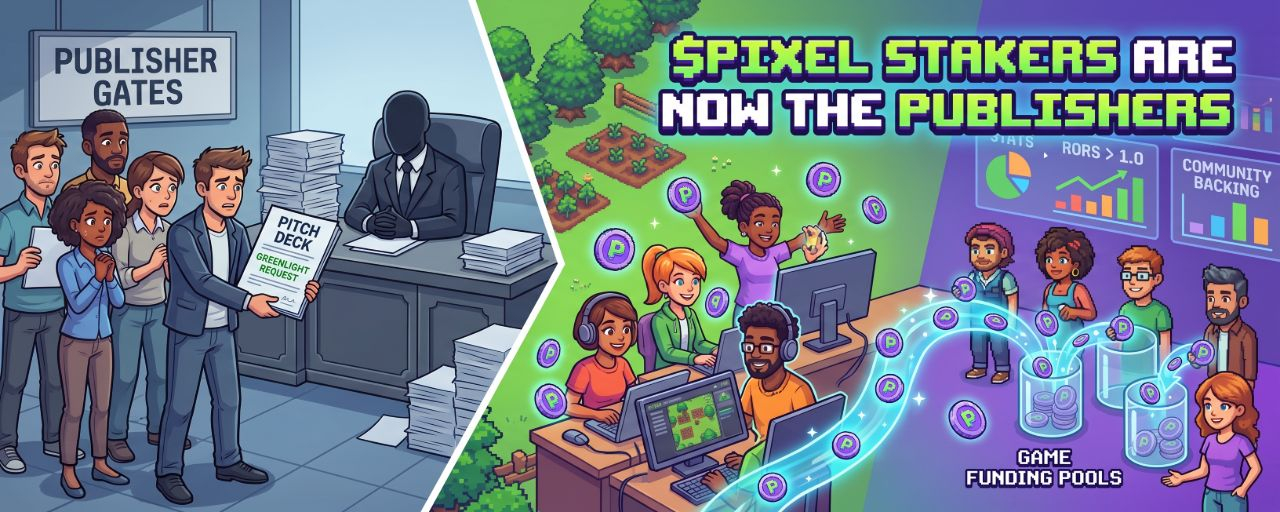
Game publishing as we know it works one way. A studio writes a deck, flies to San Francisco or Tokyo, pitches a publisher, and either gets a $50M check and two years of runway or gets ghosted. The list of people who can fund a game is short. The list of games that get made is shorter.
@Pixels is building something that doesn't look like that.
In their model, a game proves itself by hitting RORS above 1.0, meaning it generates more revenue than it pays out in rewards. Once it does, it qualifies for ecosystem staking support. Stakers route PIXEL into game pools that pay them back from real revenue. The game gets backing. The stakers get yield. Nobody had to fly anywhere.
This is not a metaphor. Pixels currently runs at RORS 0.8, Pixel Dungeons at 1.2. Sleepagotchi and Chubkins are in the same publishing pipeline. The 28M $PIXEL/month ecosystem reward cap is the hard ceiling on how much capital this model can deploy at once. There is a real budget, real metrics, and a real qualifier studios have to clear.
Step back and what this actually is becomes clearer. It is permissionless game financing. The community decides which games get capital based on whether they can prove they generate value. No VC term sheet. No publisher gatekeeper. No two-year wait for a green light.
Indie devs have been promised something like this for a decade. PIXEL is the first ecosystem actually shipping it with real metrics underneath.
Watch which third-party studios show up first. That tells you whether this works.
