
I didn’t understand Pixels at first.
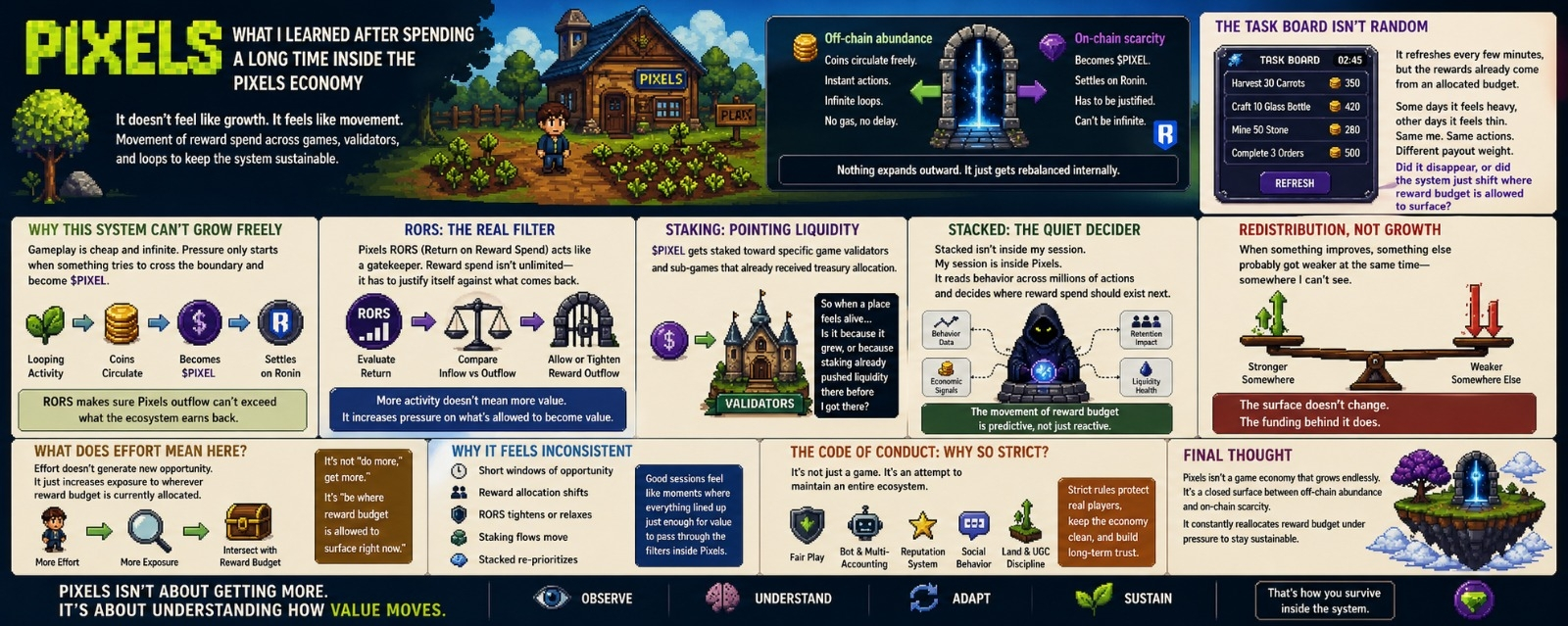
It looked familiar. A farming loop, a token, a market. The usual pattern I had seen before, plant, wait, harvest, repeat. At a glance, it felt like growth. More players joining, more farms running, more activity filling the map. The kind of expansion that usually signals a healthy game economy.
But the longer I stayed inside it, the harder it became to hold onto that assumption.
Because nothing actually expands the way it looks like it should.
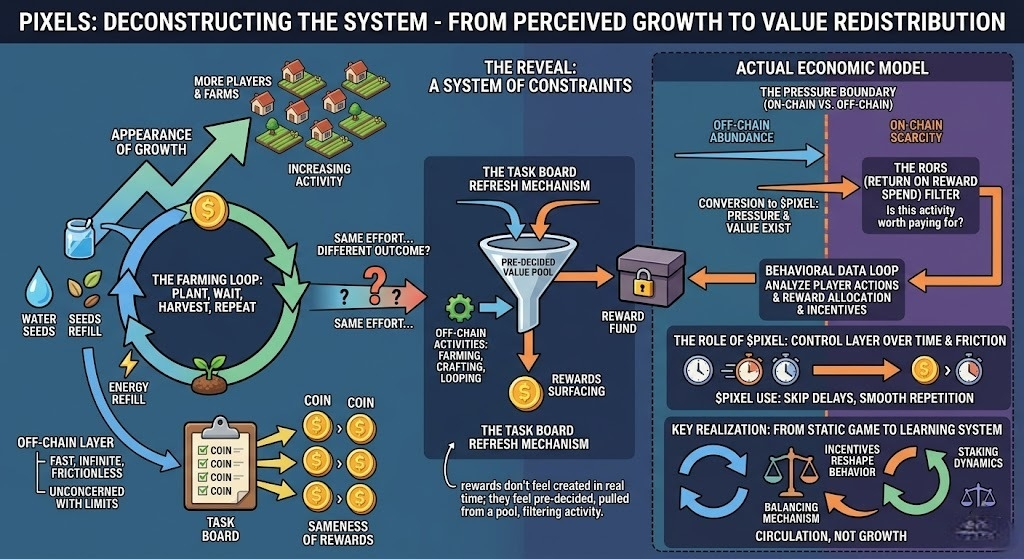
On the surface, everything is moving. Crops are cycling, energy is draining and refilling, task boards are refreshing every few minutes. The system feels alive, almost frictionless. Most of that activity lives in what feels like an off-chain layer, fast, infinite, and unconcerned with limits. Coins circulate freely, actions execute instantly, and participation never really slows down.
But then you sit with the Task Board long enough, and something starts to feel off.
The rewards don’t feel like they’re being created in real time. They feel… pre-decided. As if each refresh is pulling from a pool that already exists somewhere else, rather than generating new value from what players are doing in that moment. Some sessions feel heavy, like there’s real depth behind the rewards. Other times, everything feels thinner, even though I’m doing the exact same actions.
Same farm. Same routes. Same effort.
Different outcome.
That’s where my perspective started to shift. I stopped thinking of Pixels as a system that grows with activity, and started seeing it as a system that redistributes value under constraints.
Because the real pressure in Pixels doesn’t come from gameplay.
Gameplay is cheap. It scales infinitely. Anyone can farm, craft, and loop without adding real economic weight. The pressure only begins when something tries to leave that loop, when in-game activity converts into $PIXEL, when value has to exist outside the system and settle in a way that can’t be ignored.
That boundary changes everything.
It suggests that not all activity is meant to become value. Only a portion of it is allowed to cross over. And that portion doesn’t expand just because more players show up. It gets filtered.
This is where ideas like RORS (Return on Reward Spend) start to make sense to me, not as a technical feature, but as a constraint. Rewards aren’t just distributed; they’re evaluated. The system seems to constantly ask: “Is this worth paying for?” And if the answer isn’t strong enough, the reward simply doesn’t surface.
So more activity doesn’t necessarily mean more value.
It just increases competition for the same limited output.
That realization also changed how I see PIXEL itself. At first, I thought of it like any other in-game currency, something you earn or spend for progress. But over time, it felt less like a reward and more like a control layer over time and friction.
I noticed players using it not to “win,” but to avoid waiting. To skip delays. To smooth repetition. It wasn’t about maximizing output, it was about reshaping the experience. That kind of demand is subtle. It doesn’t spike dramatically, but it repeats quietly across thousands of small decisions.
And that repetition might matter more than growth.
Because Pixels doesn’t seem to rely on constant inflows of new players the way most GameFi systems do. Instead, it leans on behavior. On how often players return, how they interact, and what they choose to skip or engage with. The system doesn’t just reward activity, it studies it.
Over time, I started noticing that rewards feel less random and more… directed. Certain loops become more valuable, others fade. Not because they stopped working, but because something in the system decided they matter less now.
That’s when it stopped feeling like a static game economy.
It started feeling like a learning system.
Every action feeds data. That data reshapes incentives. And those incentives push players toward behaviors the system currently values. It’s a feedback loop that keeps adjusting itself, often without being visible from the player’s perspective.
Which explains another thing I kept experiencing: inconsistency.
Not chaotic inconsistency, but controlled movement.
Good sessions don’t feel permanent. They feel like moments where everything aligned, where my activity happened to intersect with where reward allocation was currently focused. And when that alignment shifts, the same actions produce less. Not because I did something wrong, but because the system moved.
That movement is subtle, but it’s constant.
It might come from staking dynamics, where PIXEL gets directed toward specific parts of the ecosystem. It might come from internal balancing mechanisms trying to prevent too much value from leaving. Or it might come from deeper layers, systems that analyze behavior across players and adjust reward distribution before I even notice the change.
Whatever the source, the effect is the same.
Value doesn’t grow outward. It circulates.
When something feels stronger, something else is likely getting weaker at the same time, just somewhere I’m not looking. And because I only see the part I’m in, it still looks like growth on the surface.
But it isn’t.
It’s redistribution.
That realization also reshaped how I think about effort inside Pixels. In most games, more effort leads to more progress. Here, it feels different. Effort increases exposure, it puts me in more places, more loops, more chances to intersect with where value currently exists.
But it doesn’t guarantee anything new is created.
So progression stops feeling linear.
It becomes situational.
And that’s probably the biggest shift for me. Pixels isn’t really trying to grow endlessly. It’s trying to stay balanced. It operates between two forces, off-chain abundance, where activity is infinite, and on-chain scarcity, where value has to be justified.
Everything I experience happens somewhere between those two layers.
Which means when something feels lighter than before, it didn’t necessarily disappear.
It was just moved.
And I don’t think I ever actually see that decision happen.
I just arrive after it’s already been made.
