I’ve started to notice something strange about how people leave games. It’s rarely dramatic. No big decision, no clear breaking point. They just… stop showing up. One missed day turns into a week, and eventually the habit disappears entirely. Most games try to fight this with pressure daily rewards, limited time incentives, constant reminders to come back. And for a while, that works. But it also creates a different problem: players return because they feel they have to, not because they want to.That distinction matters more than it seems.A lot of blockchain games leaned heavily into that “push” model. They built systems that rewarded consistency, but in a way that felt transactional. Log in, complete tasks, collect tokens, repeat. It creates activity, but it doesn’t build attachment. The moment the pressure disappears or the rewards become less attractive the player disappears with it. There’s nothing pulling them back, only something that was pushing them forward.Pixels (PIXEL) appears to be experimenting with a different approach. Instead of forcing urgency, it leans into persistence. The world doesn’t reset every day. Your farm doesn’t vanish if you miss a session. Progress accumulates quietly, and more importantly, it waits for you.That sounds simple, but it changes the emotional dynamic of the game. You’re not logging in to avoid losing something you’re logging in because there’s something unfinished. Crops to harvest, items to craft, land to develop. The game creates small, ongoing commitments rather than urgent obligations.The systems themselves reinforce this. Resource loops connect different activities, so time spent in one area feeds into another. Farming supports crafting. Crafting supports progression. Progression opens up more possibilities. It’s less about chasing rewards and more about maintaining momentum.Of course, there’s still an economy underneath it all. $PIXEL plays a role in incentivizing activity, distributing rewards, and enabling transactions between players. But the structure seems designed to avoid over-reliance on immediate payouts. Tokens circulate through sinks and usage rather than simply accumulating in player wallets.That’s where things get complicated.Balancing an economy like this means constantly adjusting how much value flows in and out. If players feel like they’re earning without purpose, the system inflates. If they feel like they’re spending without progress, 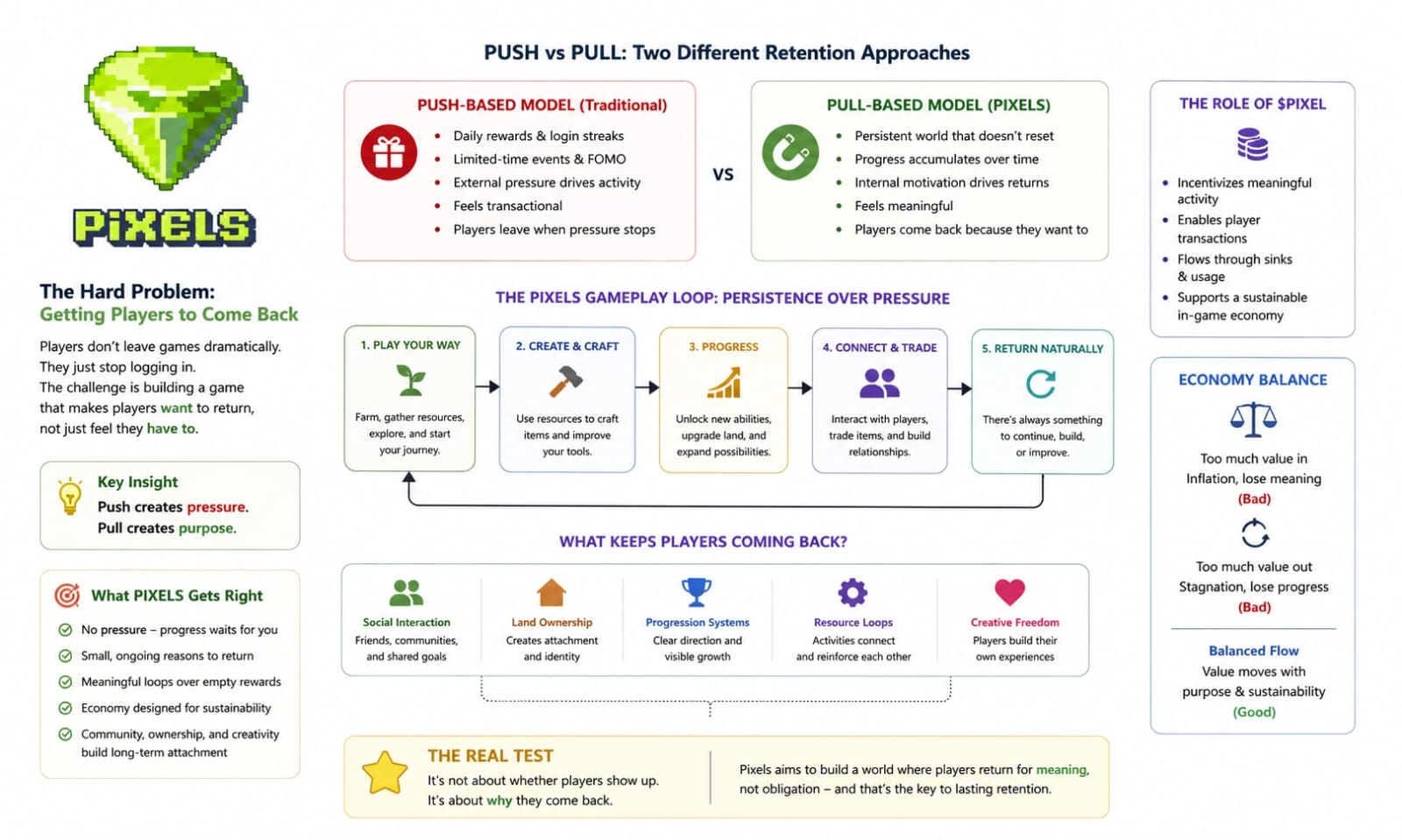 they disengage. The balance isn’t static it shifts with player behavior, and that behavior is rarely predictable.@Pixels What I find interesting is that Pixels doesn’t seem to rely on a single retention mechanism. It layers small reasons to return instead of one dominant incentive. Social interaction plays a role. Land ownership creates attachment. Progression systems provide direction. None of these are strong enough on their own, but together they create a kind of gravitational pull.Still, I wouldn’t call it solved. Pull-based retention is harder to maintain than push-based systems because it depends on genuine engagement. If the underlying loops stop feeling meaningful, there’s nothing forcing players back.#pixel So the real test for Pixels isn’t whether people show up it’s why they come back. And more importantly, whether that reason still exists after the novelty wears off.$PIXEL

Article
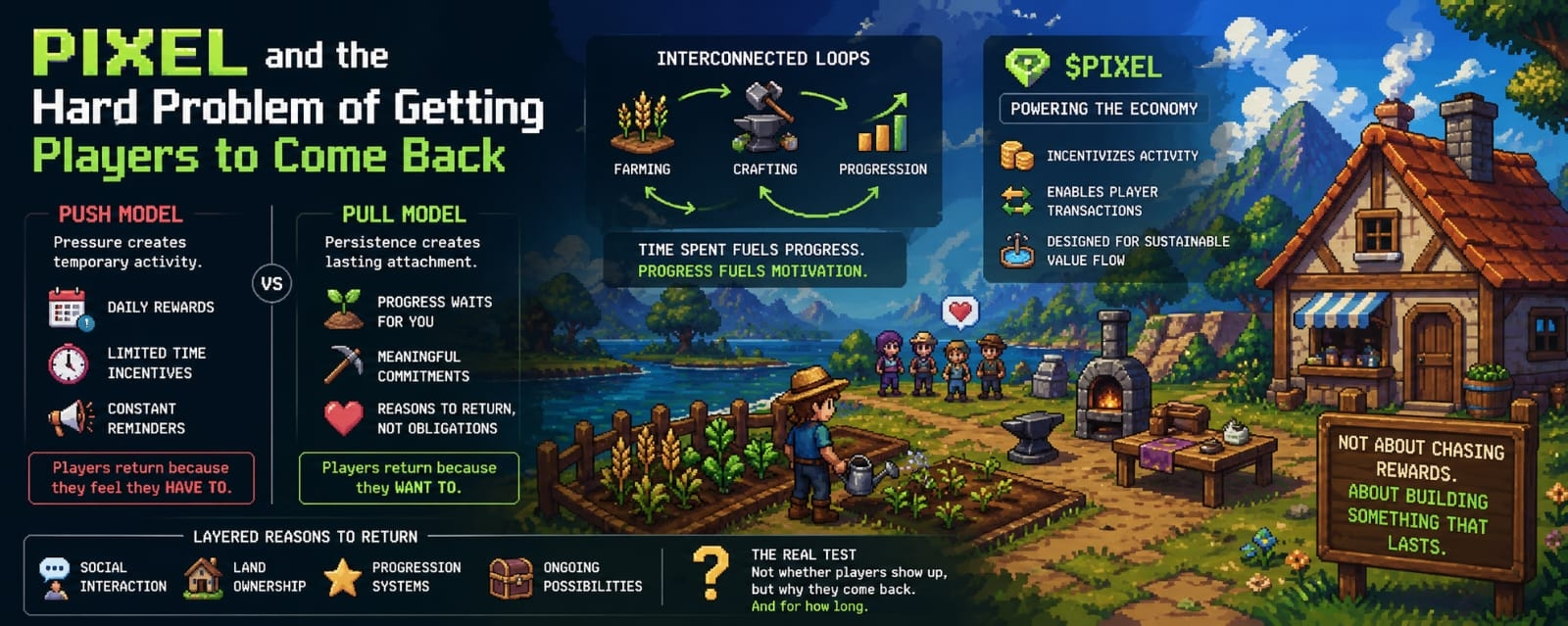
PIXEL and the Hard Problem of Getting Players to Come Back
Disclaimer: Includes third-party opinions. No financial advice. May include sponsored content. See T&Cs.