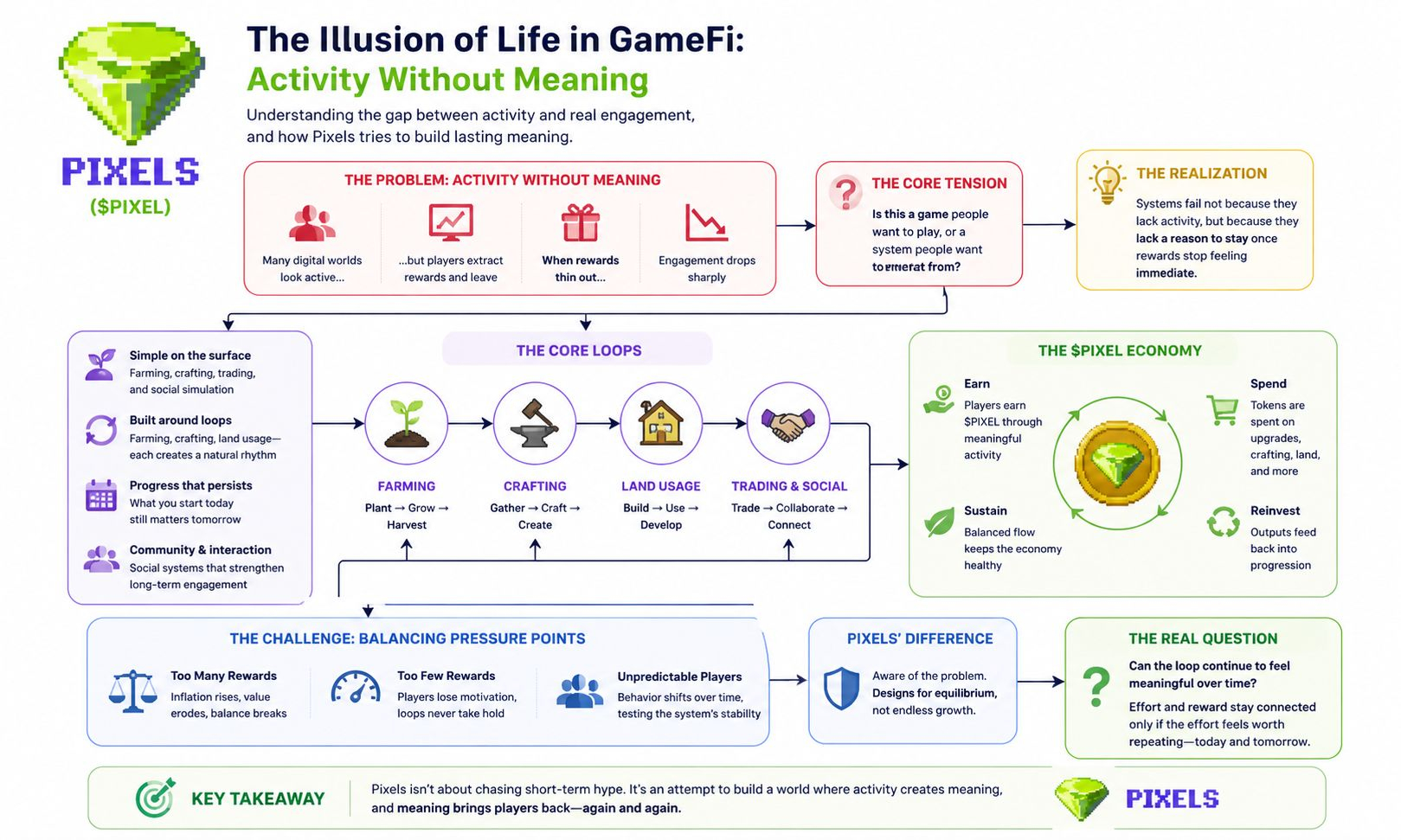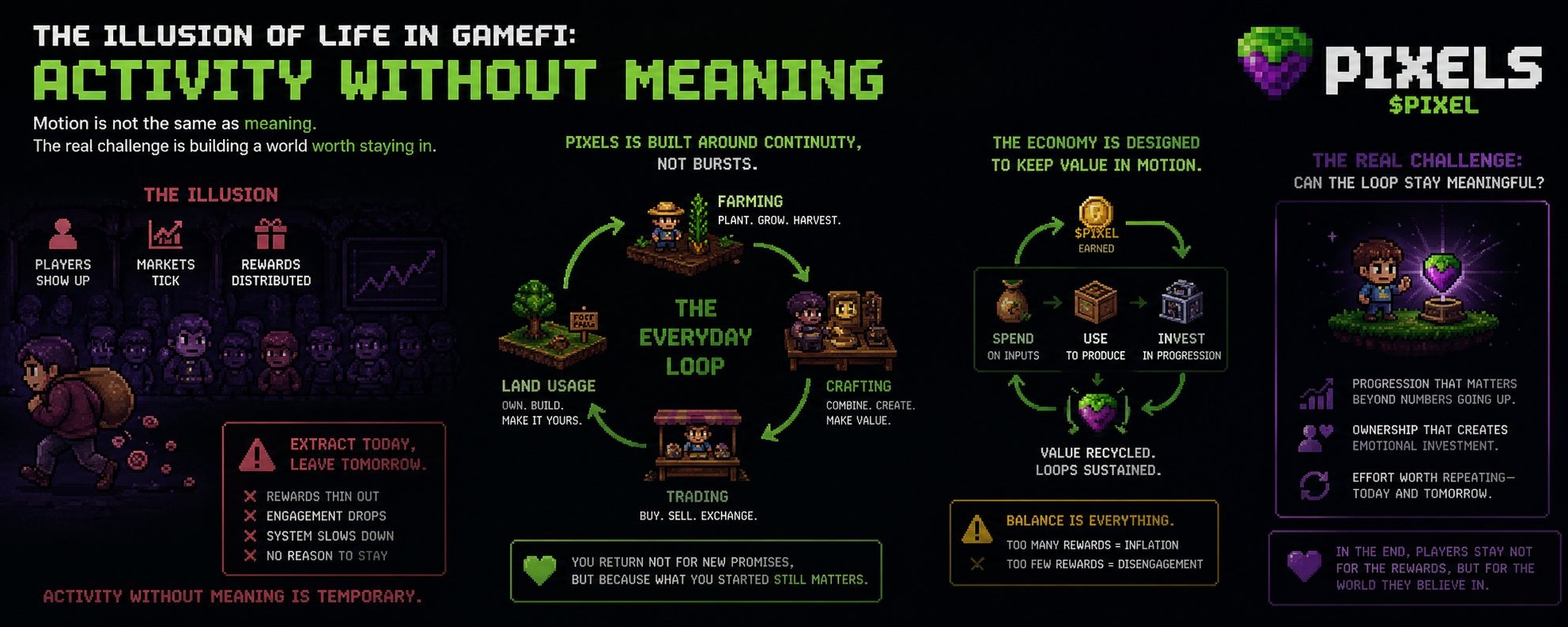
I keep coming back to this question: why do so many digital worlds feel active, but not actually alive? You can log in, see players moving, markets ticking, rewards being distributed but something feels off. The motion is there, but the meaning isn’t. It often feels like everyone is passing through, extracting what they can before the system inevitably slows down. That gap between effort and reward between doing something and actually caring about it is where most blockchain games quietly break.
I’ve seen this pattern repeat too many times to ignore. Early excitement builds around ownership and earnings, and for a while, it works. Players show up because there’s something to gain. But the moment rewards begin to thin out, the behavior changes. Engagement drops, not gradually, but sharply. What looked like a thriving economy reveals itself as a temporary alignment of incentives. The system didn’t fail because it lacked activity it failed because it lacked a reason to stay once the rewards stopped feeling immediate.
That’s the tension at the center of GameFi. Is this a game people want to play, or a system people want to extract from? It’s a harder question than most projects admit.
Pixels (PIXEL) feels like an attempt to sit inside that tension rather than ignore it. On the surface, it looks simple a farming and social simulation game with familiar loops: planting, harvesting, crafting, trading. But the longer I look at it, the more it seems designed around continuity instead of bursts. The idea isn’t just to reward activity, but to structure that activity in a way that naturally repeats.
Farming is a loop. Crafting is a loop. Land usage is a loop. None of these are inherently exciting on their own, but together they create a rhythm. You return not because something new is promised every time, but because what you started yesterday still matters today. That’s a subtle difference, but an important one.
The economy around PIXEL tries to reflect that same thinking. Tokens aren’t just handed out as incentives; they move through systems that require them to be spent, reused, or reinvested. Crops become inputs. Inputs become outputs. Outputs feed back into progression. In theory, this creates a balance where earning and spending exist in tension, not isolation.
But theory is always cleaner than reality.
Designing an economy like this means constantly managing pressure points. Too many rewards, and inflation quietly eats away at value. Too few, and players disengage before the loop has time to matter. The real challenge isn’t creating a system that works today it’s maintaining one that still feels fair weeks or months later, when player behavior becomes less predictable and more opportunistic.
What makes Pixels interesting is not that it solves this problem, but that it seems aware of it. The systems feel less like a promise of endless growth and more like an attempt to sustain equilibrium. That’s a very different mindset from most projects in this space.
Still, I’m cautious. Loops can create retention, but they can also create fatigue. Repetition only works if players feel a sense of progression or ownership that goes beyond numbers going up. If the loop becomes mechanical, it risks falling into the same trap it’s trying to avoid.
So the real question isn’t whether Pixels can build a functioning loop. It’s whether that loop can continue to feel meaningful over time. Because in the end, effort and reward only stay connected if players believe the effort is worth repeating not just today, but tomorrow too.