
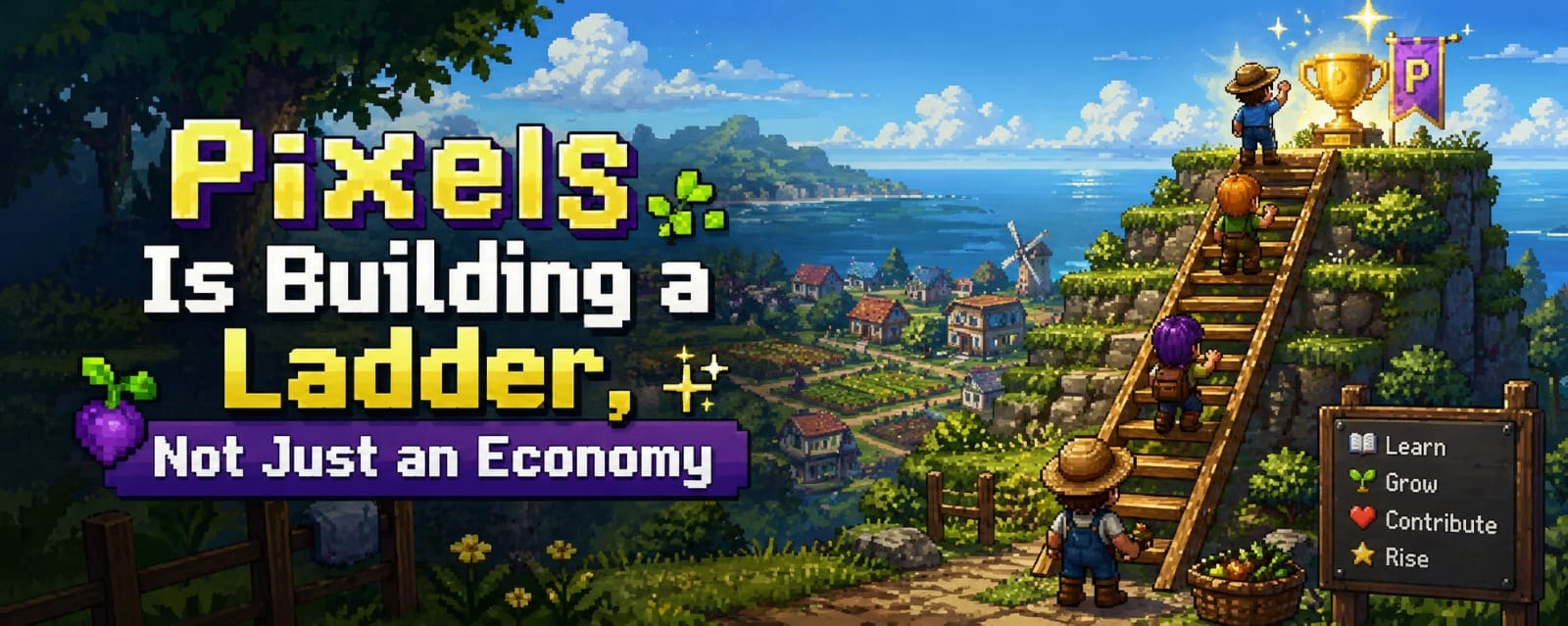

The more time I spend thinking about Pixels, the less I see it as a game about owning things. That’s the easy story. Wallets, land, tokens, assets. It fits the usual Web3 narrative. But it also feels incomplete. What actually makes Pixels interesting isn’t what sits in your wallet. It’s whether you can start small and slowly matter more over time.
Ownership is static. You either have something or you don’t. Mobility is different. It’s about movement. It’s about whether your position can change because you learned something, showed up consistently, or became useful to others. That shift feels subtle at first, but once you notice it, it changes how you read the entire game.
In Pixels, the farming loop looks simple on the surface. You plant, harvest, craft, repeat. But after a while, it stops feeling like repetition and starts feeling like rhythm. Some players just go through motions. Others begin to understand timing, resource flow, and how different systems connect. That’s where things start to shift. The game quietly separates players who are present from players who are paying attention.
That’s why recent updates feel more important than they first appear. Bountyfall didn’t just add content. It introduced shared contribution through Unions and the Hearth system. Suddenly, it wasn’t enough to just exist in the game. You had to show up in a way that helped something larger move forward. Your role started to matter. Even smaller players could become valuable if they understood how to contribute at the right time.
The Animal Care update pushed this further. On paper, it’s about feeding animals and collecting drops. In practice, it’s about understanding systems. Which inputs lead to better outputs. Which routines are worth your time. It rewards players who treat the game like something to learn, not just something to click through.
Then Tier 5 arrived and made the decision-making sharper. New resources, recipes, deconstruction, industry slots. Suddenly, progress wasn’t just about accumulating more. It was about choosing better. What do you keep? What do you break down? What do you turn into something more valuable? It feels less like collecting and more like managing a small, evolving operation.
This is where Pixels starts to feel human. Not in a story sense, but in a behavioral one. It mirrors something familiar. In real life, people don’t rise just because they own something. They rise because they figure things out, build trust, and become useful in the right contexts. Pixels taps into that same instinct. It gives players a space where effort, awareness, and consistency can slowly change their position.
That doesn’t mean the system is perfectly fair. It isn’t. Land matters. Early access matters. Some players start with more leverage than others. That’s real. But fairness in this context isn’t about equal starting points. It’s about whether there’s still a path forward for someone who starts behind. And Pixels, at least right now, seems to be trying to keep that path open.
What stands out to me is how the game rewards quiet competence. Not hype. Not noise. Just players who understand what needs to be done and keep doing it well. Task boards, group coordination, production loops, all of it creates small openings where someone can prove they are reliable. Over time, those small signals add up. A player becomes someone others depend on. And that changes everything.
Ronin plays a role here too, but not in the obvious way. It’s not just about lower fees or smoother transactions. It’s about context. Pixels doesn’t exist alone. It sits inside a network where identity, activity, and rewards can stretch beyond one game. That makes mobility feel less confined. What you learn and how you act can carry weight elsewhere.
That’s why I think focusing only on ownership misses the point. Ownership answers a simple question: what do you have? Mobility answers a harder one: what can you become here?
And that second question is what keeps people engaged. It’s the feeling that showing up today might make tomorrow different. That learning one small system might unlock a better role. That being useful, even in a small way, might eventually be noticed.
Pixels doesn’t shout this idea. It doesn’t market it directly. But you can feel it in how the systems are evolving. The farm is just the setting. The real experience is the slow climb from being just another player to someone who actually matters inside the world.
If Pixels gets this right, it won’t just prove that players can own digital assets. It will prove something more important. That even in a Web3 game, people stay when they feel like they can move forward. Not instantly, not easily, but meaningfully.
And that’s a much more human reason to keep playing.