
Pixels was one of those projects I initially overlooked. Not because it looked bad—but because it looked familiar. Farming loops, resource cycles, land mechanics, and a token quietly sitting in the background promising that eventually all of this connects to value. I’ve seen that structure play out too many times. It usually ends the same way: early excitement, heavy grinding, fast optimization, and then a slow realization that the numbers don’t justify the time anymore. People don’t leave all at once—they fade. That’s the pattern I expected here.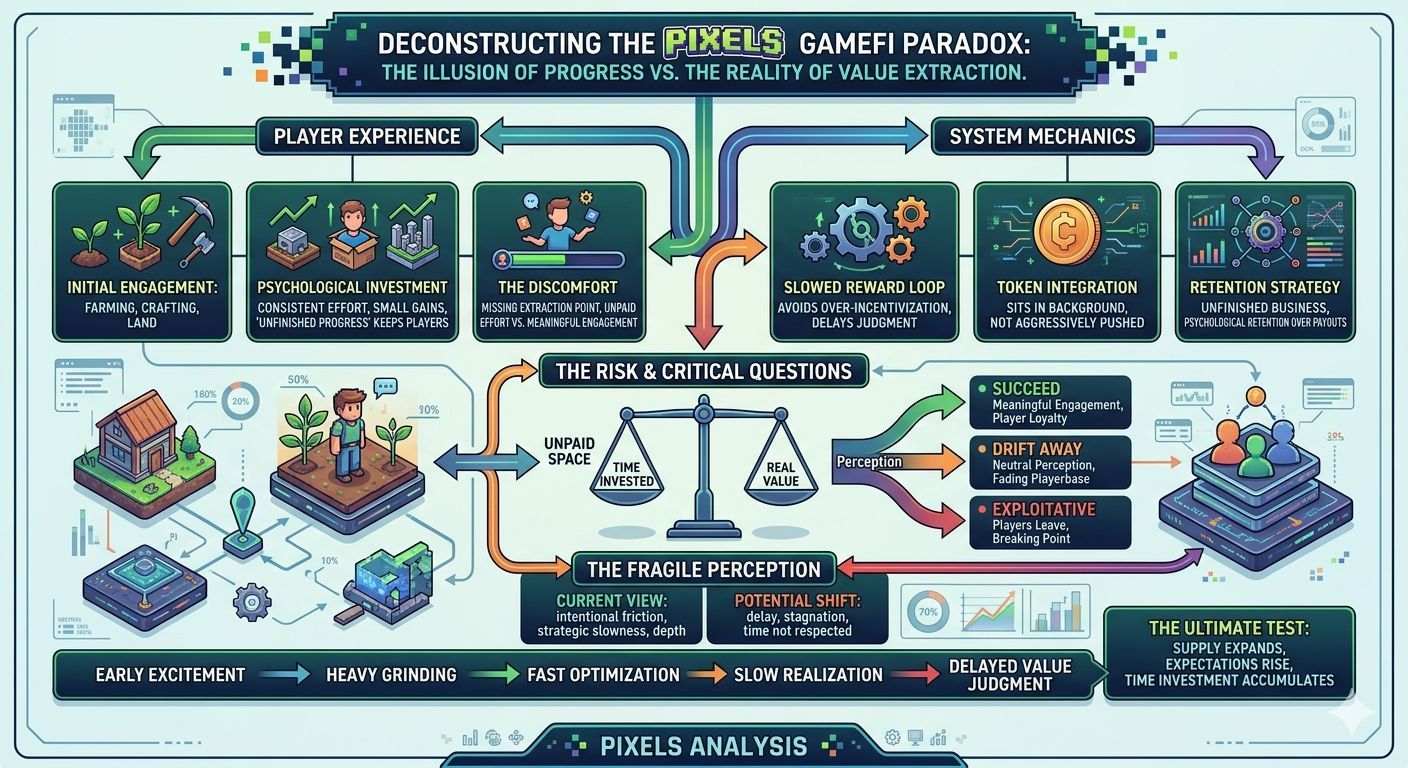
But after spending real time inside Pixels, something felt different. What stood out wasn’t what the game gives you—it’s what it doesn’t. There’s no constant payout pressure, no aggressive reward loop trying to keep you hooked every few minutes. Most of what you do just stays in the system. You farm, craft, adjust, repeat, and instead of a clear reward, you’re left with small improvements—better positioning, better efficiency, slightly more progress than before. At first, it feels slow. Then it starts to feel intentional. And if you’re honest, it becomes slightly uncomfortable.
That discomfort comes from the missing extraction point. In most GameFi systems, there’s a moment where everything simplifies into a clear equation: time in versus reward out. That’s where players decide whether to stay or leave. Pixels delays that moment. You’re always close to something, but rarely at a point where progress converts into real value. You’re preparing more than you’re earning, building more than you’re extracting. Instead of asking what you gained today, you start asking whether you’re closer than you were yesterday. It’s a subtle shift, but it changes how you experience the entire system.
There is a grind in Pixels, but it’s not obvious. It doesn’t hit you with loud repetition or obvious fatigue. Instead, it builds quietly through small actions, decisions that only matter over time, and systems that reward consistency more than intensity. You don’t feel exploited—you feel involved. That’s where the risk begins. Because the line between meaningful engagement and unpaid effort is thin, and I’ve seen projects cross it without realizing until players start disappearing. Pixels hasn’t reached that breaking point yet, but it’s close enough that you can see where it might happen.
The token plays an interesting role in all of this. It sits in the background, not aggressively pushed or constantly distributed. That feels like a deliberate choice. We’ve seen what happens when games over-incentivize rewards—everything turns into a race, players optimize instantly, and value gets extracted faster than the system can sustain. Pixels avoids that by slowing things down. But slowing the system doesn’t remove the core question—it only delays it. At some point, the time invested still has to connect to real value.
What keeps you inside the system longer than expected is not rewards, but unfinished progress. You’re always in the middle of something—building, improving, setting up the next step. Leaving feels like wasting the effort you’ve already put in. So you stay, not because you’re earning, but because you’re not done. That creates a different kind of retention, one that relies less on payouts and more on psychological investment.
The real risk isn’t that Pixels fails quickly. It’s that it stretches engagement long enough for players to delay asking the harder questions. Eventually, though, those questions come. Supply expands, expectations rise, and time investment accumulates. When that happens, the system gets tested under pressure. Not when everything feels new, but when things start to feel uncertain. That’s where most projects break.
Right now, Pixels works because the system still feels intentional. The friction feels designed, the slow pace feels deliberate, and the lack of immediate rewards feels like strategy rather than weakness. But that perception is fragile. The moment players start feeling like their time isn’t being respected, everything changes. What once felt like depth begins to feel like delay, and patience starts to feel like stagnation. Once that shift happens, it’s difficult to recover.
I keep coming back to one core idea while watching Pixels. Most of the time you spend inside the system doesn’t immediately pay you. That’s not a small detail—it’s the foundation of everything. Whether Pixels succeeds or fails will depend on how that unpaid space is perceived. If it feels meaningful, players will stay. If it feels neutral, they’ll slowly drift away. And if it starts to feel exploitative, they’ll leave.
Pixels doesn’t feel broken, and it doesn’t feel like a typical extraction loop either. It feels like a system trying to delay the moment where it gets judged. That’s what makes it interesting—but also risky. Because eventually, that moment comes for every project. The only question is whether, when it does, all this progress finally turns into value—or proves that it never really did.
