
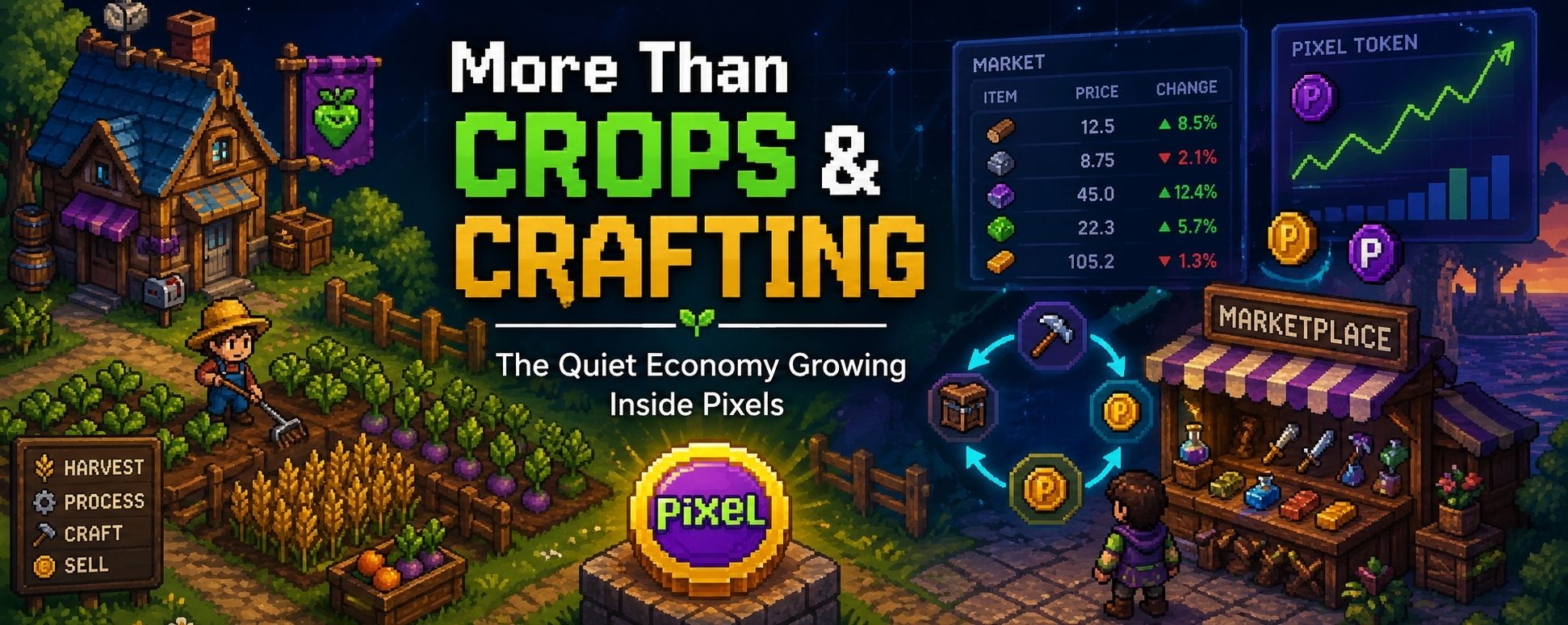
One night I was playing Pixels the way I usually do. Nothing serious. Just checking my farm, planting a few crops, letting the timers run while I did something else on the side.
At some point I noticed something strange.
I wasn’t really watching the farm anymore.
The character was still moving around the fields, crops were growing like they always do, but my attention had shifted somewhere else completely. Instead of looking at the land, I was staring at the marketplace.
Listings kept appearing and disappearing. Some materials sold almost instantly. Others sat untouched for long stretches. Prices nudged up or down depending on what players seemed to be crafting that day.
It slowly hit me that the farm on the screen was only the surface of the game.
Underneath it, something else was quietly running. Something that looked a lot like a small economic system.
Most people still describe Pixels as a farming game connected to a token. That explanation works well enough. You plant crops, harvest them, turn resources into crafted items, earn PIXEL, and trade materials with other players.
If you’ve played any farming simulator before, the rhythm feels familiar.
But when you step back and watch how everything connects, the structure begins to look less like a simple farm and more like a supply chain wearing farming clothes.
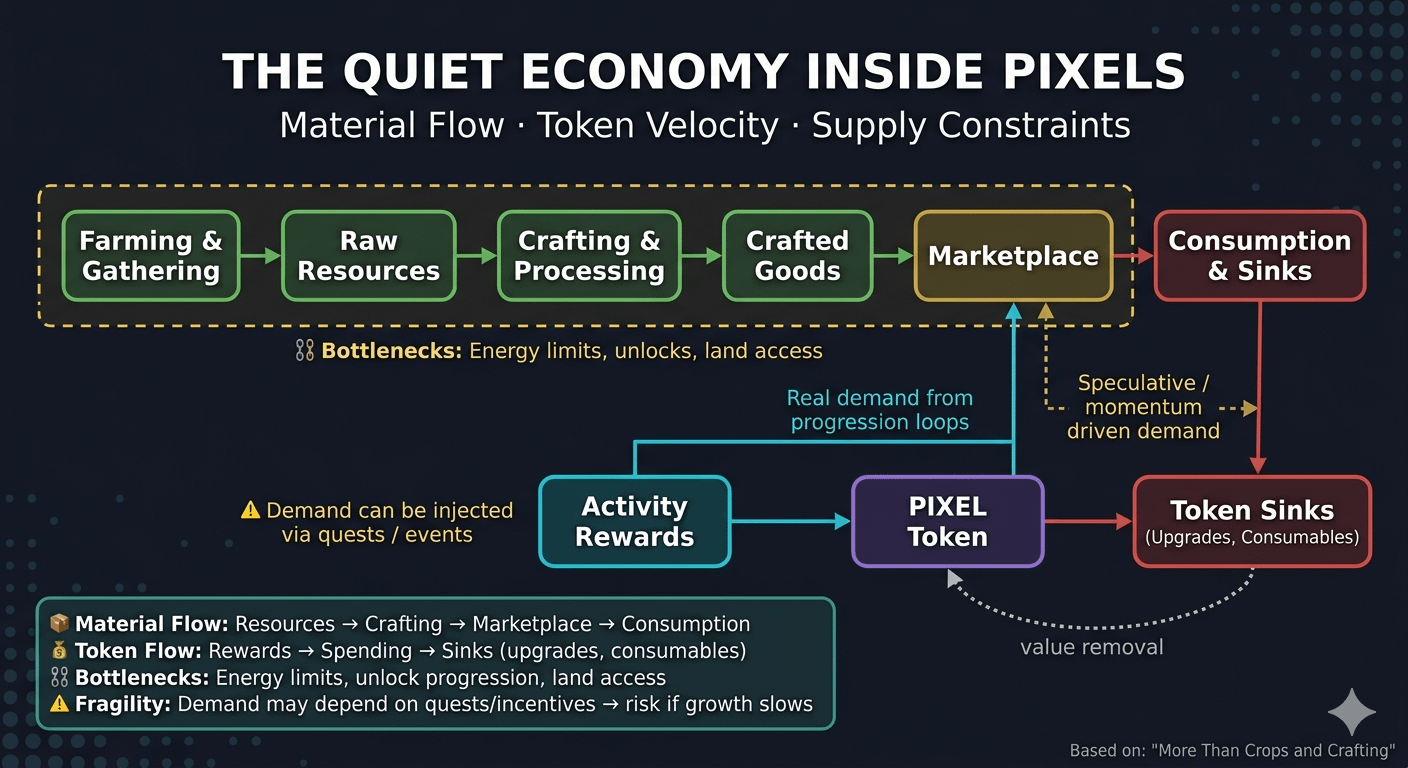
Resources enter the system through gathering and farming. Those raw materials turn into ingredients. Ingredients become tools, food, or crafted goods. Eventually those goods end up in the marketplace because someone else needs them to continue their own crafting path.
Harvest. Process. Craft. Sell.
Then it starts all over again.
The interesting part is how carefully the speed of that process seems to be controlled.
Energy limits quietly restrict how much players can do in a single session. Crafting recipes unlock step by step instead of all at once. Better tools take time to acquire. Even things like land access or plot limits act as small bottlenecks.
At first glance these mechanics just feel like normal progression systems. But economically they serve another purpose.
They regulate supply.
Without those limits, players could produce huge amounts of the same resources in a very short time. Farming games encourage repetition by design. If production ran completely unrestricted, the marketplace would likely flood with materials faster than anyone could use them.
Prices would fall quickly. Crafting would lose its value. The loop would stop feeling meaningful.
Those small restrictions slow everything down just enough to keep the system moving instead of collapsing.
The PIXEL token adds another layer to that structure.
Players receive token rewards for participating in the game, completing tasks, and contributing to different activities. That reward system encourages players to stay active and keep producing resources.
But token rewards always bring a difficult balance.
New tokens enter circulation over time, and eventually those tokens need somewhere to go. If they simply accumulate in player wallets without being used inside the game, the system starts to tilt.
That’s where sinks become important.
Some sinks feel natural because they are part of everyday gameplay. Crafting consumes resources. Consumable items disappear when used. Certain upgrades require continuous investment. Players interact with these mechanics without thinking too much about the token itself.
Other sinks depend more on optimism. Optional boosts, expansions, or investments that feel worthwhile when players believe the ecosystem will keep growing.
Those tend to work well during moments of excitement. But they slow down when expectations shift.
In a token-based environment, sentiment can change quickly because the exit door is always open.
Another question that kept coming to mind while watching the market is simple but important.
Who is actually buying all these items?
If most goods are purchased because other players genuinely need them to progress, the system becomes naturally sustainable. Crafting chains depend on earlier resources, and materials circulate between players in a steady rhythm.
But if demand mainly appears through quests or rotating in-game events, then the game itself is injecting demand into the system on a schedule.
Many online games use that approach successfully. It keeps activity high and gives players something to aim for. The difference is that the economy becomes more dependent on constant updates to maintain that movement.
Infrastructure plays a quiet but important role in making the whole system function.
Because Pixels runs on the Ronin Network, players can trade resources quickly and with minimal friction. Transaction fees are low enough that even small trades still make sense.
That matters more than it sounds.
A marketplace built on hundreds of tiny transactions only works if those transactions are fast and inexpensive. Players can list items, adjust prices, and move assets without feeling like the technical side is slowing them down.
At the same time, the Ronin Network ecosystem brings a community that already understands digital assets. Many players are comfortable watching markets, comparing strategies, and adjusting production based on profitability.
If a certain crafting path becomes unusually profitable, players tend to notice quickly.
And once they notice, they scale it.
That responsiveness is what makes the system interesting but also fragile. The economy isn’t just shaped by game mechanics. It’s shaped by thousands of players constantly looking for efficiency.
So the real challenge isn’t only technical performance.
It’s whether the in-game economy can handle being treated like a real market.
After spending time watching how things move inside Pixels, I still find myself somewhere between two interpretations.
In one version of the story, the game is gradually building a small but functional economy. Players specialize in different activities. Some focus on gathering resources, others on crafting, others on trading. Materials circulate because people actually need them.
In that world, PIXEL simply acts as the bridge between time, effort, and scarcity.
The second interpretation is a little more cautious.
In that version, many resources exist mainly as steps along the path toward token rewards. Crafting and trading still happen, but the final destination for much of the activity is token liquidity rather than long-term economic balance.
The tricky part is that both systems can look almost identical while the player base is growing.
New players arrive, buy resources, and keep markets active. Supply gets absorbed. Prices remain stable enough. Everything keeps moving.
The real difference only becomes visible when growth slows.
If demand for items remains strong during quieter periods, the economy begins to look resilient. But if activity drops sharply once incentives cool down, it suggests the system depends heavily on constant momentum.
For now, the design inside Pixels feels thoughtful. The loops work. The marketplace stays active. Nothing feels chaotic or broken.
But sometimes good design doesn’t mean the system is permanent.
Sometimes it simply means the system works as long as the conditions around it remain favorable.
And that leaves one quiet question sitting underneath the whole farm.
What happens to the economy when those conditions eventually change?