

In the evolution of Web3 gaming, the explosive rise of Pixels was no accident. Its recent deep reflection on the 'Offerwall' mechanism reveals the key growing pains of GameFi transitioning from 'traffic harvesting' to a 'sustainable ecosystem.'
As the officials say, an offer wall that doesn't know who it's talking to is essentially market noise. This 'electronic litter' design is eroding player immersion and the long-term viability of projects.

1. Structural Dilemma: The Ghost of 2014
Currently, most GameFi projects' offer walls are still stuck in the 2014 CPI (Cost Per Install) arbitrage logic. The core logic is simple and brute-force:
Maximizing exposure rather than alignment: No matter who the player is, just shove ads in their face, lacking an understanding of user intent.$PIXEL
Single blunt instrument: Simplifying complex incentive mechanisms to 'watch ads \rightarrow receive rewards', this 'blunt instrument' harms the narrative logic of the game.

Compensating quantity with quality: Hoping to sift out a few conversions from a massive influx of junk traffic while ignoring how this irrelevance damages the native economic system of the game.
2. The Philosophy of Pixels: Returning from 'Traffic' to 'Users'.
Based on the @Pixels white paper and the latest updates, the team is trying to break this 'noise' pattern. The core of Pixels lies in resource management and social simulation; introducing a fragmented offer wall will lead to uncontrollable inflation within the game.$CHIP
Identity recognition: Pixels attempts to identify 'real players' from 'bots' through on-chain data and a Reputation System. An offer wall that understands its audience should not be a disruption but an extension of the gaming experience.
Value alignment: Rewards should not merely be token distribution but should be deeply tied to in-game progress (like seeds, tools, land prestige).
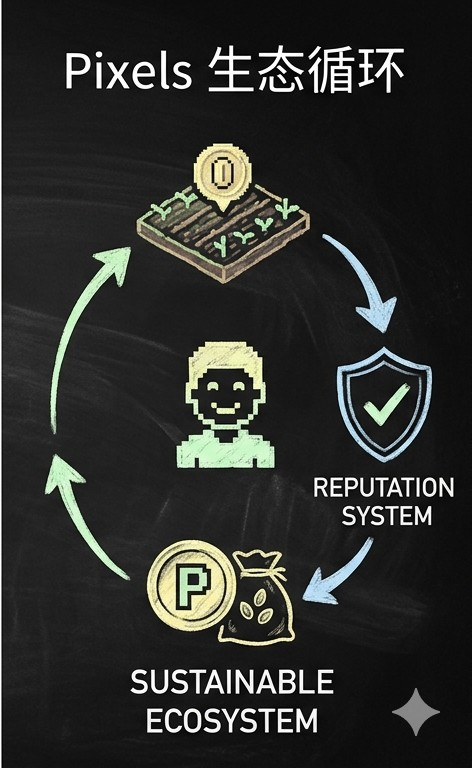
3. Paradigm Shift: From 'Arbitrage' to 'Retention'.
Pixels' attempt has left a profound insight for the industry: 'Noise' is noise because it disrupts the signal-to-noise ratio. In the Web3 environment, players are not just consumers but asset holders. When an offer wall is focused solely on boosting third-party apps without considering its impact on the in-game economy, it creates structural collapse.$RAVE
Conclusion: Rejecting mediocre integration.
Pixels' official 'sharp-tongued' comments are actually a wake-up call for the industry. Future Web3 task systems should not be rigid plugins but should be accurately matched based on user profiles. We don't need more 'watch ads', but intrinsic motivation that can enhance game narratives and elevate player asset weight. Only by eliminating those '2014 ghosts' can GameFi truly step into the mainstream.#pixel #以太坊基金会解质押4890万美元ETH #白宫晚宴枪击事件