

Pixels is one of those projects I didn’t take seriously at first, and honestly, that probably says more about what crypto has done to my brain than it says about the game.
You see a pixel farming world on Ronin. Crops. Quests. Pets. Land. Little avatars walking around. It looks harmless. Almost too harmless. After years of watching “Web3 games” turn into half-broken dashboards with a fantasy skin slapped on top, my first reaction was not excitement.
It was suspicion.
Because we’ve seen this movie before.
A game launches. The token comes. Everyone suddenly becomes a “player.” Discord fills up. Guides appear overnight. People pretend they care about the lore when really they are calculating rewards per wallet. Bots arrive. Multi-accounts arrive. Guilds optimize everything. The economy gets farmed harder than the actual crops. Then the rewards slow down and everyone discovers whether there was a game underneath the incentives.
Most of the time, there wasn’t.
Pixels is interesting because there is at least something underneath.
Not perfect.
Not clean.
But something.
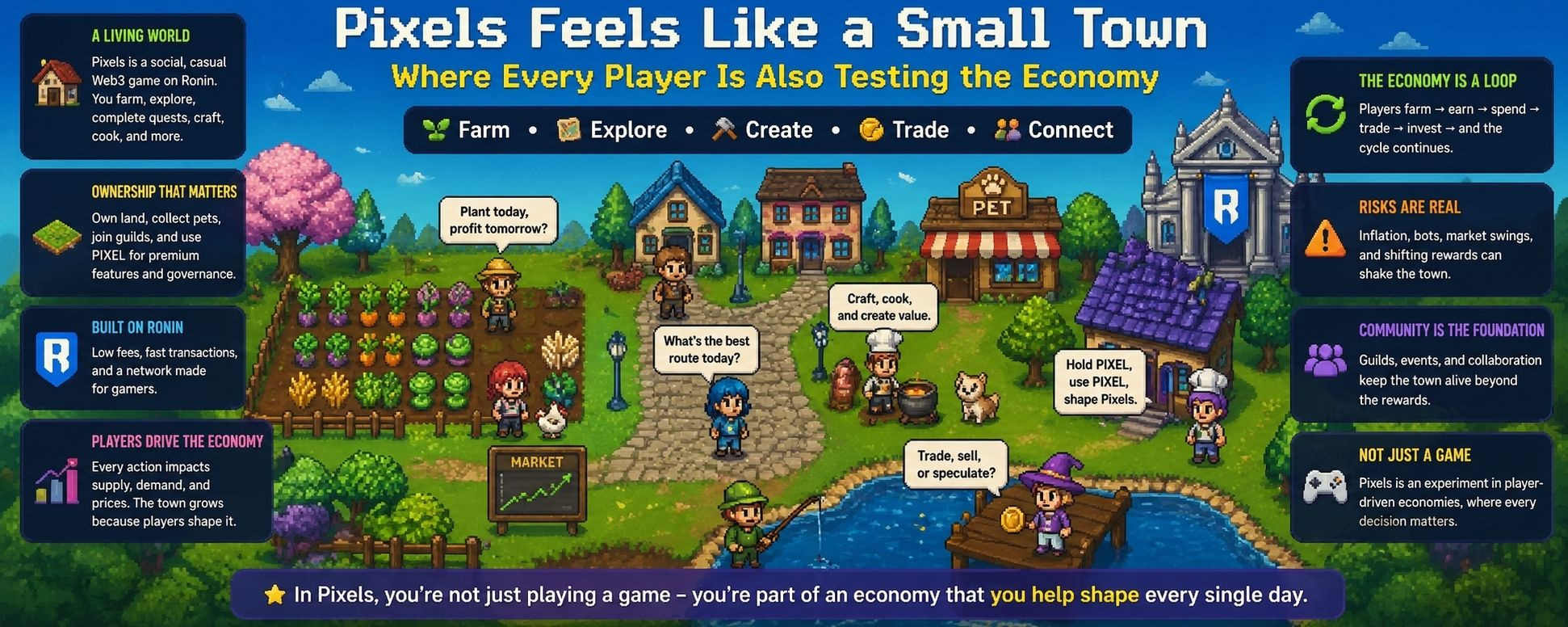
The game itself is simple on the surface. You farm, gather, craft, cook, complete tasks, manage energy, explore the world, use pets, interact with land, and move around a social space that feels more like a busy little town than a cold crypto product. It does not hit you in the face with complexity immediately. That matters. Crypto onboarding has been so bad for so long that a game simply letting you walk around before forcing you into a wallet headache already feels like progress.
Look, nobody wants to admit how much of Web3 still feels like bad plumbing.
Wrong network. Failed bridge. Gas spikes. Wallet pop-ups. Signature requests you barely understand. Tokens you need before you even know why you need them. Games that ask you to become a part-time infrastructure engineer before you can play for five minutes.
Pixels avoids some of that pain by being casual first.
That is the trick.
It lets the world feel familiar before the crypto layer starts showing. Farming makes sense. Energy makes sense. Quests make sense. Crafting makes sense. A pet following you around makes sense. You do not need a 40-post thread to understand why someone would harvest a crop or complete a task.
Under the hood, though, the crypto machinery is still there.
PIXEL is there. Land is there. Pets are there. Guilds are there. Marketplace behavior is there. Speculation is there. Ronin is there. The whole thing is sitting inside a chain culture that already lived through Axie, which means nobody is innocent. Not really.
That Ronin part matters.
Pixels did not move into some empty chain with no gaming memory. It moved into the neighborhood where play-to-earn had already exploded, made people money, hurt people, and left behind a lot of lessons nobody should forget. Ronin users know what can happen when a game economy gets too hot. They know how quickly “community” can become labor. They know what it feels like when rewards become the only reason people log in.
So Pixels came into a chain full of people who wanted to believe again, but not blindly.
That is a weird room to build in.
And honestly, probably the right one.
Pixels has always had to deal with the mess directly. The mess of fake users. The mess of airdrop farmers. The mess of people pretending to be long-term players until the claim window closes. The mess of bots finding every weak point in the economy. The mess of real players getting punished because the system has to defend itself against fake ones.
That is the trauma behind this project.
Not gas fees, exactly.
Not bridges, exactly.
The bigger trauma is fake activity.
Crypto is full of fake activity. Fake users. Fake volume. Fake communities. Fake loyalty. People show up when there is money on the floor and disappear when the floor gets swept. Any Web3 game with rewards has to face that immediately. Pixels is no exception.
The difference is that Pixels at least seems designed around the idea that users will try to break the economy.
Energy limits matter. Task systems matter. Progression matters. Separating softer in-game currency from the main on-chain token matters. Not every tomato needs to become a financial instrument. Not every action needs to hit the chain. Some things should stay boring. Some things should stay adjustable. Some things should just work quietly in the background.
That is not exciting.
It is necessary.
A lot of crypto people say they want everything on-chain until they actually have to live with the consequences. Every mistake becomes permanent. Every balance change becomes political. Every tiny gameplay loop turns into a market. Then players stop playing and start calculating.
Pixels is at its best when it resists that.
When the game feels like a game.
When PIXEL is useful but not suffocating. When land matters but does not make everyone else feel like peasants. When pets feel like part of your identity rather than just another item to flip. When guilds feel like groups of people, not little yield farms with profile pictures.
That balance is hard to build.
Really hard.
And Pixels does not always get it right. The token has had pressure. The economy has had to be adjusted. Some players came only for rewards. Some systems can feel grindy. New users can still get confused. Land ownership can create a gap between people who are early and people who are just arriving. Guilds can become social, but they can also become political and financial in that very crypto way where everyone says “community” while quietly checking who gets the upside.
The thing is, those problems are not side issues.
They are the project.
Pixels is basically trying to build a casual online world while a swarm of crypto users tests every incentive inside it. That is not a normal game design problem. A normal farming game asks, “Is this fun?” Pixels has to ask, “Is this fun, is it fair, can bots abuse it, will farmers dump it, will real players feel punished, will token holders complain, and can we change it without starting a small civil war?”
That is the job.
No wonder it gets messy.
The PIXEL token made everything louder. Tokens always do. Before a token, players can talk about gameplay with less baggage. After a token, every patch feels like a price event. Every reward change becomes emotional. Every roadmap update is read like a market signal. People stop asking only whether the game is improving and start asking whether their bags are being respected.
Look, that is crypto.
Nobody should pretend otherwise.
The challenge for Pixels is that PIXEL has to be more than a reward people farm and sell. It needs sinks. It needs utility. It needs a reason to sit inside the game without turning the whole experience into a checkout page. That is a narrow path. Too little utility and the token floats away from the product. Too much forced utility and players feel milked.
There is no clean answer.
Only constant tuning.
That is why the move toward deeper progression and more structured gameplay matters. If Pixels stays shallow, the farmers win. They optimize it, drain it, and leave. If it becomes too complicated, casual players bounce. The project has to live somewhere in the uncomfortable middle, where normal players can still enjoy the world and crypto-native users still have enough depth to care.
That middle is not flashy.
It is plumbing.
It is reward design. Bot resistance. Onboarding. Economy sinks. Land balance. Guild incentives. Marketplace health. Player retention when the token is down. Community trust after changes. Tiny decisions that most people only notice when they break.
Pixels is full of that under-the-hood work.
And that is probably why I find it more interesting now than I did during the loudest hype. Hype is easy. Binance listing energy is easy. Airdrop energy is easy. Everyone loves a game when they think the next click might pay. The harder part is what happens after the easy money leaves.
Does anyone still log in?
Does the world still feel alive?
Do people still care about their farms, pets, land, guilds, and routines?
That is the real test.
Pixels has not fully answered it yet. Maybe it takes years. Maybe the market keeps punishing the token while the game slowly improves. Maybe the team keeps adjusting until the right balance appears. Maybe some players never forgive certain economic changes. Maybe new users come in later without carrying all the old baggage.
I do not think Pixels is some perfect model for Web3 gaming.
I think it is one of the more honest experiments.
A soft-looking farming game sitting on top of all the hard problems crypto keeps creating for itself. Fake users. Reward abuse. Speculative pressure. Ownership gaps. Community politics. Token expectations. The constant fight between play and extraction.
And still, there is a little world there.
People farm. People gather. People argue. People optimize. People decorate. People join guilds. People complain about changes and come back anyway. That kind of messy activity feels more real than the polished promises most projects sell before they have anything working.
Pixels does not need to convince me that Web3 gaming is fixed.
It isn’t.
It just needs to keep proving that a crypto game can survive contact with actual crypto users and still feel like something worth opening when the chart is not doing anyone favors.
That is a lower bar than the industry likes to admit.
It is also a much harder one.