
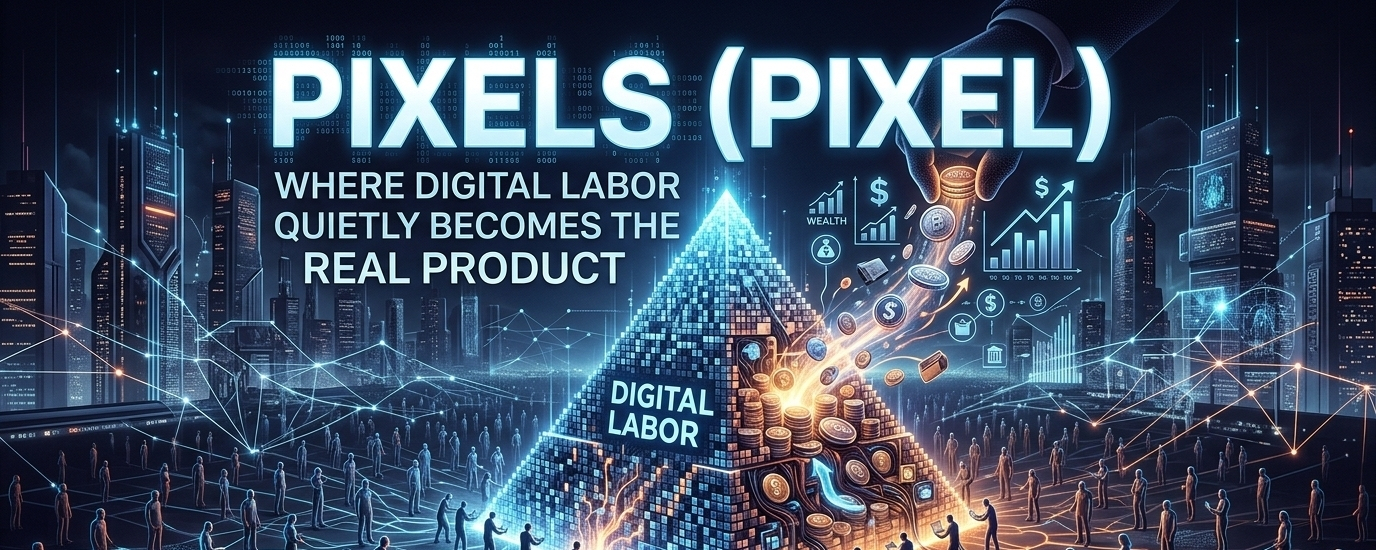
Pixels (PIXEL) doesn’t behave like a game when you look at it through a market lens. I don’t see crops, avatars, or casual exploration as the core loop. I see a live system where human time is being priced, optimized, and quietly financialized. The surface is soft and social, but underneath, it functions like a coordination engine converting attention into yield. What most players interpret as “progress” is actually participation in a structured labor economy, where the output is not just in-game assets but measurable on-chain value tied to a broader liquidity network.
The decision to build on Ronin Network is not just a scaling choice; it’s a behavioral design decision. Cheap transactions don’t just reduce friction, they reshape how often users are willing to act. When actions become nearly free, repetition becomes rational, and repetition is the foundation of labor. This creates a subtle but powerful shift: players stop thinking in terms of sessions and start thinking in terms of loops. The more loops they run, the more they resemble workers optimizing output rather than players seeking entertainment. You can track this shift in wallet activity patterns—shorter intervals between transactions, higher frequency of micro-interactions, and consistent engagement across time windows that look more like shift work than gameplay.
What’s overlooked is how PIXEL itself behaves less like a reward token and more like a settlement layer for distributed effort. When players earn, trade, or spend PIXEL, they are effectively pricing their own time in a shared marketplace. The token doesn’t just represent value; it standardizes it. That creates a feedback loop where user behavior starts aligning with token performance. When PIXEL trends upward, effort increases. When it stagnates, engagement becomes more selective and strategic. This is where GameFi stops being entertainment and starts resembling a labor market with dynamic wage expectations.
The farming mechanic is not trivial. It’s a controlled production system with inputs, outputs, and optimization strategies. Over time, players begin to identify inefficiencies—crop cycles, resource allocation, spatial positioning—and optimize them. This mirrors early DeFi yield farming, where users learned to maximize returns across protocols. The difference here is that the optimization is disguised as gameplay, which lowers the psychological barrier to entry. But the behavior it produces is identical: capital allocation decisions, risk assessment, and time management based on expected returns.
I notice something more subtle in how social coordination emerges inside Pixels. Guilds, land-sharing, and cooperative mechanics are not just community features; they are productivity multipliers. When players coordinate, they reduce individual inefficiencies and increase collective output. This creates proto-organizations that function like small economic units. If you map transaction flows between these groups, you start seeing clusters of activity that resemble micro-economies. These clusters are where real value concentration begins, not at the individual level but at the network level.
There’s also a hidden dependency on off-chain perception. Even though the assets and actions are on-chain, the motivation to participate is heavily influenced by external narratives—Twitter sentiment, influencer attention, and perceived growth trajectories. This creates a hybrid system where on-chain data tells you what is happening, but off-chain signals tell you why. The traders who understand this duality have an edge. They don’t just watch token charts; they watch engagement curves, wallet growth, and retention metrics alongside social momentum.
The risk structure here is more complex than most assume. Inflation is not just about token supply; it’s about time supply. As more players enter, the total available labor increases. If the system doesn’t create proportional demand for that labor, the value of individual effort declines. This is where many GameFi systems quietly break. They fail not because the token collapses immediately, but because the perceived return on time gradually erodes. You can detect this early by tracking average earnings per active wallet and comparing it to new user growth. If growth outpaces earning potential, dilution is already happening at the behavioral level.
From an infrastructure perspective, Ronin’s EVM compatibility matters more than its branding. It allows Pixels to plug into a broader ecosystem of liquidity, tooling, and analytics. This means the game is not isolated; it’s part of a larger financial network. Assets can move, value can be extracted, and strategies can be ported across systems. This interoperability is what turns a game economy into a financial layer. It’s also what introduces systemic risk, because shocks in one part of the ecosystem can propagate into others.
If I were analyzing this purely from charts, I wouldn’t stop at price. I’d look at active wallets, transaction frequency, retention cohorts, and token velocity. A rising price with declining activity is fragile. A stable price with increasing activity is accumulation. The real signal is when both move together—price and participation reinforcing each other. That’s when you know the system is not just attracting capital but sustaining behavior.
What I think most people miss is that Pixels is not trying to be the best game. It’s trying to be the most efficient converter of human time into on-chain value. That’s a very different objective, and it changes how you evaluate its success. You don’t measure it by fun alone; you measure it by how well it aligns incentives, how long it retains productive users, and how effectively it integrates into the broader crypto economy.
Looking forward, I expect systems like this to move toward more explicit financialization. We’ll likely see derivatives on in-game output, lending against productive assets, and more sophisticated reward structures tied to performance metrics. The line between player and trader will continue to blur, and the ones who adapt fastest will treat their in-game actions with the same discipline they apply to markets.
Pixels isn’t just a glimpse into GameFi. It’s a prototype for how digital economies might organize labor in a world where time, attention, and coordination are all tokenized. And once you see it that way, it stops looking like a game entirely.
