

I’ve been spending a lot more time lately watching where attention is flowing instead of just tracking where money is moving. It’s a weird shift, but it feels necessary. Liquidity is thinner than it used to be, narratives rotate faster, and honestly, people are getting tired of the same recycled token stories. So when something starts pulling real users instead of just traders, I pay attention.
That’s how I ended up going down the rabbit hole with Pixels.
At first glance, I almost ignored it. A farming game on blockchain? We’ve seen this before. Play-to-earn had its moment, burned bright, and then collapsed under its own weight. I still remember how quickly those ecosystems went from booming economies to ghost towns. So I went in skeptical. But the more I looked, the more I realized this wasn’t trying to repeat that cycle. It’s doing something quieter, and maybe more important.
What caught my attention wasn’t the visuals or the concept. It was the behavior. People were actually playing. Not just farming tokens, not just grinding for yield, but logging in daily, building, exploring, interacting. That’s a different signal.
And in the current market, where most Web3 apps still struggle with retention, that matters more than any token chart.
From what I’m seeing, the timing makes sense too. We’re in a phase where speculation hasn’t disappeared, but it’s no longer enough on its own. Users want something to do. Not just something to hold. The shift from “what can I flip” to “what can I use” is subtle, but it’s happening. Slowly.
Pixels sits right in that gap.
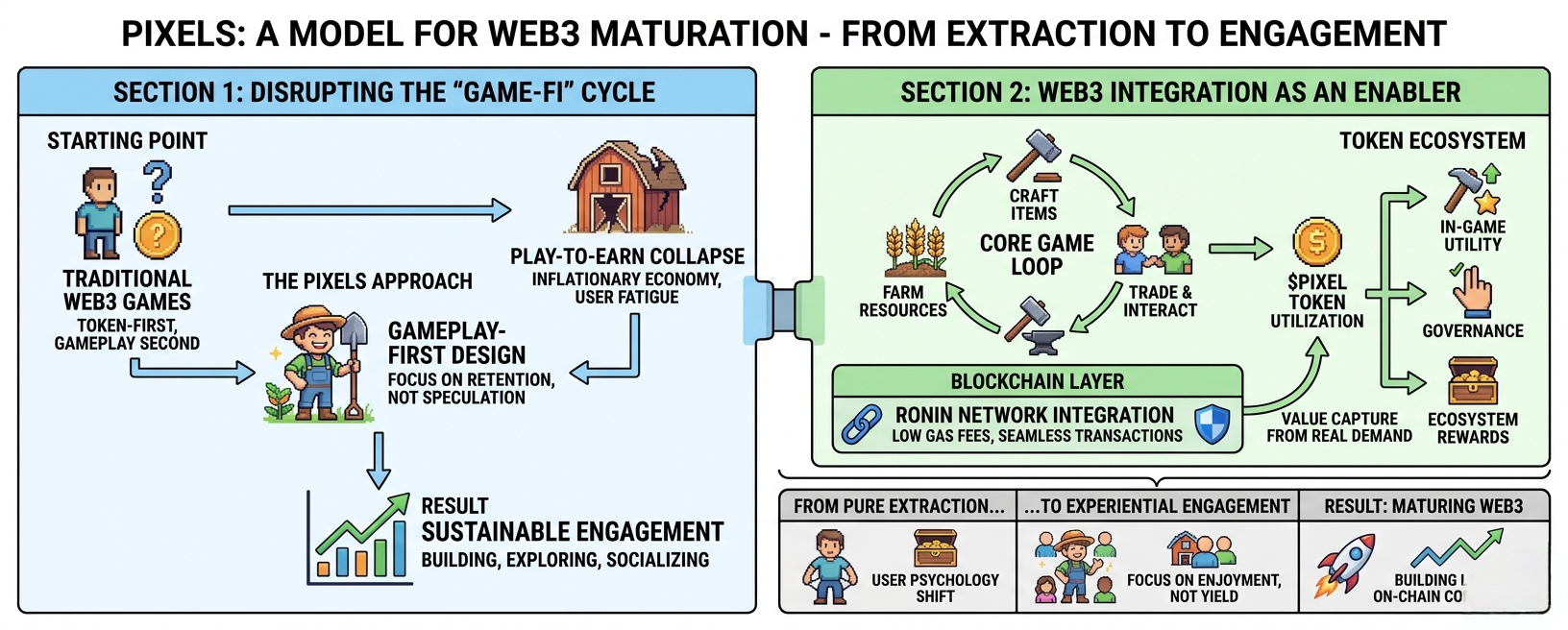
The core idea is simple enough. It’s an open-world game where you farm, gather resources, craft items, and interact with other players. On paper, that sounds almost too basic. But I think that’s part of the point. It doesn’t overwhelm you with complexity. It feels familiar. Almost like those old-school browser games or early sandbox titles where the goal wasn’t to win, but to exist and build over time.
And that’s where it starts to differ from the typical Web3 model.
Most blockchain games I’ve seen are designed backwards. They start with the token and then build gameplay around it. Pixels feels like it’s doing the opposite. The gameplay comes first, and the token fits into the experience instead of driving it entirely.
I didn’t expect that to matter as much as it does, but it changes everything.
Under the hood, it’s powered by the Ronin network, which already has a reputation for handling gaming-focused ecosystems. That part gives it a bit of an edge because it avoids the friction you usually get with gas fees or slow transactions. Players can actually interact with the game without constantly thinking about the blockchain layer, which is how it should be if this space wants to grow beyond crypto-native users.
The token itself, PIXEL, isn’t positioned as the sole reason to play. It acts more like a layer within the economy. You use it for in-game actions, upgrades, and certain interactions, but the experience doesn’t collapse if you remove the financial angle. That’s important. It creates a kind of balance that earlier projects never managed to find.
I’ve noticed that the in-game economy feels more grounded too. Instead of infinite emission and constant sell pressure, there’s an attempt to create loops where resources, time, and player effort actually matter. It’s not perfect, and I don’t think any Web3 economy is yet, but it’s at least trying to avoid the obvious mistakes.
One thing I found interesting is how social the game is becoming. It’s not just about farming your own land. There’s interaction, collaboration, even a bit of competition, but not in an aggressive way. It feels more like a shared world than a battleground. That might sound small, but it’s a big shift from the usual “optimize everything for profit” mindset.
And maybe that’s the underrated part here.
I think Pixels is quietly testing whether Web3 users are ready to move beyond pure extraction models. Whether people are willing to engage in ecosystems where the reward isn’t just financial, but experiential. That’s a harder sell in crypto, but it might be necessary if this space wants to mature.
Of course, it’s not operating in a vacuum. There are other projects trying to build in the same direction. Some are focusing on higher-end graphics, others on deeper mechanics or metaverse-style worlds. But Pixels seems to be leaning into accessibility instead. It runs easily, it’s simple to understand, and it doesn’t demand a huge upfront investment of time or money.
That’s probably why it’s gaining traction.
I’ve seen a steady increase in user activity, and more importantly, repeat users. Not just one-time spikes driven by incentives, but actual retention. That’s rare. And it suggests that the game loop itself is working, at least for now.
Still, I can’t ignore the risks.
The biggest one, in my opinion, is sustainability. Even with a better-designed economy, there’s always pressure when a token is involved. If too many players focus on extracting value instead of contributing to the ecosystem, the balance can break. We’ve seen that happen before, and it doesn’t take much to trigger it.
There’s also the question of long-term engagement. Farming and crafting are great entry points, but will they be enough to keep users interested over months or years? That depends on how the team expands the world. New features, deeper mechanics, evolving gameplay. Without that, even the most promising projects can plateau.
Then there’s competition. The gaming space in Web3 is getting crowded again. Not in the same chaotic way as before, but there’s definitely a new wave building. Better funding, better design, more experience. Pixels has a head start in terms of traction, but that lead can disappear quickly if others execute better.
I also think there’s an underlying question about identity here.
Is Pixels a game that happens to use blockchain, or is it a blockchain project that happens to be a game?
Right now, it feels closer to the first one, which is a good thing. But maintaining that balance isn’t easy, especially as the ecosystem grows and more financial layers get introduced.
One thing I didn’t expect, though, is how this project made me rethink user behavior in Web3.
For a long time, I assumed that most people in this space were here primarily for financial gain. And to be fair, that’s still a big part of it. But Pixels shows that if you create something engaging enough, people will stay even when the financial incentives aren’t the main driver.
That’s a subtle but powerful shift.
It suggests that the next phase of Web3 might not be about bigger yields or more complex tokenomics, but about better experiences. Ones that people actually enjoy spending time in.
And if that’s true, then projects like Pixels aren’t just games. They’re experiments in user psychology.
I keep thinking about how this would look if the token disappeared tomorrow. Would people still log in? Would they still build, explore, interact?
If the answer is yes, then that’s where real value is being created.
Right now, I think Pixels is somewhere in between. It still relies on its token layer, but it’s slowly building something that might stand on its own. That’s not easy, and it’s definitely not guaranteed.
But it’s enough to make me pay attention.
Because in a market where most projects are trying to capture value, this one seems to be trying to create it first and figure out the rest later.
And honestly, that feels like a better place to start.
I’m still watching closely. Not because I expect it to suddenly dominate the space, but because it’s asking a question that a lot of projects avoid.
What happens when people actually enjoy being on-chain?
If Pixels can answer that in a meaningful way, then it’s not just another Web3 game. It’s a glimpse of where this whole space might be heading.
Or maybe it’s just another experiment that looks promising until it doesn’t.
I guess that’s the part I’m still trying to figure out.
