
When I came back to Pixels after being inactive, I expected the usual break in the loop. That’s how most games behave. If you step away, your progression disconnects, your habits fade, and when you return, you’re essentially rebuilding from zero. But this time it didn’t feel like that. The system didn’t restart me. It adjusted around me. That difference is small on the surface, but structurally it’s not something manual LiveOps can do.
That’s where the shift actually sits. Pixels didn’t just improve events or rewards. It changed where decisions are made.
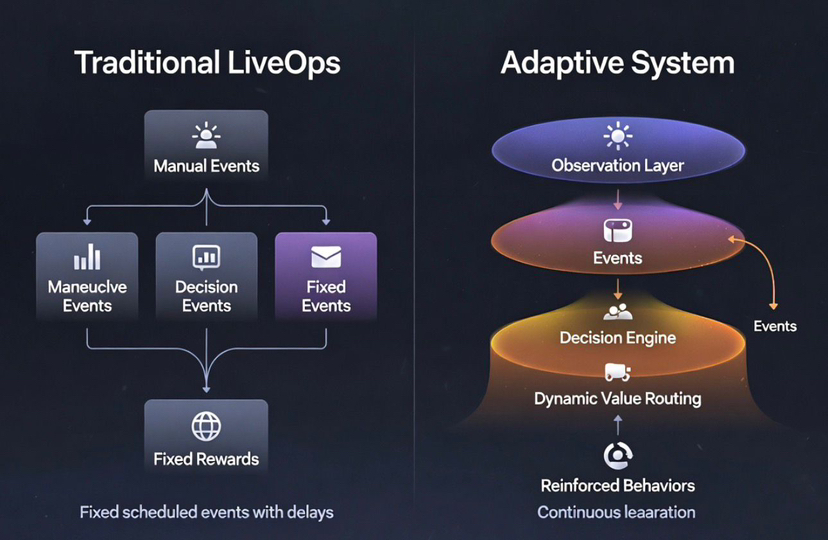
In most games, LiveOps is designed before players interact with it. Someone defines an event, assigns rewards, launches it, and then waits to see what happens. Adjustments come later. That delay is the limitation. You are always reacting to player behavior after it has already happened.
Pixels removes that delay by inserting a decision layer between player action and reward distribution. That layer is the core architecture. Every action a player takes is not treated as a simple trigger. It is treated as input into a system that evaluates where value should go next.
This is why the system behaves differently from traditional quest or reward structures. Two players can perform similar actions and receive different outcomes, not because of inconsistency but because the system is not rewarding the action itself. It is allocating value based on expected impact. That expected impact is learned from prior behavior patterns, not manually defined rules.

The Events system is where this starts, but it is not just a task layer. It is a structured observation layer. Each event is a controlled environment where player behavior is recorded under specific conditions. What matters is not the completion of the task, but how that completion fits into a larger pattern of behavior across time. Frequency, timing, consistency, and sequence all become inputs.
Once behavior is structured this way, rewards stop being fixed outputs. They become variables that the system can route. That routing is the real mechanism. Instead of distributing tokens evenly or based on static rules, the system directs rewards toward segments of behavior that produce the most meaningful change in the loop.
This is where the transition from manual to automated actually happens. It is not about automation for efficiency. It is about automation for allocation. A human operator can design reward structures, but cannot continuously decide how to distribute rewards across thousands of players in real time while accounting for changing behavior patterns. Pixels shifts that responsibility into the system itself.
This is also why the concept of reward in Pixels behaves differently from traditional game economies. The token is not simply being spent or earned. It is being routed through a decision process. Each distribution is effectively a signal about what behavior the system is reinforcing. Over time, this creates directional pressure on how players act, not through explicit rules but through adaptive reward placement.
The Events API plays a critical role here, but not as a storage layer. It functions as system memory. The distinction matters because the system is not just storing actions; it is using past patterns to influence future allocations. This creates continuity in decision making. The system doesn’t reset with each event. It evolves as more behavior is observed.
That accumulated behavior data is also what makes the system difficult to replicate. Another project can copy the surface layer quests, rewards, UI but without the same depth of behavioral history, their reward distribution remains static or inefficient. Pixels’ advantage comes from how long the system has been observing and adapting to player behavior.
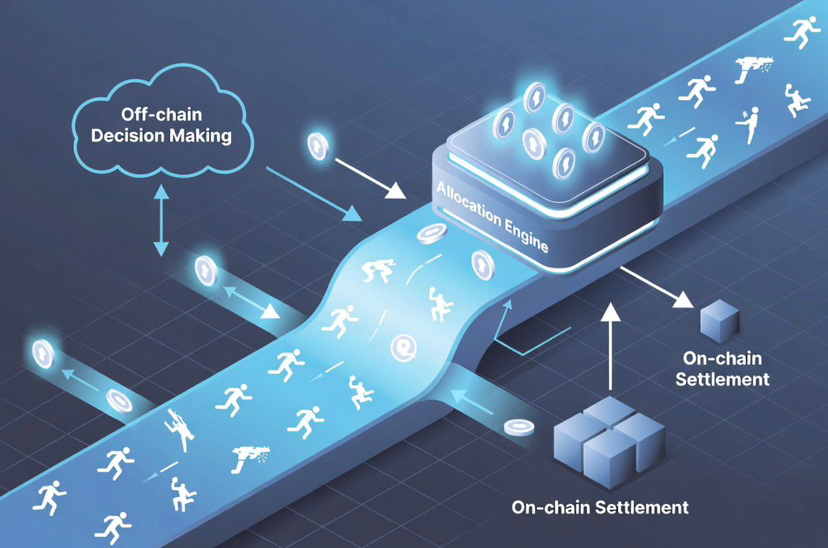
There is also a structural separation that keeps this system functional. Decision-making happens off-chain, while execution settles on-chain. This is not just a technical choice. It allows the system to remain flexible in how it evaluates behavior while maintaining verifiable outcomes for token distribution. If all logic were on-chain, adaptation would be too slow and rigid. If everything were off-chain, trust in the economy would weaken. Pixels balances both.
This architecture also explains why the system does not collapse into simple reward farming. Automated reward systems usually create exploitable loops because they distribute value based on easily repeatable actions. Pixels mitigates this by evaluating patterns instead of isolated actions. Repetition without meaningful variation does not produce the same outcome as sustained or evolving behavior. This reduces the effectiveness of shallow farming strategies.
Stacked sits on top of this system as an interface, but it is not the core innovation. It exposes the decision layer rather than replacing it. For studios, this means they are not required to design detailed reward logic themselves. They define constraints such as budgets and desired outcomes, and the system handles allocation within those boundaries.
What emerges from this is not just a better LiveOps model. It is a shift in how game economies are controlled. Instead of managing player behavior directly through predefined rewards, the system shapes behavior indirectly by adjusting where value flows. This creates a feedback loop that continuously refines itself as more data is collected.
The important part is that this system is still in motion. It is not a finished design. Misallocations happen, and some reward distributions are less efficient than others. But that is expected because the system improves through iteration, not through static optimization. Each allocation feeds back into future decisions, gradually refining how value is routed.
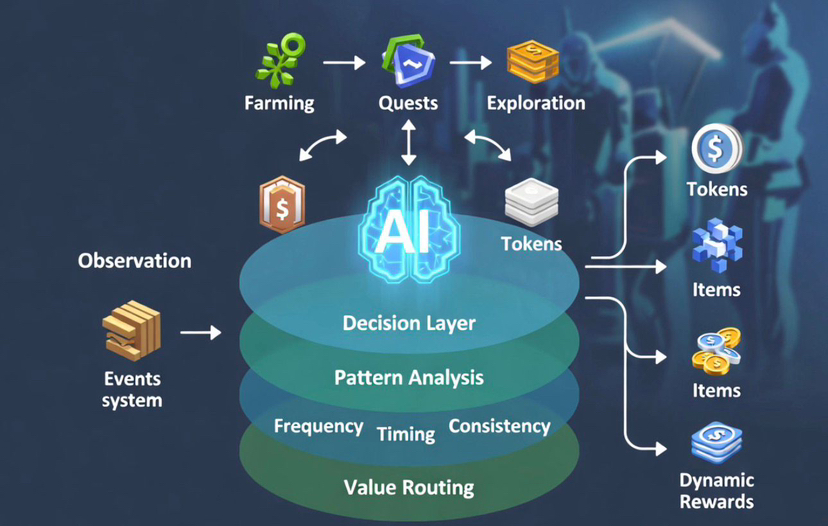
What Pixels has built is not a quest system or a reward engine in the traditional sense. It is a continuous allocation layer that operates between player behavior and economic output. That layer is what transforms LiveOps from a manual scheduling process into an adaptive system that runs in real time.
That is the real shift. Not more events. Not bigger rewards.
A different place where decisions are made.
