
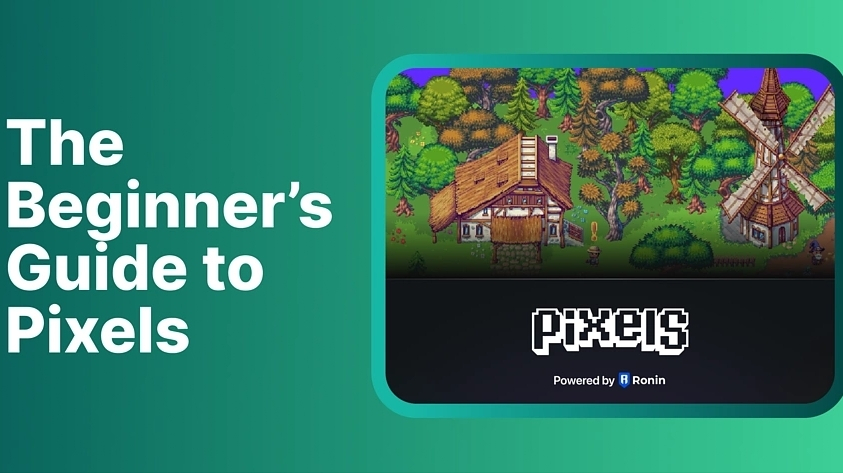
Pixels (PIXEL) doesn’t introduce itself with noise. There’s no overwhelming tutorial wall or complicated setup pushing you to “learn fast.” Instead, it gently places you into a world that feels familiar, almost like stepping into a small digital town that already has its own rhythm — and you’re free to join it at your own pace.
It’s a Web3 game built on the Ronin Network, but that detail stays in the background. What you notice first isn’t blockchain mechanics — it’s land, movement, and space to simply exist inside a growing world.
A world that doesn’t rush you
Most games today push urgency. Pixels does the opposite.
You’re not racing. You’re not constantly under pressure to optimize every move. You start small, usually with basic land and simple tools, and everything grows gradually from there.
That slow build is intentional. It gives weight to progress. When something improves, you actually feel it — not because the game told you it matters, but because you’ve seen it evolve over time.
Farming that feels more like rhythm than repetition
At the center of Pixels is farming, but not the kind that feels mechanical or repetitive.
You plant crops, leave, return later, and find change waiting for you. It creates a subtle rhythm — almost like checking something you’ve been quietly taking care of in the background.
Over time, your land becomes less about function and more about identity. Some players optimize it. Some design it. Some just enjoy the steady loop of growth. There’s no single direction forcing you into a playstyle.
Exploration that feels unstructured in a good way
Instead of pushing you down a fixed path, Pixels lets you drift.
You explore because you’re curious, not because a quest marker tells you to. You might come across new areas, other players, or systems you didn’t expect to find so early.
It’s not heavily scripted. And that’s what makes discovery feel more personal — like the world isn’t handing you answers, but letting you figure things out as you move through it.
Creation that quietly becomes ownership
One of the most interesting layers in Pixels is how creation naturally turns into expression.
You’re not just building for utility. You’re shaping a space that starts to feel like yours. Over time, the way you arrange things, expand, or design areas reflects how you approach the game itself.
It’s subtle, but powerful. Your land slowly becomes a record of your decisions — not in a competitive sense, but in a personal one.
A social world that doesn’t force interaction
Pixels doesn’t push you into constant social pressure.
You’ll see other players, trade occasionally, or pass by while exploring, but interaction happens naturally instead of being forced into structured systems.
That creates a softer kind of online presence. You’re not always “performing” socially — you’re just sharing space with others who are also building at their own pace.
The blockchain layer you don’t have to think about
Yes, Pixels is part of Web3. It runs on the Ronin Network, which handles ownership and digital economy mechanics behind the scenes.
But the important part is that you don’t need to constantly think about it.
The system is there, quietly supporting the game, while your attention stays on actual gameplay — farming, exploring, building. That separation keeps the experience grounded instead of turning it into something technical or overwhelming.
Why it feels different from most Web3 games
A lot of blockchain games lean too hard into either finance or complexity. Pixels avoids both extremes.
It doesn’t try to be a trading simulation dressed as a game. And it doesn’t reduce itself to shallow gameplay with tokens attached.
Instead, it builds something slower and more human: a world that rewards consistency over intensity.
A pace that actually stays with you
What makes Pixels interesting isn’t a single feature — it’s how everything blends together.
Farming feeds progression. Exploration feeds curiosity. Creation builds identity. Social interaction sits quietly in the middle of it all.
Nothing feels isolated. Everything connects naturally without forcing attention.
That’s why players don’t just “complete” Pixels and leave. They return. Not because they have to — but because the world keeps moving even when they’re gone.
Closing reflection
Pixels doesn’t try to overwhelm you with scale or complexity. It works in the opposite direction — small actions, steady growth, and a world that slowly becomes familiar the more time you spend in it.
And maybe that’s its real strength. It doesn’t demand attention. It earns it quietly, one crop, one discovery, and one small change at a time.
