
In May 2024, Pixels hit 1 million daily active users. Then Chapter 2 launched in June, changed the reward mechanics, and within eight days 74% of those users were gone. I spent a while trying to understand what went wrong. The longer I looked, the more I realized the question itself was wrong. Nothing went wrong. The number that collapsed was never measuring what I thought it was.
When $PIXEL listed on Binance and the price was climbing, a player arriving at Pixels for the first time encountered one signal: this game pays. The rational response to that signal is to optimize for payment. Farm for yield. Treat guilds as earning infrastructure. Filter every decision through ROI. A different player arriving during a quieter period received a different signal: this is a genuinely good farming game. Their response was to engage with the content, spend into the experience, build social ties. Same game. Different entry signal. Completely different behavior.
Most analyses stop here, having identified two player types. The more interesting structure is what happens next.
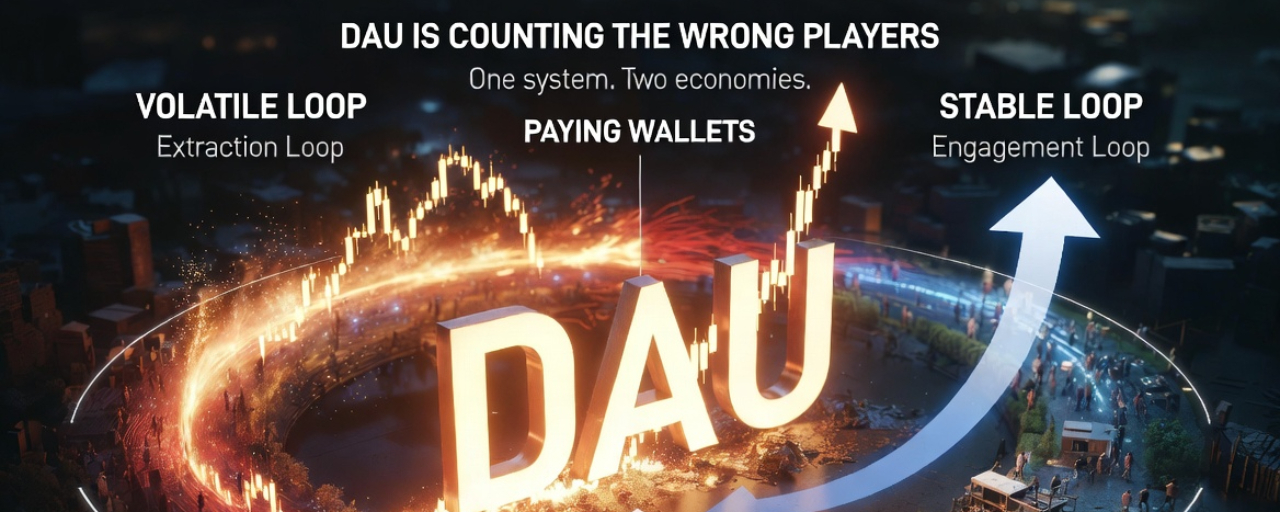
When $PIXELS's price rises, extraction inflow increases and DAU (Daily Active Users) spikes. That spike gets read as evidence of ecosystem health. Healthy narrative amplifies price. Amplified price produces more extraction inflow. The loop accelerates. But extraction-oriented players aren't building spending habits or social dependencies, so when the earning mechanics change, the rational calculation reverses and they exit. DAU collapses not because the game deteriorated, but because the loop generating that population stopped running.
The engagement loop was running in parallel the entire time, quieter and invisible in the aggregate number. Content creates depth, depth creates spending habits, spending habits create retention. This loop doesn't spike during price runs, but it doesn't reverse when earning mechanics change either. Paying wallets kept climbing through the same June collapse that erased 74% of DAU. Two numbers moving in opposite directions from the same system in the same month.
That divergence isn't a coincidence. It's structural. In a system running two parallel loops, the volatile loop dominates the headline metric during its active phase and the stable loop shows up in the spending data throughout. Aggregate both into a single DAU number and you get a figure that systematically overstates scale during price runs and understates economic health during corrections. The metric isn't broken. It's accurately counting the wrong thing.
The split also doesn't stabilize. It regenerates. Every price event produces a new wave of extraction-oriented arrivals. Every content update deepens the engagement loop for players already inside it. The system continuously sorts incoming players by what signal was loudest when they walked in, with no memory of previous cycles. Pixels is always running two economies simultaneously, regardless of what chapter the game is on.
The Farmer Fee, the $vPIXEL spend-only token, the RORS framework: none of these stop the volatile loop from running when price moves. What they do is buy time. A player who arrived for the token but stays long enough to build a crafting dependency, join an active guild, or develop a daily routine inside the game has changed their own exit calculation. They're now harder to lose when the price signal reverses. And their presence, their spending, their social ties, makes the game slightly more worth staying in for the next person who arrives.
That conversion rate is the actual health metric of this system. Not DAU. The ratio of players whose reason to stay is something the price chart cannot take from them.
The 74% drop was the volatile loop reversing. The paying wallets climbing through the same period was the stable loop becoming visible once the volatile loop stopped drowning it out. The most important thing happening in Pixels isn't in the headline number. It's in what happens to each new price-driven inflow before the exit signal appears.
That's the question the DAU chart was never built to answer.