
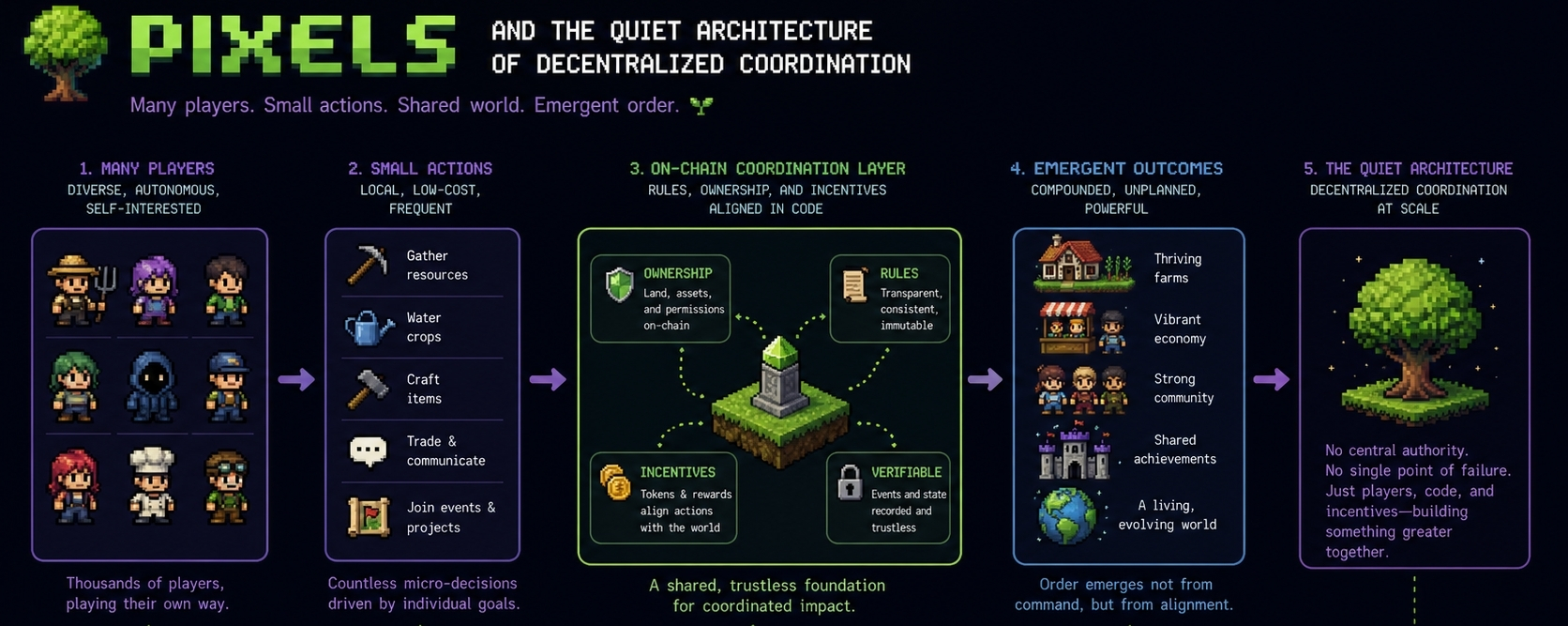
I’ve been spending time observing Pixels, not really as a player trying to optimize outcomes, but more like someone watching a small ecosystem develop its own internal logic. At first, it looks ordinaryplant crops, collect resources, move around a colorful world—but the longer I sit with it, the more it starts to feel like something else entirely. It feels like a space where coordination is being quietly tested in a new form.
What keeps pulling me back is not the surface activity, but the structure underneath it. In most games, everything you do exists inside a sealed environment. Your effort is meaningful only because the developer says it is. In Pixels, that assumption begins to loosen. The world is still designed, of course, but parts of its reality are anchored outside the game itself. Ownership, progress, and exchange aren’t just internal recordsthey’re tied to a system that exists beyond any single authority.
This changes the emotional weight of simple actions. Planting something is no longer just part of a gameplay loop; it becomes a small contribution to a shared state that persists independently of the game’s interface. I find that subtle shift fascinating. It turns routine activity into something that feels slightly more permanent, slightly more connected to others, even if those connections aren’t immediately visible.
As I keep looking closer, I start noticing that Pixels isn’t really about farming at all. It’s about organizing people—quietly, almost invisibly—into patterns of cooperation. Players fall into roles without being forced into them. Some gather, some refine, some trade, some explore. These roles don’t feel assigned; they emerge. And what’s interesting is that the system doesn’t need to fully control this process. It just provides enough structure for behavior to stabilize on its own.
That’s where it begins to resemble something closer to an economy than a game. Not in a loud, speculative sense, but in a quieter, more structural way. Actions become interdependent. My output becomes someone else’s input. Over time, a web of reliance forms, and the game starts to feel less like an isolated experience and more like a shared environment where people are indirectly working with each other.
What I find particularly interesting is how trust is handled. It’s not removed—it’s repositioned. Instead of trusting a central system to remember everything correctly, players rely on a broader network that guarantees certain truths. This doesn’t eliminate uncertainty, but it shifts where confidence comes from. The system itself becomes something you can lean on, not because it’s controlled, but because it’s verifiable.
There’s also a kind of memory forming within the system. Actions don’t just happen and disappear; they accumulate. Over time, this creates a history—not just of individual progress, but of collective activity. It’s subtle, but it changes how participation feels. You’re not just passing through; you’re leaving traces that persist and can influence what comes next.
I keep thinking about how this might evolve if the participants weren’t only human. The structure already supports coordination between independent actors. There’s nothing stopping those actors from being automated systems or AI agents in the future. If that happens, the same mechanics used for farming and trading could become tools for machines to negotiate tasks, distribute work, or collaborate without direct oversight.
That possibility makes Pixels feel less like a finished product and more like an early experiment. The game layer gives people a reason to engage, but underneath it, there’s a framework for organizing behavior in a decentralized way. It’s simple right now, almost deceptively so, but simplicity can be a starting point for more complex forms of interaction.
Another thing I can’t ignore is how it reshapes the idea of effort in digital spaces. Usually, what you do in a game disappears into the system that hosts it. Here, effort feels like it lingers. It becomes part of something shared, something that others can build on or respond to. That doesn’t just affect how people play—it affects how they think about their time and their role within the environment.
The longer I watch Pixels, the less I see it as a game in the traditional sense. It starts to feel more like a small model of how distributed systems might coordinate human (and eventually non-human) activity. It doesn’t present itself as something revolutionary. It doesn’t need to. Its significance shows up gradually, in the way small interactions begin to connect and form patterns.
And maybe that’s what makes it worth paying attention to. Not because of what it claims to be, but because of what it quietly demonstrates. It shows that even the simplest digital actions can become part of a larger system of cooperation when they’re given persistence, transparency, and shared ownership. Over time, that combination starts to look less like a featureand more like the foundation of something bigger.