
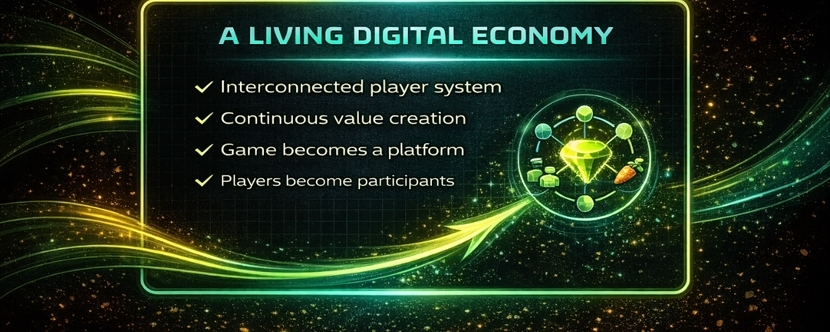

Pixels is starting to look less like a traditional Web3 game and more like an evolving system—one that reacts, adapts, and subtly responds to player behavior rather than just executing fixed mechanics. That shift sounds small on the surface, but in practice it changes how players experience the entire world.
Most games, especially in Web3, are built on predictable loops. You farm, you earn, you upgrade, you repeat. The system is transparent in a mechanical way: if you do X, you get Y. Even when there are economies involved, they tend to behave like static rulebooks. The game doesn’t “think”; it just processes inputs. Players eventually learn the patterns, optimize them, and the experience becomes about efficiency rather than discovery.
Pixels, however, is beginning to feel different because the system seems to respond in ways that are not fully linear. Instead of just rewarding actions, it appears to interpret behavior patterns over time. That means the value of an action is not only in what it produces immediately, but in how it fits into a broader behavioral context.
When a game starts operating like this, players stop being just participants in a loop and start becoming inputs into a dynamic system. That is a major psychological shift. You’re no longer asking, “What gives me the best reward right now?” You begin asking, “How is the system reacting to what everyone is doing?”
In traditional farming-style games, inflation and reward distribution are usually predictable. If too many players farm a resource, its value drops. If fewer players engage, scarcity increases value. But the system remains passive—it does not actively interpret behavior beyond supply and demand curves.
A behavior-driven system, on the other hand, can potentially adjust in more nuanced ways. It might not only respond to volume but also to patterns like timing, concentration, coordination, and even player psychology. If thousands of players rush the same strategy, the system can subtly shift incentives elsewhere. If activity becomes too uniform, it can reward deviation. If engagement slows, it can stimulate movement in targeted areas.
This is where Pixels starts to feel less like a game and more like a living environment.
The most interesting part of this shift is not the mechanics themselves, but the illusion of awareness they create. Even if the system is not truly “thinking,” it can still produce outcomes that feel reactive. Players begin to perceive patterns that suggest the game is observing them. That perception alone changes behavior.
Once players believe the system adapts to them, they stop playing optimally in a static sense and start playing strategically against the environment. Every action becomes a signal. Every decision potentially shapes future outcomes.
This introduces a new layer of gameplay that is not about resources or progression, but about influence.
In that kind of environment, meta no longer stays stable. In traditional games, a meta forms when one strategy becomes the most efficient and dominates until it is patched or countered. But in a responsive system, the meta is always under pressure because success itself changes the system’s reaction.
If too many players adopt the same strategy, the system can indirectly weaken it by redistributing incentives. If a strategy becomes too dominant, it loses efficiency not through nerfs, but through adaptation.
That creates a constantly shifting equilibrium where no single approach remains optimal for long.
For players, this can feel chaotic at first. Humans naturally look for stable patterns to master. We like certainty. We like knowing that effort A leads to result B. But a behavior-responsive system removes that certainty and replaces it with probability and adaptation.
Over time, though, this can also become more engaging. Instead of memorizing systems, players start reading them. Instead of optimizing fixed paths, they start interpreting signals. The game becomes less about execution and more about observation.
In this sense, Pixels begins to resemble something closer to an ecosystem than a traditional game. Ecosystems don’t reward individual actions in isolation; they respond to collective behavior. If one species overpopulates, the environment adjusts. If resources become scarce, behavior changes. Everything is interlinked.
If Pixels is moving in this direction, then player activity itself becomes part of the system’s balance mechanism. That means the most important variable is no longer individual efficiency but collective behavior patterns.
And that’s where things get even more interesting.
Because once players realize they are part of a feedback loop, they start trying to game the feedback itself. Instead of just optimizing within the system, they begin trying to influence how the system responds. Groups form. Trends emerge. Counter-strategies develop not just against the game, but against other players’ influence on the game.
At that point, the game stops being just a place where value is extracted and becomes a space where behavior itself has value.
There is also a subtle psychological effect here. In static systems, burnout comes from repetition. In adaptive systems, burnout comes from uncertainty. Players may feel like they are always slightly behind an invisible adjustment curve. But at the same time, this uncertainty is what creates engagement, because it keeps the environment from becoming fully solved.
A solved game loses tension. An unsolved, shifting system maintains it.
The real question for Pixels is not whether this approach is more complex or more innovative, but whether it can remain readable to players. Systems that feel too opaque risk losing trust. If players cannot understand why outcomes happen, they may disengage. The balance between transparency and adaptability becomes critical.
If done well, though, Pixels could represent a shift in how Web3 games evolve—from static economies to responsive systems that simulate living markets and adaptive environments. That would place player behavior at the center of design, not just as input, but as a shaping force.
In that scenario, winning is no longer just about having better strategies. It becomes about understanding the rhythm of the system itself—how it reacts, how it shifts, and how collective behavior reshapes the rules over time.
And that is why Pixels, at least in its current perception, feels like more than a game. It feels like a system learning from its players while simultaneously training them to learn it back.
