
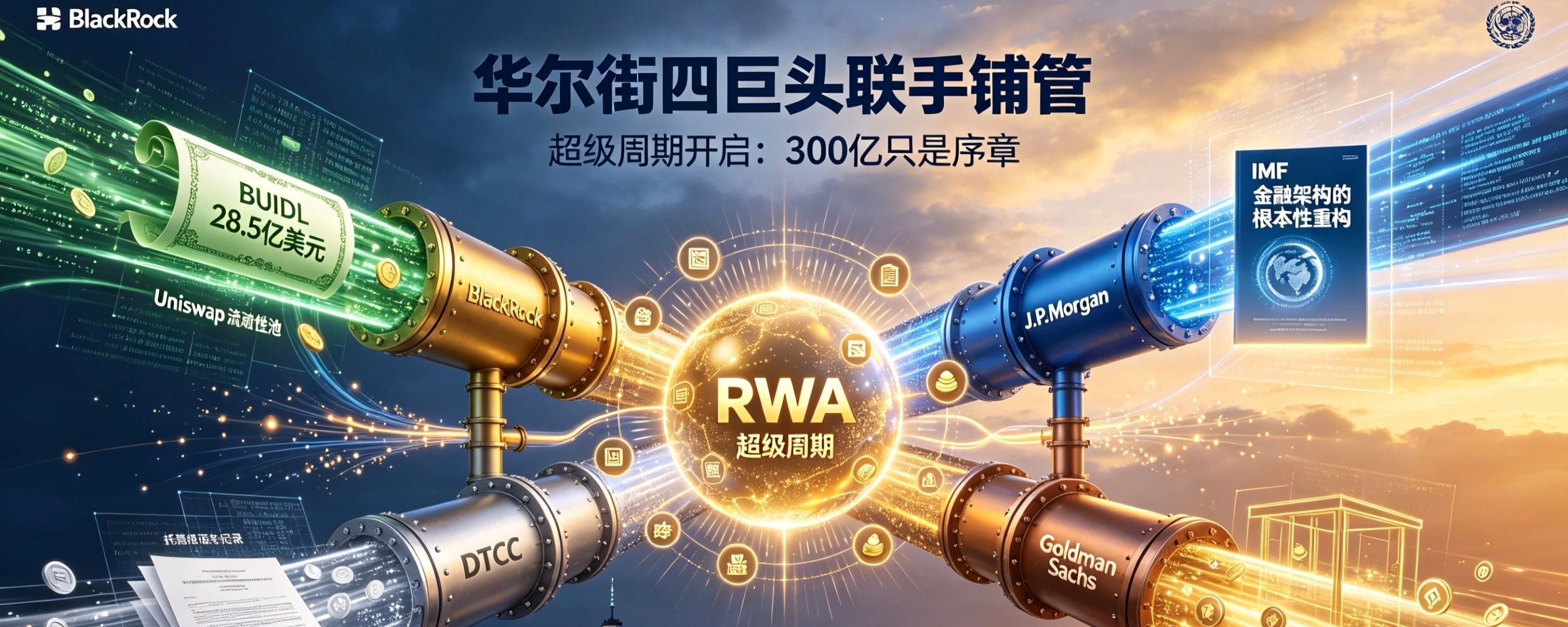

On April 22, analyst Tim Warren called out four institutions—BlackRock, JPMorgan, DTCC, and Goldman Sachs. He mentioned that these four Wall Street giants are actively building infrastructure for on-chain treasuries, real estate, and bonds. The term he used was 'supercycle'.
This isn't just talk, nor is it a vision. These four institutions aren't just doing research, checking reports, or waiting for the next big trend. They've already taken action. BlackRock has ramped up its BUIDL fund to about $2.85 billion, launching on Uniswap to open up liquidity for institutional-grade RWA assets in a permissionless manner. JPMorgan is expanding its blockchain-based infrastructure usage. DTCC received a no-action letter from the SEC, starting to step into the space for tokenized asset custody and settlement. If it were just talk, it would be a regular industry commentary. But with all four pushing forward on the 'pipeline laying' level simultaneously, the gravity of this situation is entirely different. Breaking it down, what are the four giants laying down? 🔍 Tim Warren's report didn't detail what each is doing, but piecing together public information, the layout paths of these four giants are already very clear. BlackRock is paving the way on the asset management side 💼. The size of the BUIDL fund already speaks volumes—it's grown 65% this year.
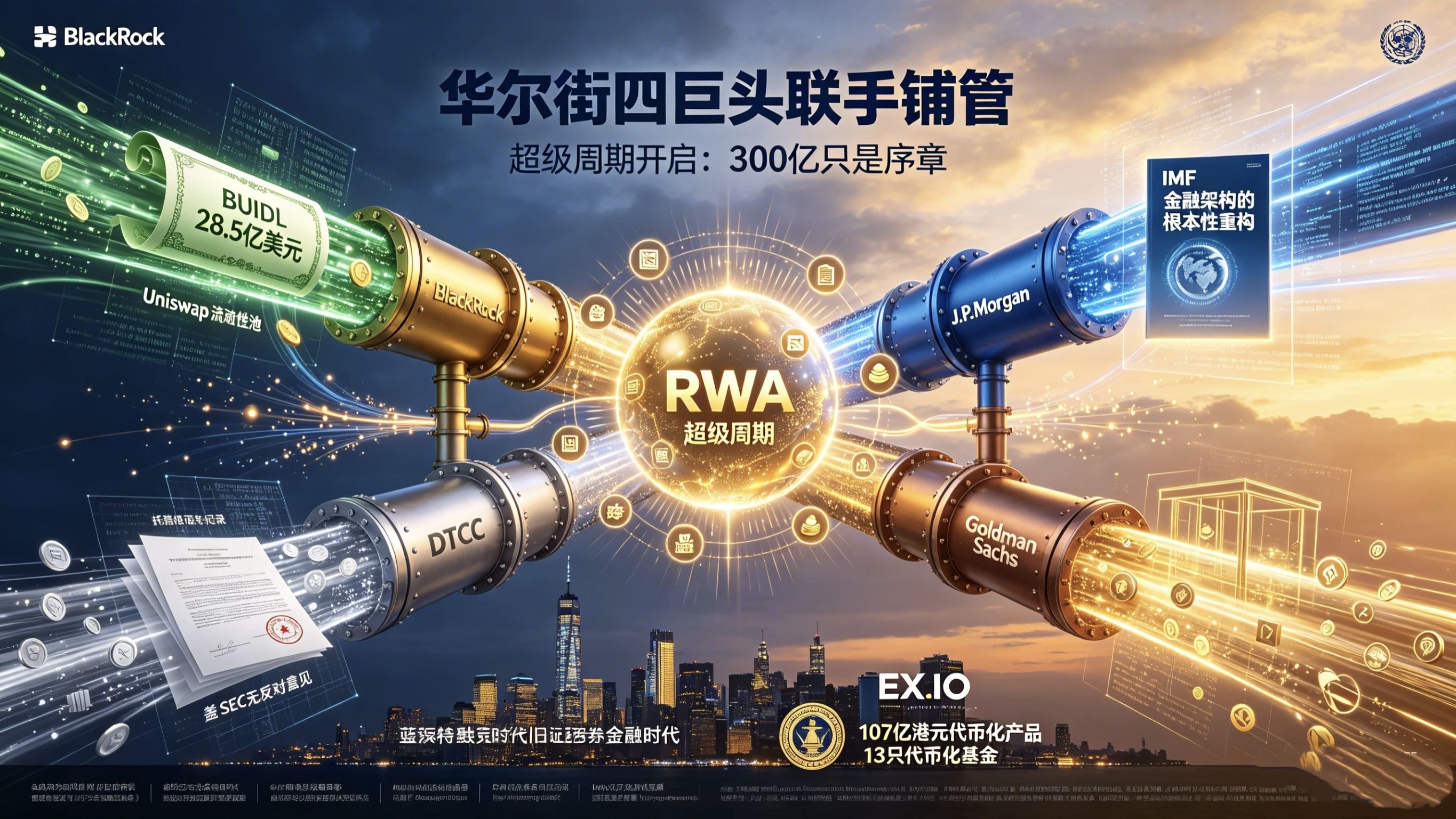


Launching Uniswap is a landmark move: institutional-grade RWA assets are opening up liquidity to the entire DeFi ecosystem for the first time in a permissionless way. This means that the underlying assets of traditional finance are no longer just sitting in institutional accounts; they can now flow freely on-chain, be collateralized, and borrowed against. JPMorgan is paving the way on the trading side 📈. It's expanding its blockchain-based infrastructure, focusing on making these on-chain assets efficiently traded, settled, and circulated.
A complete tokenized pipeline, if it only has the issuance side and no trading side, is just a display rack, not a functioning pipeline. DTCC is laying the groundwork at the infrastructure level 🏗️. Its full name is the 'Depository Trust & Clearing Corporation'—a giant in the financial back office. A significant portion of stock trade settlements, clearings, and settlements in the US is done through DTCC's systems. Its receipt of 'no objection' from the SEC means that the custody and clearing of tokenized assets have been streamlined at the institutional level.
Goldman's strategy leans more towards 'empowering' ⚡—it's providing financing and capital tools for this ecosystem. While BlackRock has built the issuance side, JPMorgan has set up the trading side, and DTCC has established the custody and clearing side, Goldman’s role is to enable more capital to flow through this new system. The four aren’t laying down the same pipeline, but a whole system—asset issuance, trading settlement, custody clearing, and capital allocation. With all four pipelines being constructed simultaneously, the industry finally resembles what we mean by 'infrastructure.'
✌ $30 billion is just the prologue: data is speaking 📊 The simultaneous moves of the big four are not coincidental. When you dive into the data, you'll find they are competing not for existing assets but for a rapidly expanding new market. According to RWA.xyz data, the total value of on-chain RWA surged from about $21 billion in Q1 2026 to $27.5 billion, with a quarterly growth rate exceeding 30%. By April, this figure climbed further to over $30 billion 💰. Looking at the total isn’t enough; breaking down the growth engines is even more interesting. The total value of tokenized US government bonds has exceeded $14 billion, a 37-fold increase since the beginning of 2023. The entire market has grown over 2.4 times in just one year 📈.
Behind these numbers, traditional financial institutions are moving real-world assets—government bonds📜, bonds, gold🥇, stocks—onto the chain, category by category. This isn't 'discussion' or 'pilot'; it's real, on-chain capital flow. Boston Consulting Group predicts that the market for tokenized assets will reach $16.1 trillion by 2030. Standard Chartered's prediction is even bolder—by 2034, that number will hit $30 trillion.
👍 From New York to Hong Kong: the supply chain is fully laid out 🌏 The big four's strategy is about 'upstream infrastructure'—they are building the pipeline, creating systems, and laying down tracks. But the significance of infrastructure lies in what vehicles can run on it. What Hong Kong is doing perfectly answers this question.
✌ On April 20, the Hong Kong Securities and Futures Commission published a new regulatory framework 📜, officially allowing tokenized approved investment products to be traded in the secondary market. Tokenized assets are no longer just tools for issuance and holding; they can now circulate freely as trading objects within a compliant framework. As of March 2026, 13 tokenized products will have been offered to the public in Hong Kong, with a total managed asset value reaching HKD 10.7 billion, an increase of about 7 times in scale over the past year 📈. The market value of tokenized funds in Hong Kong has also surged from around USD 2 billion in 2024 to over USD 8 billion in 2025.
Four days later, on April 24, Hong Kong's licensed platform EX.IO officially listed compliant US stock tokens. The first phase of underlying assets includes giants like Apple🍎, Nvidia, and other blue-chip stocks like Broadcom and Walmart. The minimum investment amount is just $10 💵, supporting fractional trading, and providing direct access to NASDAQ and NYSE liquidity.
👍 Shocked! No need to open overseas brokerage accounts anymore! Hong Kong's licensed platform has launched US stock tokens, with Apple and Nvidia starting at just $10. HashKey's CEO Anna Liu revealed at the carnival that the RWA market size approached $30 billion in Q1 this year, with an annual growth rate exceeding 260%. The IMF has directly characterized it as a 'fundamental restructuring of the financial architecture' 🏛️.
The big four are laying down tracks, Hong Kong is rolling out products, and the IMF is providing definitions. RWA tokenization is flowing together from Wall Street offices and Hong Kong’s regulatory framework. The essence of the super cycle: financial pipelines are being completely reworked 🏗️, returning to the term Tim Warren used—'super cycle.'
The financial system has a systematic infrastructure: how assets are issued, traded, custodied, settled, and financed. For decades, this pipeline has been designed for traditional securities, bonds, and funds.
Now, BlackRock, JPMorgan, DTCC, and Goldman Sachs are all doing one thing at the same time—reworking this pipeline to handle tokenized assets. This isn't about 'innovative products'; it's an 'infrastructure upgrade.'
Wall Street isn’t just shouting slogans. They are reworking the pipeline. Once the pipeline is completed, the vehicles that can run on it—tokenized government bonds, tokenized US stocks, tokenized funds, tokenized real estate—will only increase. The super cycle isn't 'coming soon.' It's being kicked off by the big four. Hong Kong’s regulatory advantages and product innovations are providing the first batch of vehicles that are truly up and running.
⚠️ Risk Warning: This content is for industry information sharing only and does not constitute any investment advice. The digital asset and tokenized asset markets are highly volatile and uncertain, and related technologies and regulatory frameworks are still evolving. The companies, products, and market data mentioned are sourced from public information, and investors should make independent investment decisions.#币安推出黄金vsBTC未来资产对决活动
