
Nothing in the game stops you but somehow, you’re still not moving at the same speed as everyone else.
That’s the part that feels strange in Pixels.
At first, everything looks open. You can farm, collect, repeat no restrictions, no barriers. It feels fair. Almost too fair. Like everyone is running on the same track.
But after a while, you start noticing something subtle.
Some players just flow better.
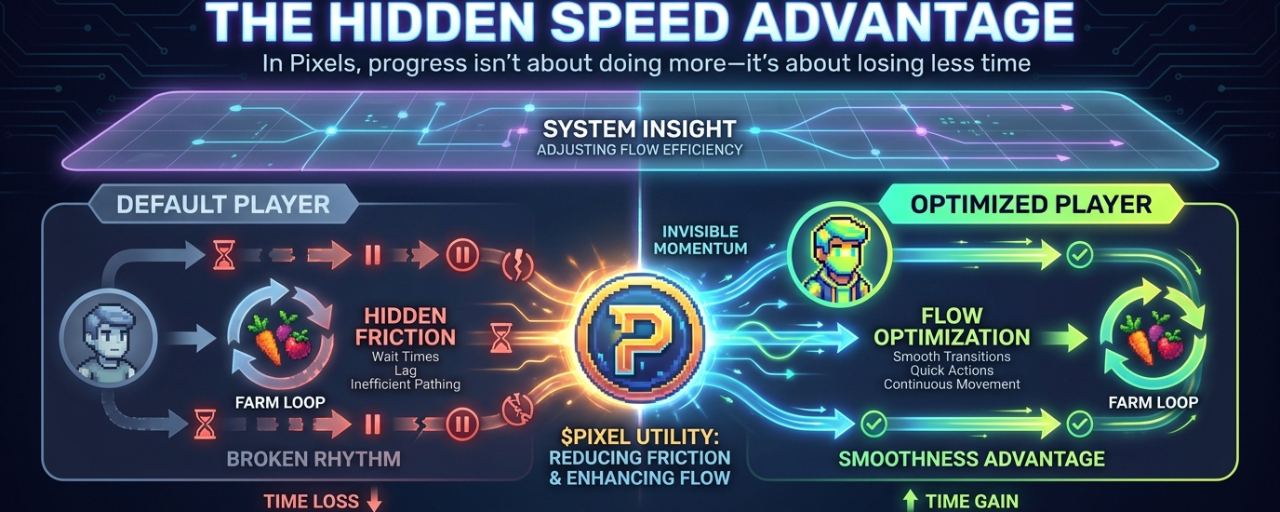
They don’t seem faster in a dramatic way. They just don’t get interrupted as much. Their loops feel cleaner. Fewer pauses. Less waiting. Meanwhile, you’re still doing the same actions but your rhythm keeps breaking in small, almost invisible ways.
And that’s when $PIXEL starts to make sense.
Not as a reward. Not even as something you “need.”
But as something that quietly removes friction.
Think about a simple scenario.
You plant, wait, harvest. Standard loop. Now imagine two players doing the same thing. One keeps hitting small delays, timers, inefficiencies, little pauses that don’t feel like a big deal individually. The other? Those pauses are slightly reduced, slightly smoothed out.
At first, nothing changed.
But over time?
One player completes more cycles not because they worked harder, but because they lost less time.
That difference compounds.
And that’s where the system reveals itself.
This isn’t really about earning more it’s about wasting less.
That’s a very different kind of design. Most Game Fi systems push you to maximize output. Here, the game nudges you to optimize flow. To notice inefficiencies you didn’t care about before. To slowly reshape how you play, not through force but through discomfort.
Because once you feel friction, you can’t un feel it.
That’s the hook.
What makes this slightly uncomfortable is how quiet it all is. There’s no clear moment where the game tells you, “you’re behind.” No obvious paywall. You can keep playing exactly as you are.
But you start to realize you’re operating at default speed.
And default isn’t bad.
It’s just not competitive.
That creates a strange kind of system. One where access is equal, but experience isn’t. Where everyone can participate, but not everyone moves efficiently. And over time, that efficiency gap becomes more important than anything else.
It’s not a visible leaderboard.
It’s a hidden layer of momentum.
And momentum decides everything.
The more I think about it, the less PIXEL else like a token and the more it feels like positioning. Like a way to operate closer to the system’s “ideal state,” where friction is minimized and loops stay intact.
That’s powerful.
But it also raises a question.
Because if efficiency can be influenced, then progression isn’t just about effort anymore. It’s about how smoothly the system lets you act. And that means some players aren’t just playing better they’re playing under better conditions.
That’s not unfair.
But it’s not neutral either.
If the real advantage isn’t what you earn but how little time you lose getting there, are you still competing on effort or on access to smoothness?
I keep thinking about that.
Part of me actually likes it feels more subtle than the usual pay-to-win mechanics.
But at the same time, I can’t ignore how quietly it changes the playing field.
I’m not sure if I’m optimizing my strategy anymore or just trying to keep up with a pace I didn’t choose.