Honestly... I didn't expect to feel this specific kind of attention reading through how Pixels structures the relationship between its different player tiers.
Not skepticism. not alarm. something closer to the feeling you get when a system that reads like a monetization funnel turns out to have been designed with something more deliberate in mind, and the evidence for that intention is sitting quietly in the mechanics themselves rather than in any announcement.
because there's a pattern in how Web3 games think about player tiers that this space accepts without examining what the tiers are actually doing. the standard model treats tiers as revenue segmentation. free players are future paying players. paying players fund the game. the hierarchy exists to convert one into the other, and the game is designed around that conversion pressure. the free tier is a sample, not a destination.
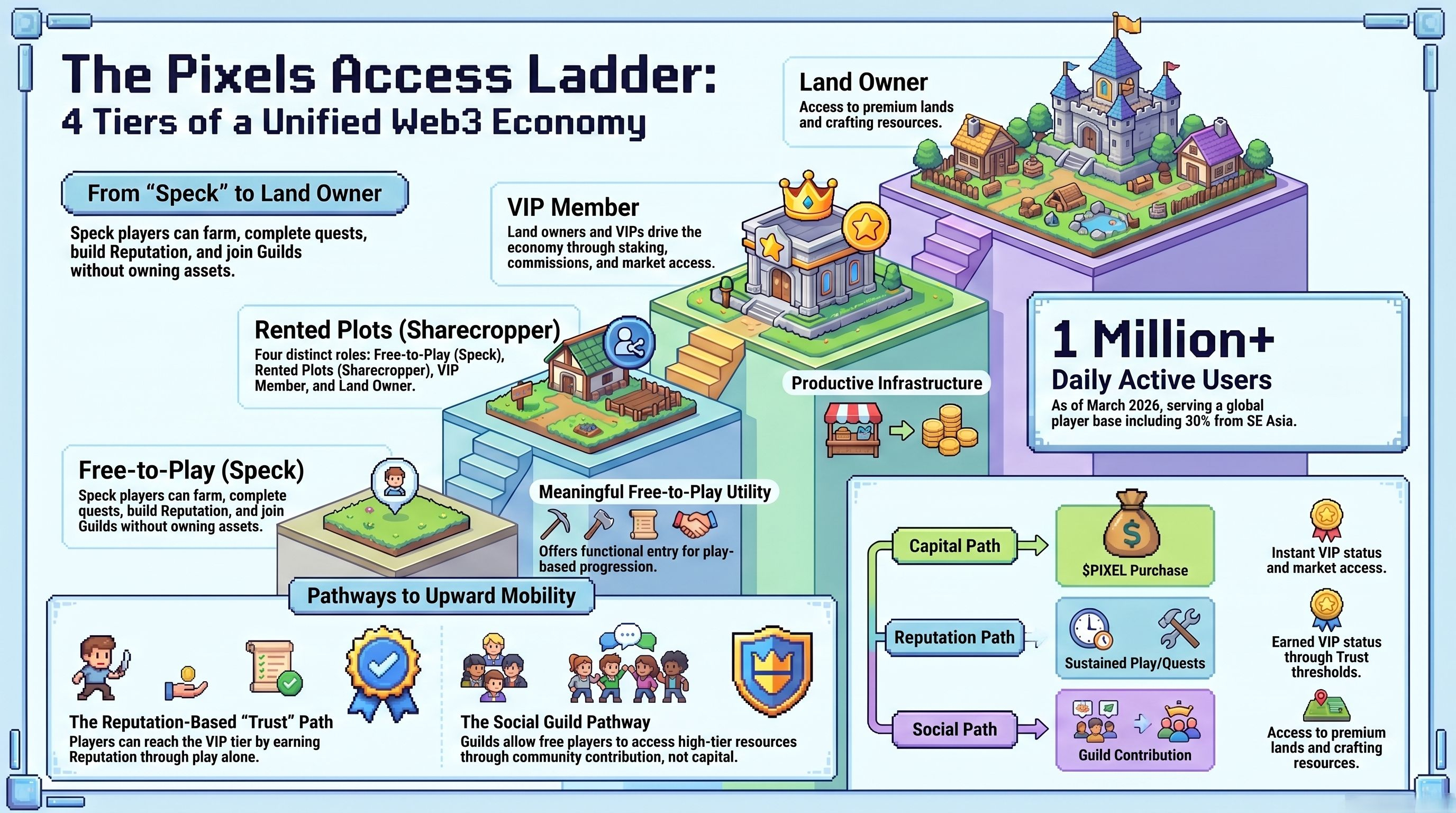
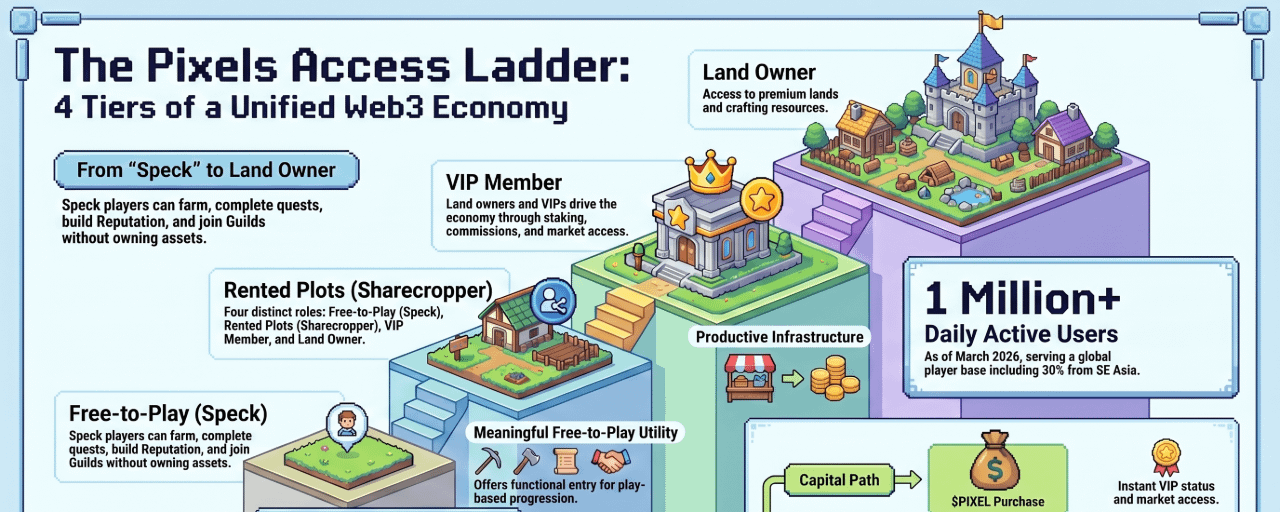
but Pixels built four genuinely distinct entry points that are each designed to be a real place to exist inside the economy, not just a waiting room for the next tier up.
because the structure they built is real. a free-to-play player on a Speck can farm Coins, complete quests, build Reputation, participate in seasonal events, join a Guild through an existing member's invitation, and access higher-tier resources through that Guild's land without owning anything. a sharecropper on a rented NFT plot earns yield split with the land owner, accessing production capacity they could not build independently. a VIP member unlocks token withdrawal, player markets, exclusive areas, and tiered earning boosts calibrated to how much PIXEL they spend. a land owner operates the productive infrastructure the rest of the economy depends on, with staking boosts, sharecropper commissions, and automation capacity layered on top.
so yeah... the four-tier architecture is real and operational.
but tier design has never been the hard part of building an economy with multiple participation levels.
the hard part is whether movement between tiers is genuinely possible or just theoretically available in documentation that most players never read carefully enough to act on.
because here's what I keep coming back to. the path from Speck player to VIP participant does not require purchasing PIXEL from an exchange. it requires building Reputation through play to the Trust threshold that makes the player market accessible, then earning PIXEL through Task Board completions at a sufficient rate to purchase VIP from within the game economy itself. that path is slower than buying directly. it requires sustained engagement over weeks rather than a single transaction. but it is a real path, and the design of the Reputation system is what makes it possible.
a game that only allowed capital entry into premium tiers would have no reason to build a behavior-based Reputation system with a threshold reachable through quests alone. the existence of that system is the evidence that the design intent goes beyond revenue maximization.
then comes the Guild pathway question. because of course.
and here's where the access architecture gets genuinely compelling to examine. free-to-play players cannot found a Guild without meeting the Trust score requirement and spending PIXEL on a Charter. but they can join an existing Guild through invitation, and Guild membership gives them access to Guild lands, higher-tier crafting resources, and Guild-specific events that the Speck tier alone cannot provide.
the Guild system creates a social pathway into the higher-resource layer of the economy that is not mediated by capital at all. it is mediated by community. a free-to-play player who is a valuable contributor to their Guild, reliable, skilled, active during competitive seasons, has access to productive resources that a VIP member playing solo might not. the social layer of the economy is doing access work that the capital layer alone cannot.
the relationship between these two access mechanisms, capital and community, is one of the things that makes the Pixels economy structurally more interesting than a simple tier hierarchy.
there's also a dimension nobody talks about enough.
the VIP tier is designed with escalating benefits calibrated to how much PIXEL a player spends, with instant tier advancement rather than waiting periods. this design creates a meaningful incentive for players who have already reached VIP to continue spending PIXEL on upgrades and in-game activities rather than withdrawing to the market. the VIP system is simultaneously an access gate and a PIXEL sink, and the two functions reinforce each other. a player who values their VIP benefits has a direct economic reason to keep PIXEL circulating inside the game economy rather than extracting it.
the access architecture and the token economics are not separate design decisions running in parallel. they are the same design decision expressed through different mechanics.
still... I'll say this.
the decision to build a Reputation system that offers a non-capital pathway into premium participation reflects something genuine about how Pixels thinks about who the game is for. over one million daily active users as of March 2026, with approximately 30% from Southeast Asia, means the game is operating across a wide range of economic contexts where the capital pathway into VIP represents very different levels of commitment for different players. designing a behavior-based alternative was not the path of least resistance. it was a deliberate choice about who gets to have a real place in this economy.
the question is whether the players currently on Specks who have not yet discovered the Reputation pathway know that the path to the player market and eventually to VIP is open to them through play alone, on their own timeline, without the capital commitment they may have assumed was required from the start.
and in this world, the players who know the full map of access mechanisms available to them are the ones who make the most of wherever they are currently standing.
@Pixels #pixel $PIXEL $ORCA $AGT