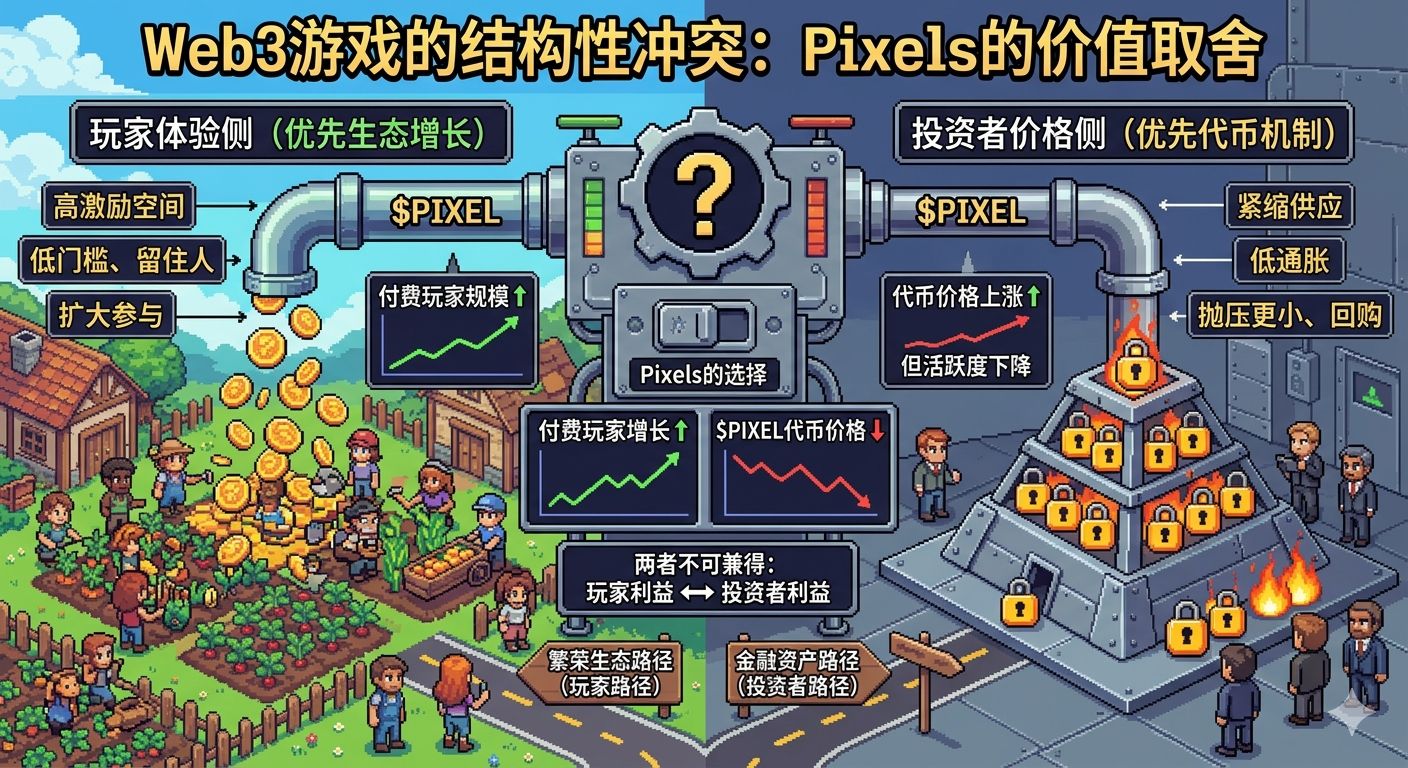
Looking at the recent data from $PIXEL , there's a clear observation: the number of paying players is increasing, yet the token price keeps weakening, one going up, the other down, and this isn't just short-term volatility but a persistent divergence. This isn't just a superficial differentiation; it feels more like the structure itself is providing the answer— in Web3 games, the goals of players and investors have been in conflict from the very beginning.
Players are more focused on the experience and profit potential, looking for higher incentives, lower entry barriers, and more direct returns; investors care more about the price, wanting inflation to be manageable, sell pressure to be minimized, and supply-demand dynamics to be tighter. The issue is that these two sets of goals cannot be optimized simultaneously within the same system. @Pixels only amplifies and publicly presents this contradiction: from a mechanics standpoint, it hasn't significantly tightened incentives, resources are still skewed towards players, resulting in a continuous expansion of user base and activity, but the token price remains under long-term pressure, with growth happening at the game level while value doesn't smoothly translate to the asset level.
The key here isn't about whether it's done well or not, but rather how the system itself determines the flow of value. I've seen similar situations before, where a company with strong product capabilities sees rapid user growth, but profits remain weak over the long haul. As a user, you want it to be cheap and provide a great experience, while as an investor, you want prices to go up and profitability to improve. Having both roles in one person creates a fundamental conflict, forcing you to choose a stance. The issue with Web3 games is that this conflict is compressed into the same group of people; players and investors are often the same individuals. You want the project to provide more incentives while also hoping the token price steadily rises, but the system can't simultaneously optimize for two opposing directions.
@Pixels The current choice is clear; it leans towards the player side, meaning its priority is to retain users and expand participation rather than support the token price. The short-term result is a more vibrant ecosystem, but the token will continuously get diluted. Conversely, if it took the investor route, such as tightening incentives, lowering inflation, and strengthening buybacks, the token might look better, but player attrition would be almost inevitable, leading to a decline in ecosystem activity. This isn't an optimization issue, but a path selection problem, essentially making trade-offs between two incompatible directions.
A similar situation occurred with Axie Infinity, which initially relied on high incentives for rapid user expansion, but later adjusted the economic model in an attempt to stabilize the token, resulting in a noticeable drop in user scale. You'll find that the game ecosystem and financial asset are never in a balanced state; rather, they are results of constant oscillation at different stages. So, the real issue with Pixels isn't about how well it's done, but rather it must answer a more fundamental question: who exactly is it optimizing for?
If prioritizing players, it becomes a constantly expanding gaming system, but the token struggles to maintain strength long-term; if prioritizing investors, it turns into a more financialized asset system, but game activity will decline. Both paths are valid but cannot coexist.
Back to $PIXEL , I'm currently leaning towards a simpler framework: is its recent change focused on enhancing player experience or strengthening the token mechanics? If it's the former, then it's an ecosystem-centric system; if it's the latter, then it's more of a price-centric asset.
@Pixels The current choice is actually quite clear—it stands on the player's side, which means its core focus isn't on whether the price will rise, but whether this ecosystem can continue to grow. The two are related but don't need to be aligned.