
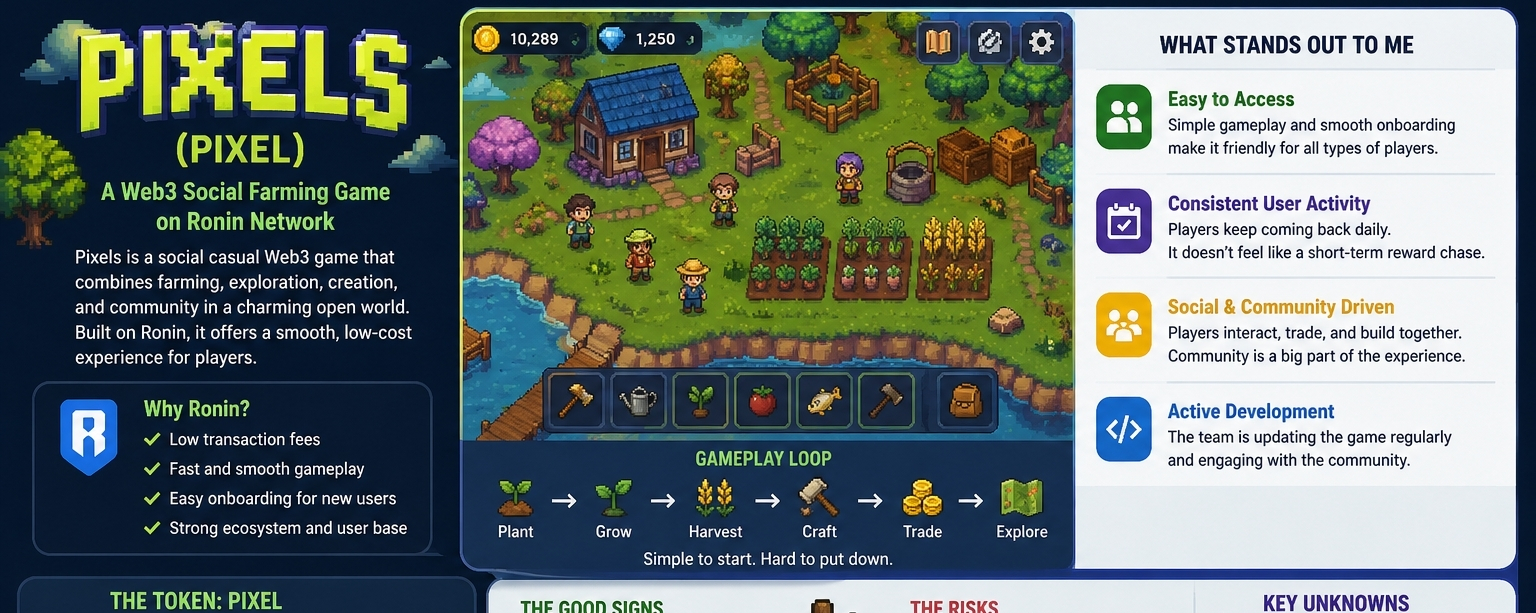
I’ve been looking at Pixels for a while now, and the more I sit with it, the more it feels like one of those projects that doesn’t really reveal its true shape in the beginning. At first glance, it looks simple—almost too simple. A farming-based social game built on Ronin where people grow, explore, and build over time. Nothing flashy on the surface, nothing that screams innovation immediately. But in crypto, I’ve learned that what looks simple is sometimes where the real experiment is happening.
The first thing I noticed is how familiar the gameplay loop feels. Planting, collecting, upgrading, repeating. It reminds me of older casual games that didn’t need much explanation to keep people engaged. That simplicity is not accidental in my view. A lot of Web3 games in the past tried to be overly complex, thinking complexity equals depth. But what actually happened is that they lost users before those systems even mattered. Pixels goes in the opposite direction. It doesn’t try to impress with mechanics—it tries to keep you inside a loop that is easy to understand and easy to return to.
What stood out to me more than the gameplay itself is how little friction there is in getting started. That might sound small, but in blockchain gaming it’s actually one of the biggest barriers. I’ve seen users drop off just because onboarding felt too heavy or confusing. Here, being on Ronin makes things smoother. Transactions feel less painful, movement feels more natural, and that alone changes how long someone stays in the ecosystem during their first experience.
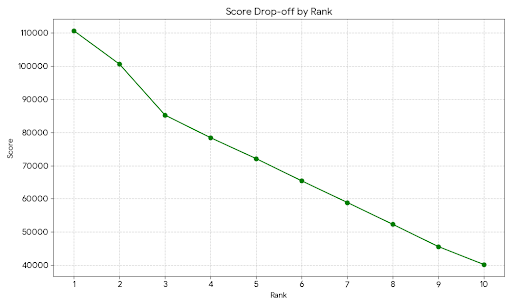
As I kept observing, I noticed something more important than the game itself—the behavior of the users. There’s a pattern of repetition, but not in a negative way. People don’t just come in, farm once, and disappear. They come back. Daily activity matters here more than big spikes. That’s something I always pay attention to, because in many past Web3 games I’ve seen, early numbers looked strong but they were mostly driven by short-term incentives. Once rewards slowed down, activity collapsed. Pixels, at least from what I’ve seen so far, doesn’t look fully dependent on that kind of instant reward cycle.
But I’ve also learned not to trust early patterns too much. I’ve seen this story before. A game launches, users are active, everything looks alive, and then a few weeks or months later the energy slowly fades. The difference between a passing trend and something lasting usually shows up later, not in the beginning. That’s why I stay cautious even when things look stable.
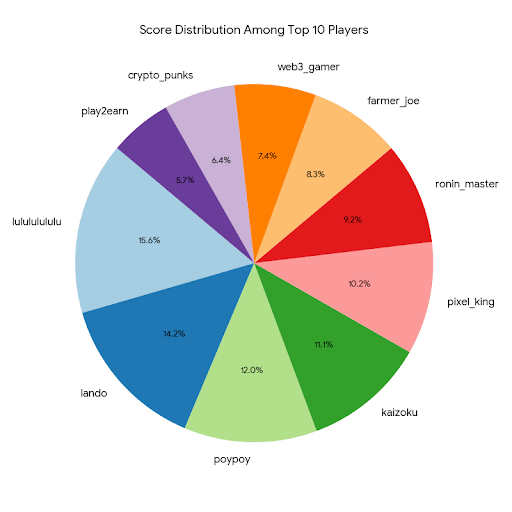
The economic layer is where things always get complicated. Whenever a game introduces a token, the behavior changes. People stop playing for experience and start playing for efficiency. Every action becomes optimized. That shift is subtle at first, but it changes everything over time. I’ve seen it too many times—users farming instead of playing, liquidity flowing in during hype phases, and then leaving when rewards don’t match expectations anymore. Pixels has to deal with that same pressure. No matter how good the gameplay loop is, the token dynamics can either support it or slowly distort it.
What makes Pixels slightly more interesting to me is that it doesn’t feel like it is purely built around speculation. There’s a social layer that seems more intentional than in many other projects. Players are not just isolated farmers—they exist in a shared space where interaction, trading, and casual presence matter. I’ve noticed in other ecosystems that when users start forming small habits and relationships inside a game, they tend to stay longer even when incentives change. That kind of social gravity is difficult to create artificially, and even harder to maintain.
Still, I can’t ignore how fragile that balance can be. Social engagement in Web3 games often depends on momentum. If updates slow down or the world stops feeling alive, users drift away quickly. I’ve seen strong communities lose activity not because the product was bad, but because nothing new kept pulling people back in.
Another thing I keep thinking about is how Pixels fits into the current phase of Web3 gaming overall. The hype cycle has already gone through its explosive stage. People are more skeptical now. They’ve seen play-to-earn experiments rise and fall. That changes how new projects are received. It also means that survival today is less about hype and more about patience. Projects don’t get endless chances anymore. They either build something that naturally holds attention, or they slowly fade out of relevance.
From a development perspective, I’ve noticed steady activity rather than dramatic announcements. That kind of slow iteration is often overlooked, but in this space it’s usually more reliable than sudden bursts of marketing. Consistency doesn’t create excitement immediately, but it builds structure over time. I’ve seen projects that looked quiet early on eventually become more stable simply because they kept improving without losing direction.
At the same time, there are still open questions. How deep can the gameplay actually become? Will players stay once the novelty of farming wears off? Can the economy remain stable if incentives shift? These are not small details—they are the core issues that decide whether a Web3 game survives beyond its early phase.
I also think about liquidity and token stability, because even if the game itself is enjoyable, external market pressure can still affect user behavior. If price movements become too volatile, it can pull attention away from gameplay and back into speculation. That’s something every blockchain game struggles with in its own way.
So when I look at Pixels today, I don’t see something I can quickly label as a success or failure. I see a system that is still forming its identity. It has familiar parts that I’ve seen before in both successful and unsuccessful projects. It also has small signals that suggest it’s trying to build something more sustainable, but those signals need time to prove themselves.
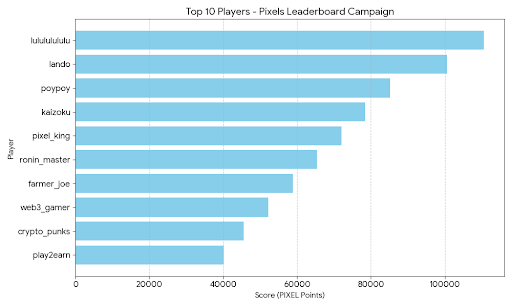
Right now, it sits in a middle space for me. Not early hype anymore, but not mature enough to judge properly either. The only real answer will come from time and user behavior once incentives normalize and the game is no longer in its initial growth phase.
So for now, I’m not taking a strong position on it. I’m just observing how it evolves, how people interact with it when rewards become less of a focus, and whether the experience alone is enough to keep them coming back. That’s usually where the real story of these projects finally shows itself.