
There was a time when I shut my computer down very late, yet my mind still would not leave an unfinished chain of calculations. It was not because I had just missed some big reward, but because the more I thought about it, the more I felt that Pixel’s real story was not about how many tokens could be earned in a day, but about the way the project split value into two different streams and then made players live with both of them. That feeling was not loud and it did not come as a shock, but it lingered for a long time, like the kind of instinct anyone who has lived through enough market cycles would recognize immediately.
At first glance, the dual token model is easy to like because it gives a sense of order. One layer of assets is used to sustain the daily loop, keeping farming, crafting, accumulation, and quest turn ins from losing momentum, while the other layer in Pixel sits at a higher level, tied to unlocks, upgrades, and a longer term sense of expectation. On the design surface, this is clearly quite an intelligent division of roles because it avoids stuffing the entire burden into a single token.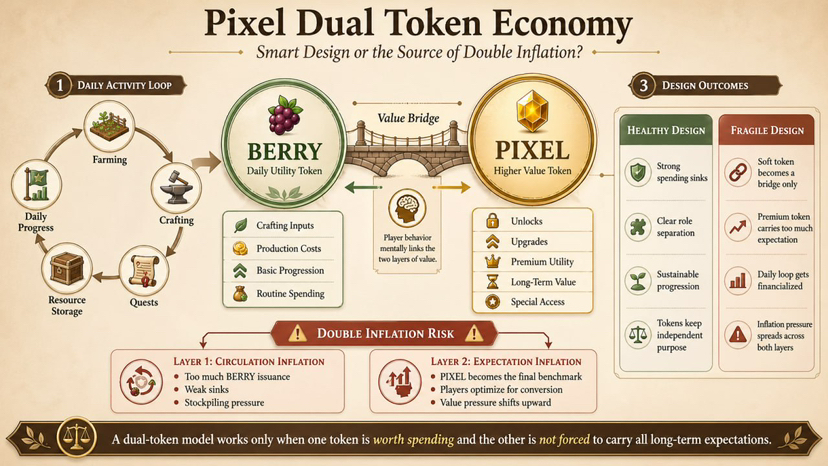
But what made me stop is that those two layers never remain fixed in the roles originally assigned to them. After some time, players no longer see one token as a spending tool and the other as a value holding asset, because once they follow Pixel long enough, they naturally connect both into one continuous path. What do I earn today, what do I keep tomorrow, and in the end, what is this whole chain of behavior actually being converted into. From the moment that line of thinking takes shape, the first token has already started losing its independence.
So, to speak as directly as possible to the topic, the issue is not simply whether issuance is high or low. What matters more is whether Pixel’s design unintentionally creates inflation on two levels at the same time. The first level is inflation in circulation, where the softer asset has to flow out steadily enough for players to still feel they are making progress. The second level is inflation in expectation, where the remaining asset becomes the community’s final yardstick for achievement, causing any adjustment at the lower level to be quickly read as pressure being pushed upward.
This is where I think many people judge too quickly. A dual token structure does not automatically fight inflation, it only splits the pressure into several layers that are harder to see. If at some stage Pixel cannot generate enough real consumption demand for the softer token, players will delay spending and turn toward accumulation instead. And if the harder token has to carry the image of scarcity, preserve confidence, and also act as the final destination of every psychological conversion, then sooner or later it will be forced to do too many jobs at once. To be honest, that is always a sign of a structure beginning to tighten beyond its limits.
I think the key question is whether the project can make the first token more worth spending than holding. An economy is only truly healthy when players use an asset because they need it for their current living loop, not because they merely see it as a transit ticket. If you look more closely at Pixel, the biggest risk is not that the community earns too quickly, but that it learns too quickly to treat all daily work as an intermediate step toward another layer of value. Once that happens, the gameplay is still there, but the operating logic underneath has already started to become financialized.
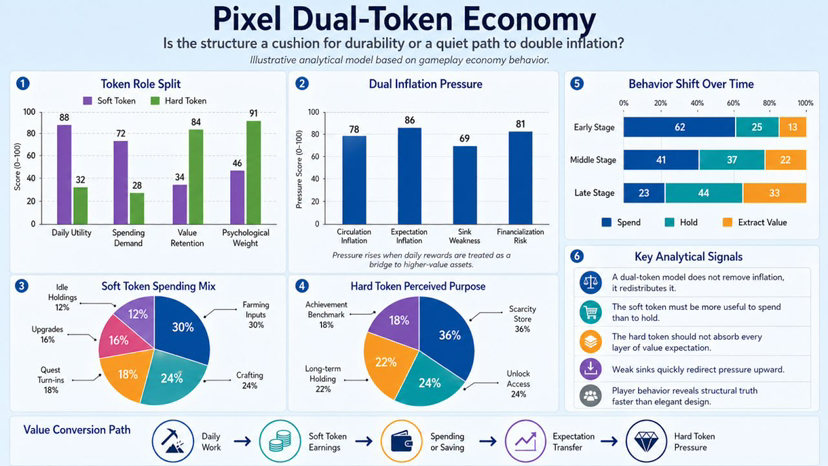 That is also why I do not want to conclude that this model is wrong. I can still see a fairly sober design intention in the way Pixel has built these two layers of assets, because at the very least the project understands that short term rewards and long term value should not be mixed together. But understanding the problem does not mean solving it. The more carefully the project restrains rewards to avoid overheating, the more subtle it has to be in designing sinks, unlocks, and consumption rhythm, because once a single link weakens, players will immediately see where the pressure is being pushed.
What keeps me watching Pixel is not that I believe this model will definitely succeed, but that it is touching the hardest problem in game economy design, how to keep one asset being spent as a living tool while the other does not turn into a place that absorbs every desire to extract value. Many systems do not collapse because the design is terrible, but because at some point players understand too clearly what is worth holding and what is only meant to be passed through. What I want to see is whether the project can answer that hard question through the community’s real behavior, not just through a structure that looks elegant on paper, because in the end, is Pixel’s dual token model a cushion that makes the economy more durable, or is it the quiet crack that opens the door to double inflation from within.
$PIXEL $ORCA $AGT @Pixels #pixel