I took a small $PIXEL position last week—nothing serious, just enough to pay attention. It wasn’t even based on a strong conviction. I’d been playing around in Pixels again, and something felt… off. Not in a bad way. Just different from the usual GameFi loops I’ve seen.
At first, I couldn’t place it. The gameplay is simple—farm, collect, repeat. No pressure, no aggressive push to optimize. You can honestly just drift through it. That’s what I did for a while.
But then I started noticing how other players were moving.
Some felt smooth. Almost uninterrupted. Their loops flowed cleanly—plant, harvest, move, repeat. Others, including me, kept hitting these tiny pauses. Cooldowns, delays, small inefficiencies. Nothing major on its own, but enough to break rhythm.
That’s when I started paying attention to PIXEL differently.
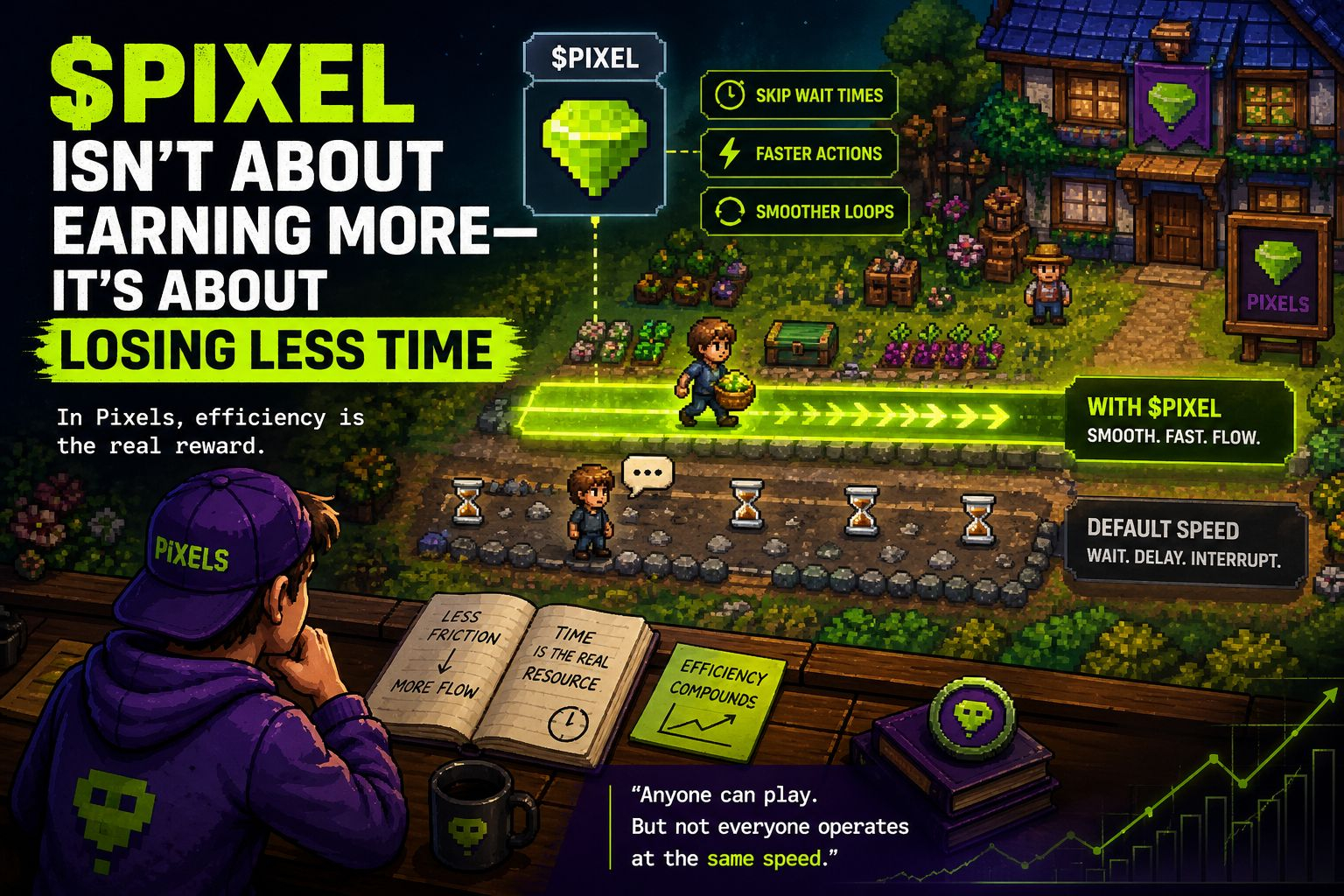
It doesn’t behave like a typical reward token. There’s no loud incentive screaming “earn more.” Instead, it sits quietly in the background, shaping how much friction you experience. You can ignore it—I did at first. But ignoring it means you’re playing at the system’s default speed.
And default speed is fine… until you realize others aren’t on it.
That’s the part that got me.
This isn’t about increasing output. It’s about reducing wasted time.
I’ve seen this dynamic before, but not in games—in trading infrastructure. Two traders spot the same setup. One gets filled instantly. The other slips or misses. Same skill, same idea, different outcome. The difference isn’t intelligence—it’s positioning. Access. Speed.
Pixels replicates that, but in a softer way.
There’s no hard barrier. No moment where the game says, “you must buy this to continue.” Instead, you start feeling inefficiencies. You notice where time is leaking. A delay here, a pause there. And naturally, you look for ways to smooth it out.
That’s where demand for $PIXEL tually comes from.
Not big decisions. Small, repeated ones.
“Let me speed this up.”
“Let me skip this wait.”
“Let me keep my loop going.”
Individually, these choices look insignificant. But they stack. And stacking behavior is where systems reveal their real design.
I tested this myself. Nothing fancy—just ran two sessions differently. One where I ignored optimization completely, and one where I leaned into reducing friction wherever possible. Same time spent, same general actions.
The difference wasn’t dramatic in the moment. But over a few cycles, it became noticeable. The optimized loop just felt… cleaner. Less stop-and-start. More continuous.
And continuity compounds.
That’s the hidden layer here. The system isn’t rewarding you for doing more—it’s rewarding you for losing less time between actions.
That’s a very different axis than most play-to-earn models.
It also explains why the token doesn’t feel urgent. There’s no pressure to buy it immediately. But once you feel the inefficiency, it becomes harder to ignore. Not because you’re chasing profit, but because you’re trying to maintain flow.
And flow is addictive.
There’s something slightly uncomfortable about this design, though.
On the surface, everything is equal. Anyone can log in, play, progress. But underneath, efficiency isn’t evenly distributed. Some players operate closer to the system’s “ideal state”—minimal friction, smooth loops. Others stay in the default layer, where small delays accumulate.
It doesn’t feel unfair. But it’s not entirely neutral either.
It creates quiet layers.
Not visible hierarchies, but functional ones.
And over time, those layers matter. Because the player who saves time consistently doesn’t just feel better—they progress faster without necessarily doing more.
That’s where my hesitation comes in as a trader.
If Pixel effectively pricing friction reduction, then its value isn’t tied to rewards—it’s tied to how sensitive players are to inefficiency. If players don’t notice or don’t care, demand stays weak. If they do, demand becomes sticky.
Right now, it feels like we’re in that middle zone.
Easy to overlook. Hard to ignore once you see it.
I’m not increasing my position yet. That small entry is still just a probe. But I’m watching behavior more than charts on this one.
Because if this model holds, Pixel selling upside.
It’s selling smoothness.
And in systems where time quietly becomes the real currency, that might matter more than most people expect.
@Pixels $PIXEL #pixel