
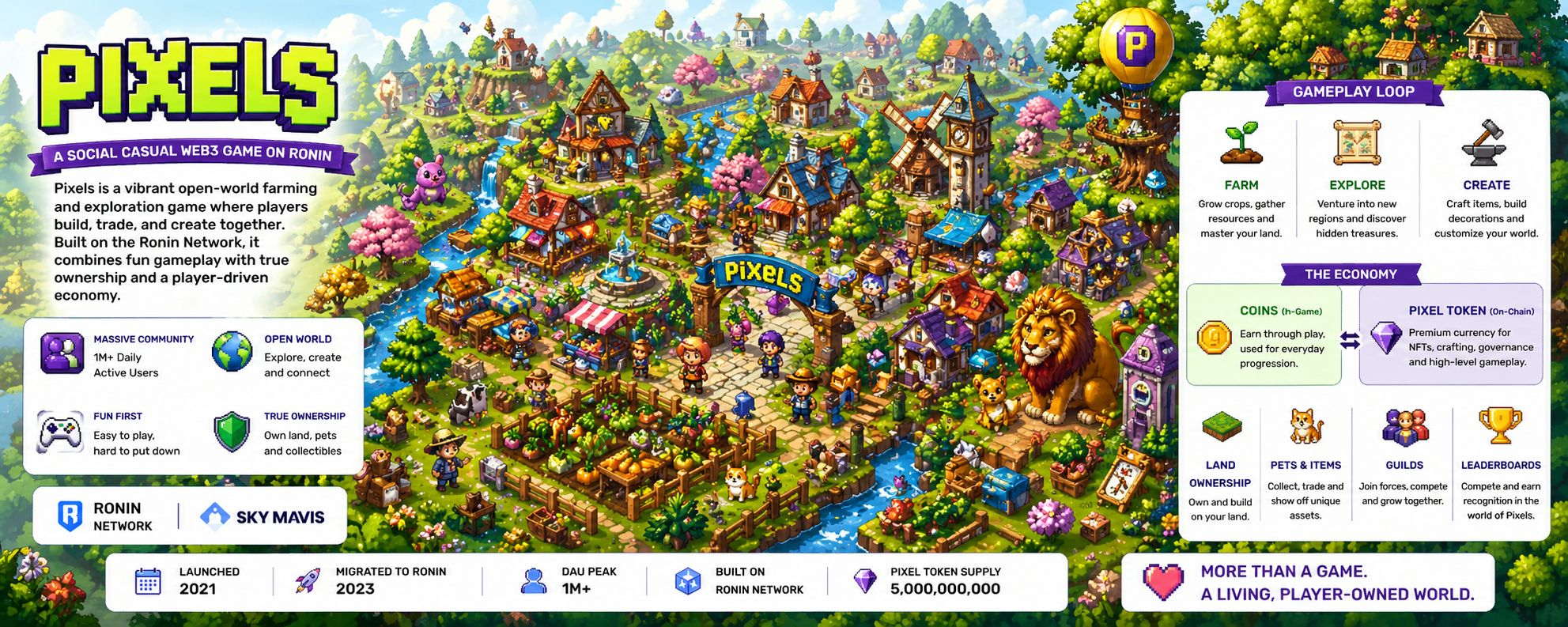
@Pixels #pixel $PIXEL There is something quietly deceptive about Pixels. At a glance, it looks like a simple, almost nostalgic farming game—the kind of experience you open to relax, plant a few crops, maybe wander around and chat with strangers. Nothing about it immediately signals that it belongs in a serious conversation about the future of digital economies or the evolution of the internet. And yet, the longer you sit with it, the more it begins to feel like something else entirely—not just a game, but a living experiment in how people might inhabit online worlds differently.
For a long time, blockchain gaming struggled with a fundamental misunderstanding of human behavior. Projects were built around incentives rather than experiences. The assumption was that if players could earn, they would stay. And they did—briefly. But as soon as rewards dropped or markets cooled, entire ecosystems emptied out almost overnight. What those systems lacked was not better tokenomics. It was emotional gravity. People were not attached to the worlds themselves.
Pixels seems to have taken that lesson seriously, whether intentionally or instinctively. It does not begin with money. It begins with rhythm. You plant something, you come back later, you harvest it, you improve your land bit by bit. It is slow, repetitive, almost meditative. But that repetition is doing something important beneath the surface. It is building habit. And habit, over time, turns into attachment.
The world of Pixels does not try to overwhelm you. It unfolds gently. You explore, you meet other players, you start recognizing names, you trade items, you visit someone else’s land. Without realizing it, you stop thinking of it as a system and start experiencing it as a place. That shift—from system to place—is where many Web3 projects fail, and where Pixels begins to succeed.
Its move to the Ronin network played a crucial role in that transformation. Not because of technical specifications alone, but because of what Ronin represents. It is one of the few blockchain environments designed specifically with gaming behavior in mind. Fast interactions, low friction, and a player base already comfortable with digital ownership—all of these factors allowed Pixels to feel less like a crypto experiment and more like a functioning world. When infrastructure disappears into the background, players can focus on what actually matters: the experience.
And that experience is deliberately familiar. Farming, crafting, decorating, exploring—these are not revolutionary mechanics. They are recognizable, even comforting. That familiarity is not a lack of ambition; it is a strategic choice. By grounding itself in known behaviors, Pixels lowers the barrier to entry and gives players space to settle in before introducing more complex layers. It respects the idea that people do not fall in love with systems—they fall in love with routines.
The economic layer sits quietly beneath all of this. There is an in-game currency that handles everyday interactions, and then there is the PIXEL token, which operates at a different level. What is interesting is not just that the token exists, but that it is not forced upon the player. You can spend hours in the game without ever engaging with the blockchain side of it. But if you choose to go deeper—own land, trade assets, participate in the broader economy—the option is there.
This separation feels subtle, but it is significant. Earlier generations of blockchain games blurred the line between playing and earning so aggressively that the experience became transactional. Pixels allows those two modes to coexist without collapsing into each other. It gives players room to decide how they want to engage, and that flexibility may be one of its strongest advantages.
Of course, introducing a token into any ecosystem brings its own complications. Speculation arrives quickly. Some players are drawn not by the world, but by the possibility of profit. That creates a tension that is difficult to resolve. A healthy game economy requires stability and long-term participation, while speculative markets thrive on volatility and short-term movement. Balancing those forces is not just a design challenge—it is an ongoing negotiation between different types of users who want different things from the same space.
What keeps Pixels grounded, at least for now, is its community. Not in the abstract sense that the word is often used, but in a more tangible way. Players interact, depend on each other, trade, collaborate, and build. Over time, these interactions create a kind of social fabric that holds the world together. A farm is not just a collection of assets; it is something others can visit. A marketplace is not just a feature; it is a shared space shaped by real activity. These details give the world weight.
And that weight matters. Because the real question facing Web3 is not whether digital ownership is possible—it clearly is—but whether it can feel meaningful. Ownership without context is just data. Ownership inside a living, social environment becomes something else. It becomes identity, reputation, history.
That is where Pixels starts to feel like more than a game. It begins to resemble a prototype for a different kind of online space, one where the boundaries between playing, socializing, and participating in an economy are less rigid. Not perfectly integrated, not fully solved, but moving in that direction.
Still, there are risks that cannot be ignored. Repetition, which gives the game its calming rhythm, can also lead to fatigue if the world does not evolve fast enough. Economic balance remains fragile, as it does in any token-based system. And like all Web3 projects, Pixels exists within a broader ecosystem that can shift unpredictably. External sentiment, market cycles, and infrastructure trust all play a role in shaping its trajectory.
Yet even with those uncertainties, there is something quietly important happening here. Pixels does not try to convince you of the future through complexity or scale. It does it through familiarity. It suggests that the path forward might not be about making digital worlds more intense or more financially aggressive, but about making them more livable.
That is a different kind of ambition. Less visible, but potentially more durable.
If the next phase of the internet is going to include ownership, economies, and persistent identities, it will need spaces where those elements feel natural rather than imposed. Worlds where people stay not because they are rewarded to, but because they want to return. Pixels is not the final version of that idea, but it might be one of the first to make it feel plausible.
And in a space that has often struggled to turn possibility into reality, that alone is worth paying attention to.
