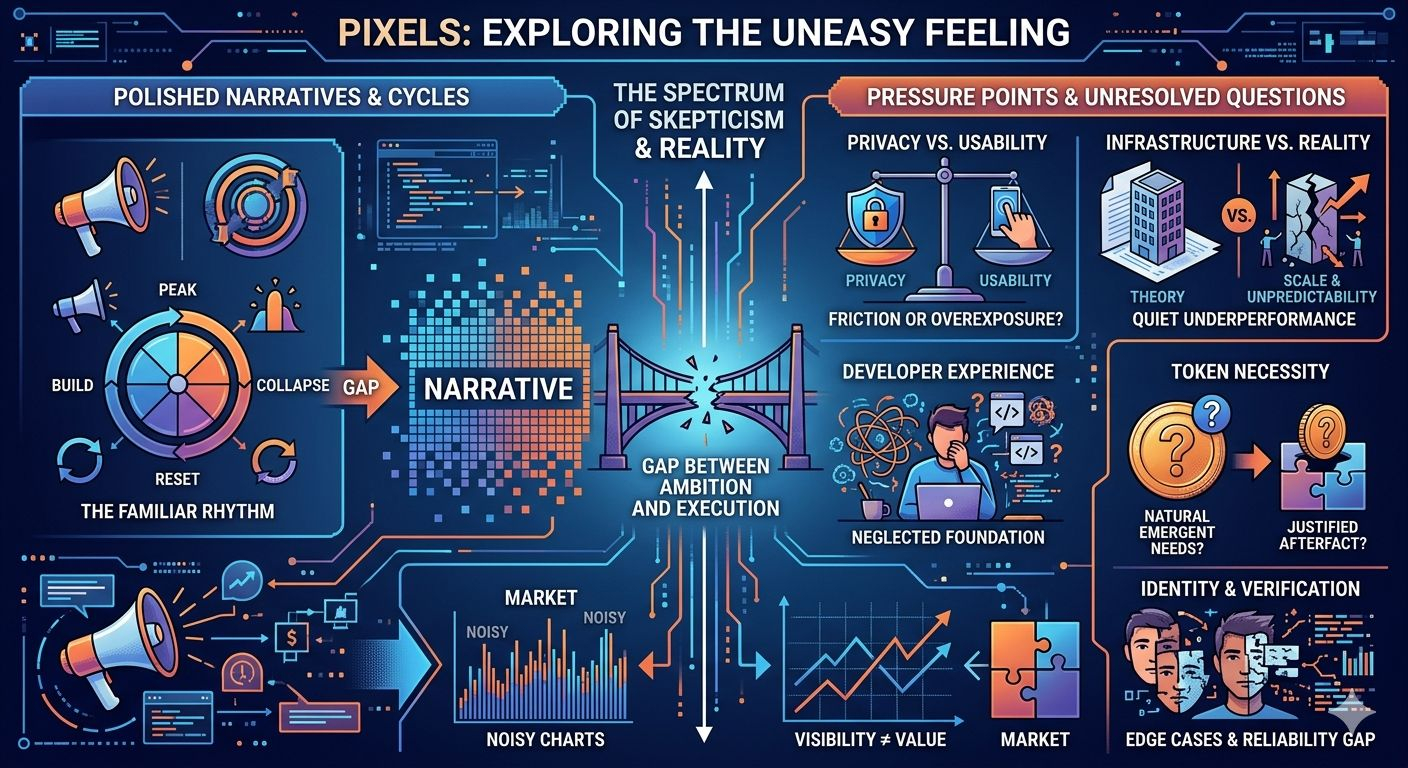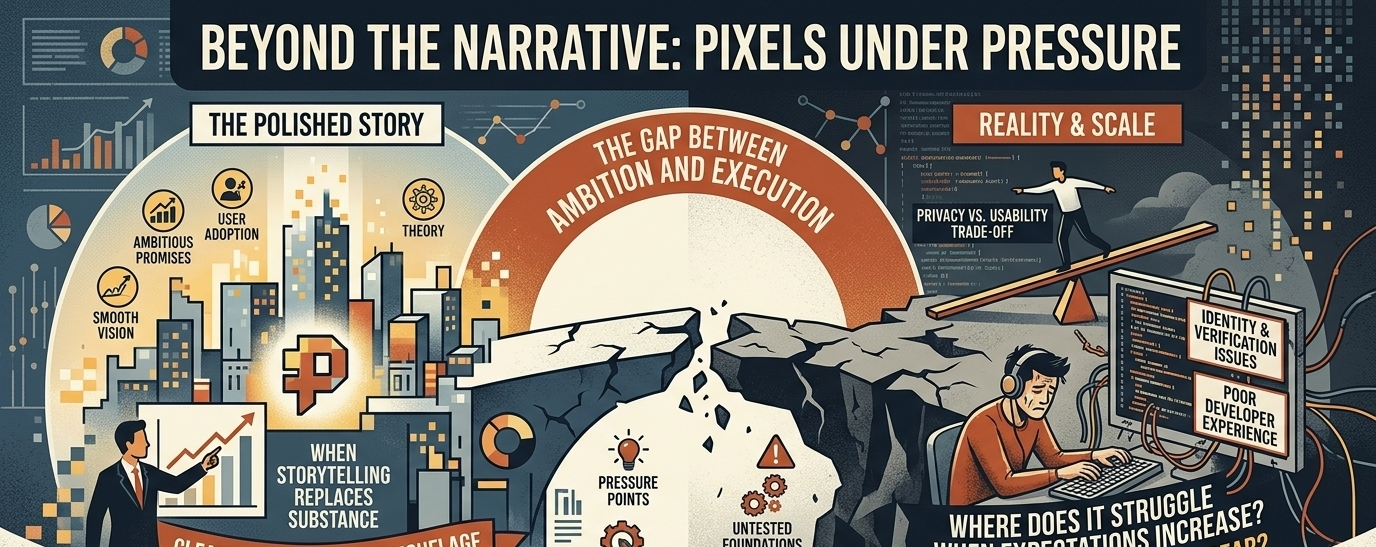
I keep coming back to the same uneasy feeling whenever I look at something like Pixels. Not because it’s doing something obviously wrong, but because I’ve seen this rhythm before. I’ve watched cycles build, peak, collapse, and then quietly reset with slightly different language. And every time, it feels like I’m being asked to believe that this time the foundation is different. But when I sit with it long enough, I realize I’m not reacting to what’s being said—I’m reacting to how familiar it all feels.
With Pixels, like with so many others before it, I notice how quickly narratives start to sound polished. Too polished. It’s like the words are doing more work than the system itself. I’ve spent enough time around these spaces to recognize when storytelling starts to replace substance. Not intentionally, maybe. But gradually. Quietly. Until the story becomes the product. And I’ve reached a point where I don’t really trust clean narratives anymore. They feel like camouflage, covering up the parts that haven’t been tested yet.
What keeps bothering me, even when I try to stay open-minded about Pixels, is how often I’m forced into this strange trade-off between transparency and privacy. It’s like I’m expected to accept that I can’t have both in a meaningful way. Either everything is exposed in the name of openness, or everything is hidden in a way that makes the system feel distant and hard to trust. And neither option feels right. Somewhere along the way, overexposure started being treated as normal, almost necessary. But it never really sat well with me.
Then on the other side, when I look at privacy-focused approaches—even in something like Pixels—I see a different kind of problem. They often go so far in protecting the user that the experience starts to break. It becomes harder to navigate, harder to verify, harder to trust. And that’s where I get stuck. Because privacy without usability doesn’t feel like progress. It just feels like a different kind of friction. And if trust becomes harder to establish, then what are we really building toward?
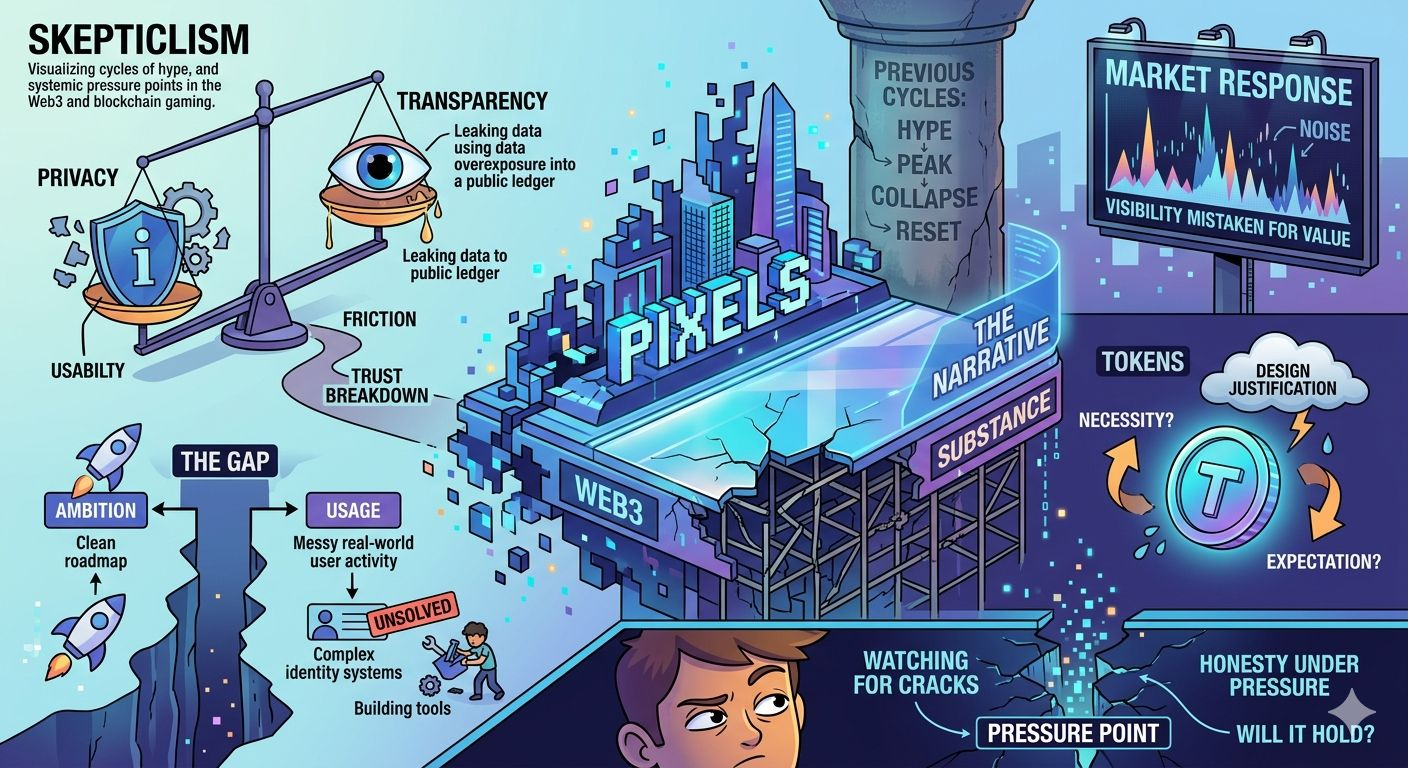
I also can’t ignore how many of these systems, including Pixels, seem to exist more comfortably in theory than in reality. The ideas always sound solid when explained. Infrastructure always sounds convincing on paper. But real pressure tells a different story. Scale, unpredictability, actual user behavior—these things expose weaknesses quickly. And I’ve noticed that many systems don’t fail loudly. They just quietly underperform, never quite reaching the level they promised.
Something else I keep noticing, especially when I think about Pixels, is how little attention gets paid to the people actually building on top of these systems. Developer experience is rarely part of the conversation, yet it’s one of the first things that determines whether anything meaningful grows. If it’s difficult, unclear, or frustrating to build, adoption doesn’t just slow down—it fades out. And no amount of narrative can compensate for that over time.
Then there’s the question of tokens, which still feels unresolved to me when I look at Pixels. Not in a technical sense, but in a conceptual one. I often find myself wondering whether the token exists because it’s necessary, or because it’s expected. And more often than not, it feels like the latter. The design starts to feel forced, like it’s trying to justify itself after the fact rather than emerging naturally from the system’s needs.
Identity and verification add another layer of uncertainty, even in something like Pixels. These systems are still messy. Still unreliable. Still full of edge cases that don’t quite work. And yet, they’re often treated as if they’re already solved problems. But from what I’ve seen, they’re not. Not even close. And until they are, there’s always going to be a gap between what’s promised and what actually functions in practice.
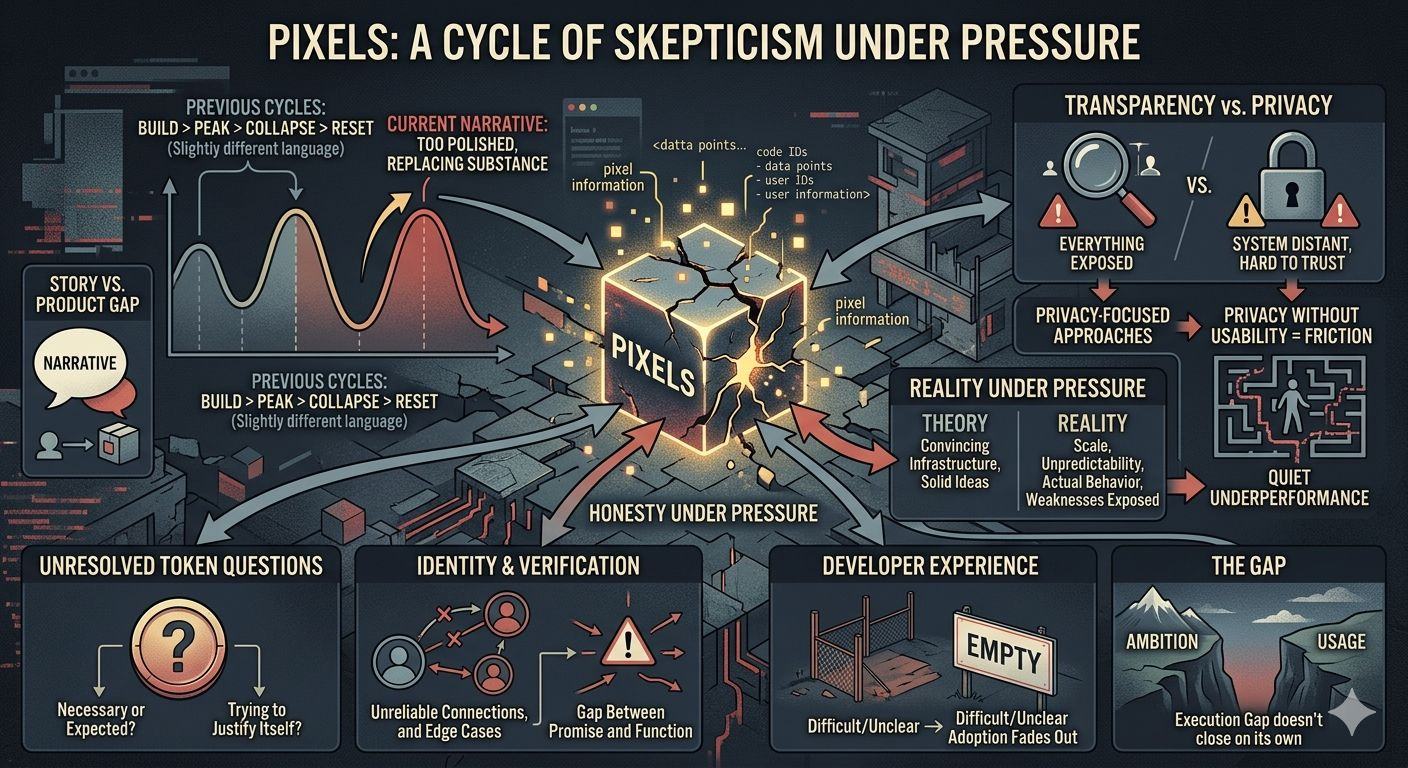
That gap is probably the thing I notice the most when I think about Pixels. The distance between ambition and usage. It’s never as small as it’s presented. Big ideas come easily in this space. Execution doesn’t. And over time, I’ve learned that the gap doesn’t close on its own. It either gets addressed directly, or it becomes permanent.
What makes it harder is how the market responds to all of this. Noise gets rewarded. Visibility gets mistaken for value. And systems that are still figuring themselves out can look just as convincing as those that are actually working. That’s where my skepticism comes from—not from disbelief, but from experience. I’ve seen too many things look complete before they were ready.
So when I look at Pixels now, I don’t really try to label it as success or failure. That feels premature. Instead, I find myself watching for pressure points. Where does it struggle when expectations increase? Where does the experience start to crack? Where does the narrative stop aligning with reality? Those are the moments that matter more than any announcement or report.
I guess, at this point, I’m not looking for perfection in something like Pixels. I’m looking for honesty under pressure. I’m looking for systems that don’t just sound right, but hold up when things stop being controlled. And maybe that’s why I still keep watching, even with all this skepticism. Not because I’m convinced—but because I’m still curious enough to see what actually breaks, and what doesn’t.