
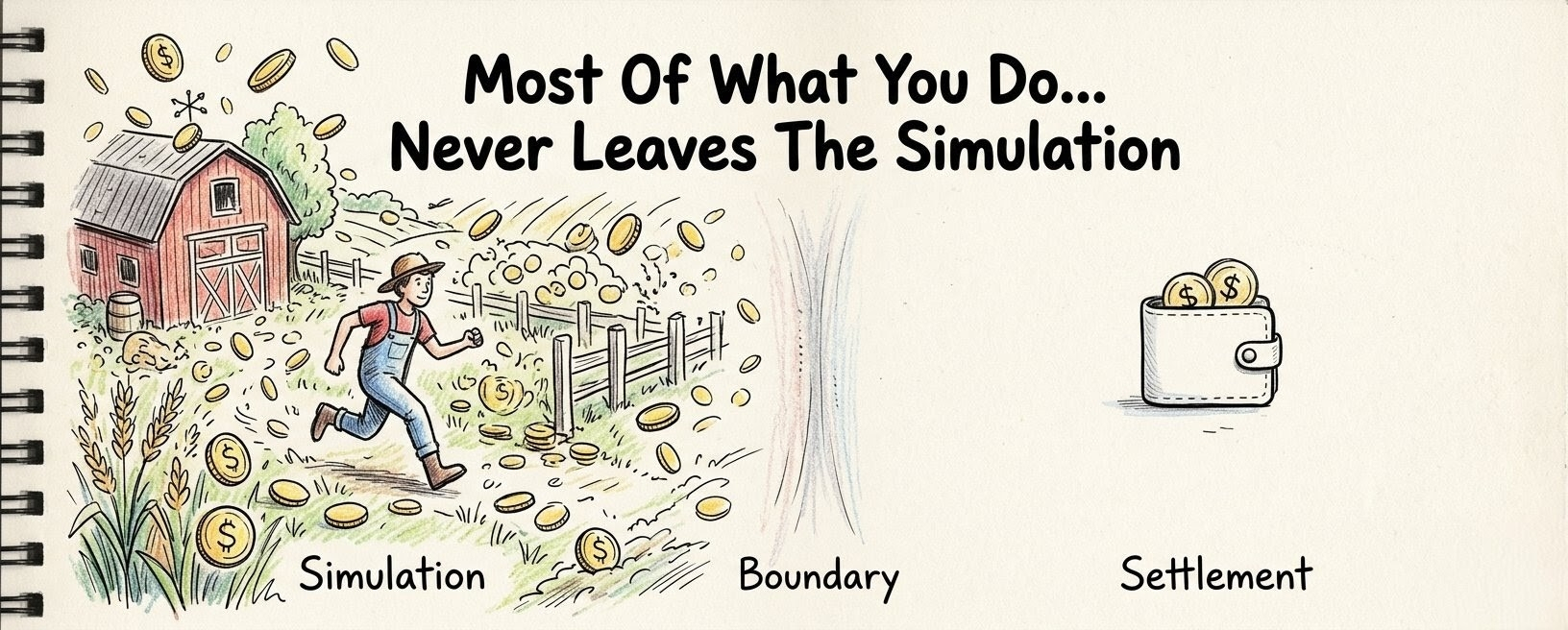

i didn’t think pixels Trust Score was the part i should care about first… it sounded like one of those background systems that exists because games need to keep bots out, keep farmers under control, stop people from draining everything too fast… normal stuff, or at least that’s how i treated it at the start on Pixels .
but the longer i sit inside Pixels, the less it feels like background security and the more it starts looking like something much heavier… like the part that decides whether value can actually leave with me or not.
because earning something and being allowed to realize it are not the same thing here.
and that difference is easy to miss while you’re still inside the Pixels loop, because the game doesn’t stop me from moving. i can farm, craft, run Tasks, cycle through Coins, maybe touch Pixels pathways when they show up… everything still feels open enough from inside the session. but the moment value tries to move toward the outside, toward the Ronin wallet, toward something that is no longer just activity inside the game, Trust Score suddenly cares about who i am in a different way.
not my name, not some clean identity thing… more like what kind of player have i been behaving like.
and that’s where Trust Score starts feeling less like a bot filter and more like an economic permission layer inside pixels. because it’s not only asking “are you human?” in some simple way. it’s asking whether value should travel with less friction, whether i’ve built enough behavioral weight to make the Farmer Fee feel lighter, whether my gameplay looks like something the Pixels economy can trust instead of something trying to extract and disappear.
and that question lands differently because if Pixels RORS already decides what can be funded, and Stacked helps decide what behavior is worth surfacing, then Trust Score sits after that like another gate nobody talks about with the same weight… the place where even funded value still has to pass through reputation before it becomes clean exit.
so what did i actually earn then.
the reward itself… or the right to move it properly.
because those are not the same thing.
and i keep coming back to that because it changes how “ownership” feels inside Pixels. outside the game, ownership sounds like a straight line from reward to wallet. but Pixels doesn’t really behave like that from the player side. it lets me generate activity off-chain, lets Coins absorb most of it, lets some behavior surface into Pixels paths, and then when something finally tries to become withdrawable, Trust Score asks another question entirely.
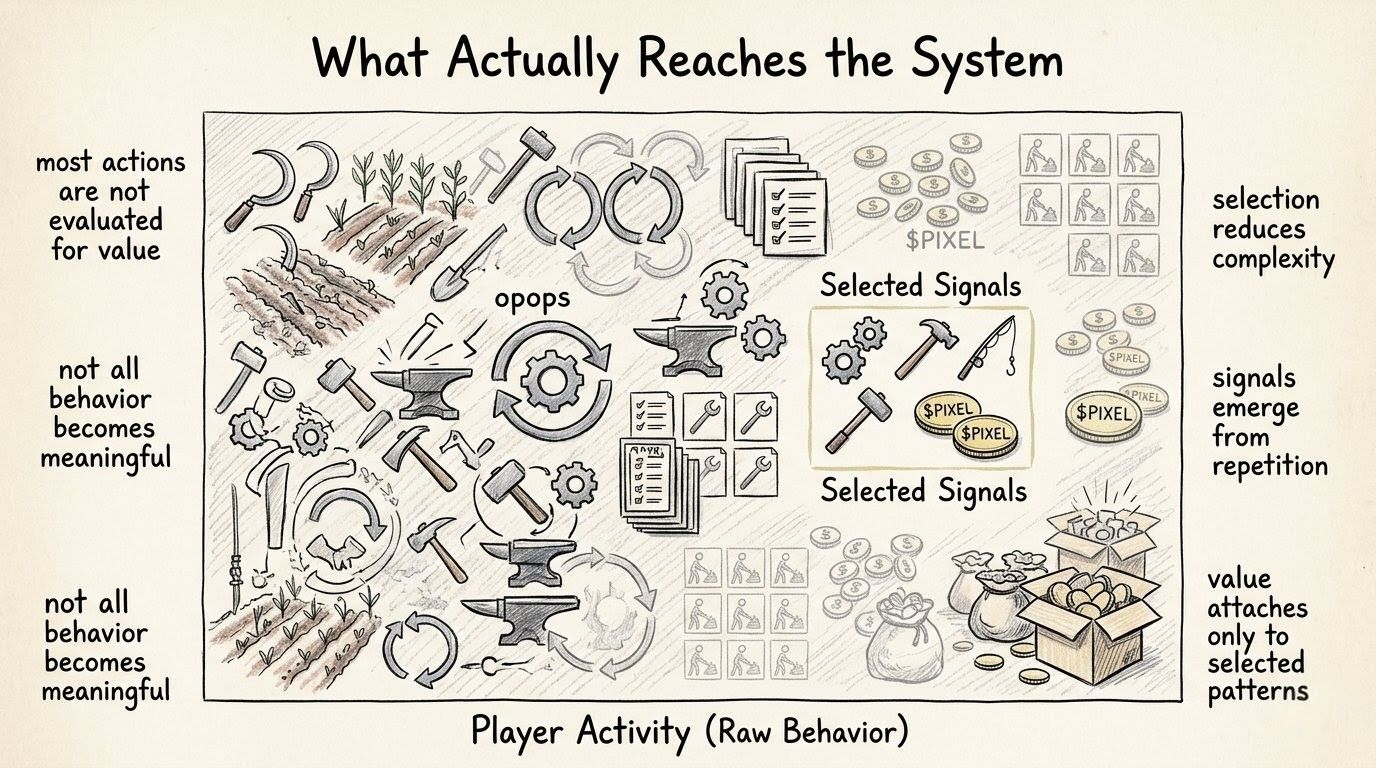
have you proved enough to carry this out.
that line feels uncomfortable because it makes value conditional even after it appears, and maybe that’s the point.
because early play-to-earn broke partly because exit was too easy, too direct, too extraction-heavy. players didn’t need to become part of the world, they just needed to find the shortest path from activity to cash-out. so Pixels doesn’t only control what gets paid. it controls how cleanly that payment can leave. the Farmer Fee makes that visible in a quiet way… low reputation doesn’t have to ban you, doesn’t have to accuse you, doesn’t have to shout fraud.
Pixels can just make leaving more expensive, and that is almost worse in some ways, because it turns suspicion into pricing… not punishment exactly, more like the withdrawal path saying yes, you can move value, but not cheaply, not yet, not with this level of trust.
so the exit isn’t just technical anymore inside pixels. it’s behavioral. the Ronin wallet may be the settlement side, but Trust Score decides how heavy the bridge feels before you get there. two players can touch the same reward path, clear similar activity, maybe even arrive at similar Pixels outcomes, but if one has stronger reputation and the other doesn’t, the final experience is not the same.
same value on screen.
different cost to realize it.
and that’s where the whole thing bends a little.
because now Pixels gameplay isn’t only producing rewards… it’s producing a record of whether i deserve easier access to those rewards later. quests, assets, repeat behavior, how i move through the world, how long i stay, whether i look like someone contributing to the Pixels economy or someone squeezing it… all of that starts to feel like it’s being folded into a quiet score that follows me toward the exit.
so am i playing for rewards, or am i playing to become less suspicious.
that’s the question i don’t like, but it keeps sitting there.
because pixels Trust Score makes the game remember me in a way Coins don’t. Coins just move around. Tasks refresh. sessions end. but reputation feels like residue. something from my behavior sticks, and later it changes how withdrawal treats me. not in a loud cinematic way, not like some level-up screen where everything is obvious, but in the Farmer Fee, in the friction around moving value, in the way Pixels becomes more or less reachable depending on what kind of player the reputation layer thinks i am.
and maybe that is how Pixels keeps the social farming side from becoming just another extraction machine. it doesn’t only ask “what did you do”… it asks “what does your pattern mean”.
and that’s a much harder thing to game casually, at least in theory. because a Pixels bot can repeat actions. a farmer can chase Tasks. but building a reputation that lowers withdrawal friction means behaving across time, across quests, across assets, across signals that are harder to fake cheaply. Trust Score turns time and behavior into Pixels economic credibility, and then uses that credibility at the exact point where value wants to leave.
that’s not just anti-bot… that’s pixels architecture.
because Trust Score doesn’t need to stop everyone at the Pixels door if it can make the door different for each player. a trusted player gets one kind of exit. a suspicious player gets another. not necessarily blocked, just taxed, slowed, made less efficient. and suddenly the “fairness” question gets messy because Pixels is no longer treating all earned value equally. it is treating value through the player who carries it.
and maybe it has to, because if every account could convert and withdraw with the same friction, then reputation wouldn’t matter and the whole pixels economic defense would fall back onto reward filtering alone. RORS can control emission, Stacked can shape reward paths, but Trust Score controls the withdrawal side… the moment where behavior has to prove it deserves a cleaner path out.
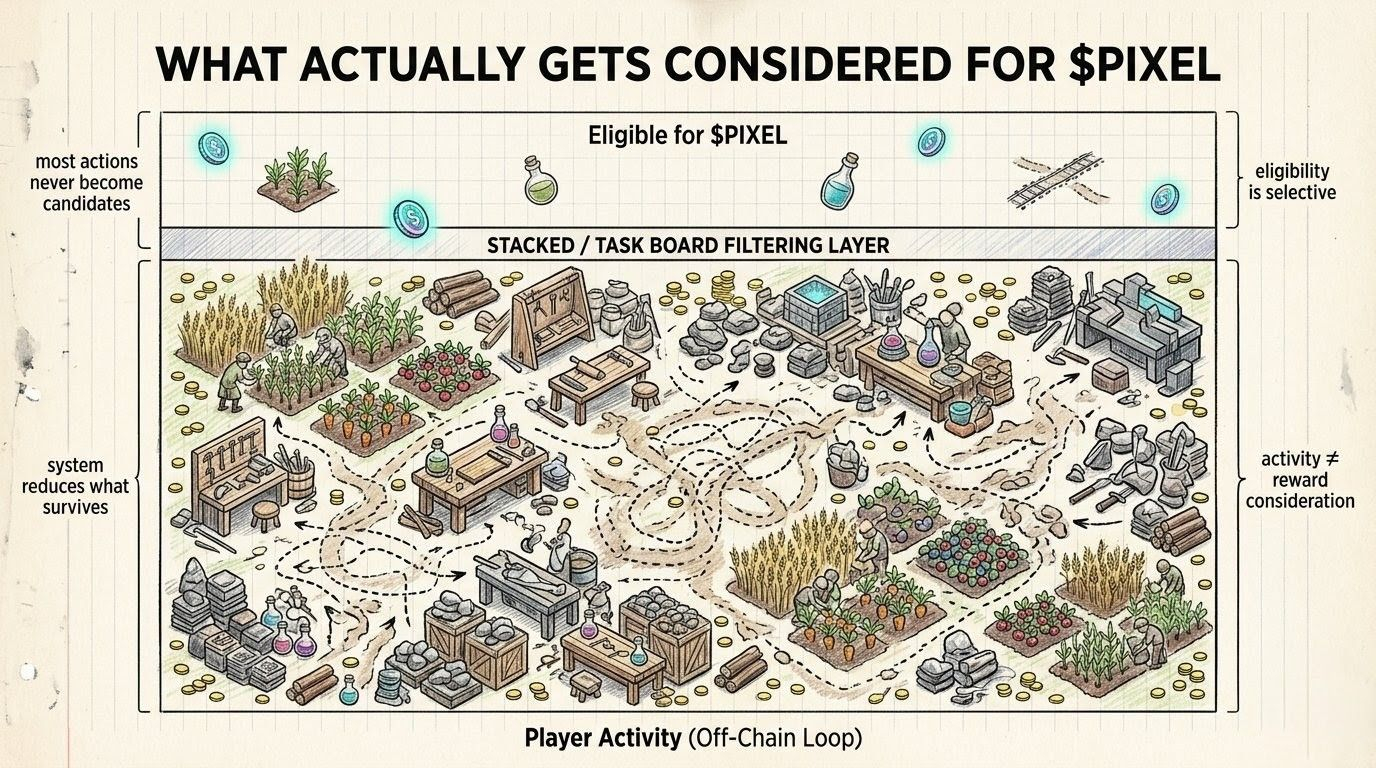
this is the part people skip when they talk about Pixels being fun-first or play-to-earn 2.0. fun can stay open inside the loop, but exit cannot be equally open for everyone. otherwise the old problem comes back. bots, farmers, short-term extractors, accounts that don’t care about the world, only the withdrawal. Trust Score is the reputation layer saying participation has to build a case before value gets cheaper to remove.
and i’m not sure that feels good or bad… it just feels honest in a way, because Pixels can’t treat the Ronin wallet like the only boundary that matters. the real boundary starts earlier, inside reputation, inside the Farmer Fee, inside the slow question of whether the account carrying value has actually earned a cleaner exit.
so now when i look at Trust Score, i don’t see a side metric anymore. i see a second economy sitting behind the visible one. one economy is about Coins, pixels, Tasks, rewards. the other is about credibility, friction, withdrawal cost, the slow proof that you are not just passing through to extract.
and those two economies meet at the exit, which is the part that changes everything for me.
because if my rewards are filtered on Pixels before they appear, and my withdrawals are filtered again after they appear, then the real game isn’t just earning. it’s surviving both sides of the filter. first RORS and Stacked have to decide the behavior is worth funding, then Trust Score has to decide i am trusted enough to take the result out without heavy friction.
so the question isn’t clean anymore.
did i earn this… or did i earn enough trust for this to matter outside the Pixels loop.
and maybe that’s why Trust Score feels quiet but central. it doesn’t need to dominate the screen. it just has to sit near the bridge on Pixels between off-chain activity and Ronin settlement, shaping the final cost of leaving. the farm can feel casual, the Tasks can feel like gameplay, Coins can keep everything moving, but when value tries to become real outside the loop, reputation steps in and asks what kind of player is carrying it.
and once that lands, even normal play starts feeling like it has a second shadow, like even when i’m not withdrawing, maybe i’m still building the conditions of a future withdrawal. maybe Pixels is not only watching what i earn, but whether i should be allowed to leave cleanly when the time comes. and if that’s true, Trust Score isn’t sitting after gameplay.
it’s inside the Pixels meaning of gameplay, quietly turning behavior into permission before i even open the withdrawal path of pixels.