
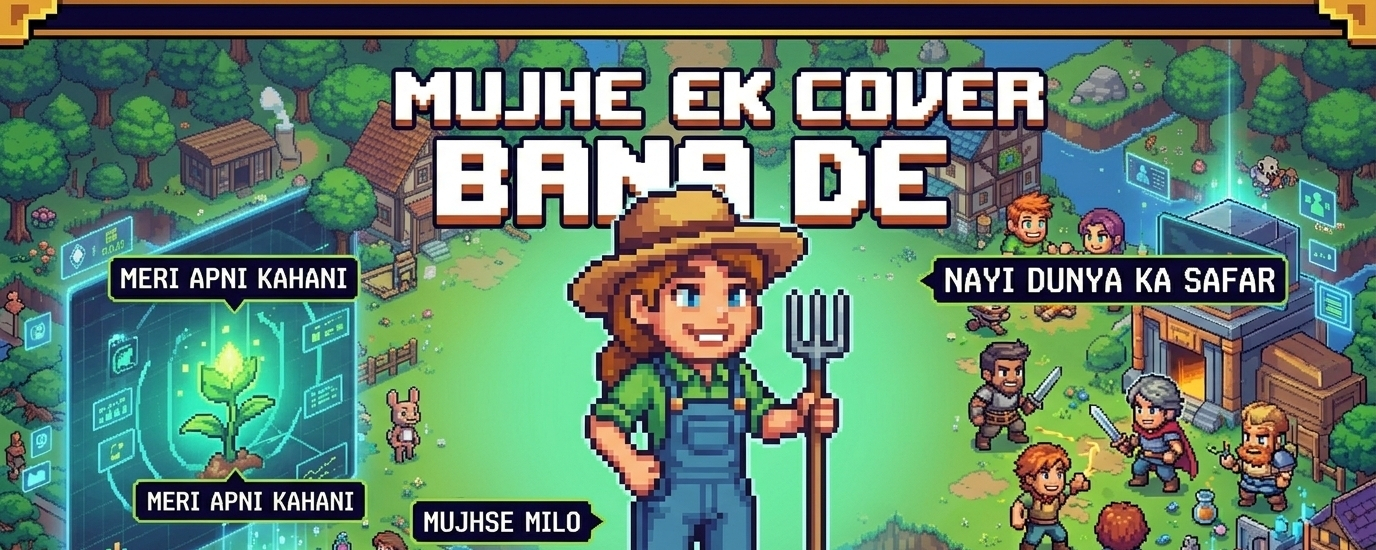
Pixels is one of those rare Web3 projects that actually makes sense the moment you strip away the jargon. At its core, it is a cozy, social world built around farming, exploration, crafting, and ownership but the interesting part is not just the feature list. It is the way those features are braided together so the game feels like a place to spend time, not a system to optimize. The official Pixels lite paper describes it as an open-ended world where players gather resources, advance skills, build relationships, and move through quests in a blockchain-backed universe, while Ronin positions the game as part of a gaming-first ecosystem built for player-owned economies
A Game That Starts Quietly, Then Keeps Expanding
The first thing Pixels gets right is restraint. It does not throw combat, chaos, and complicated token charts at you from the first minute. The game’s own documentation frames the early experience around farming, quests, cooking, and personalizing your space, which is a very deliberate choice: these are familiar activities, even to people who have never touched a crypto game before. The official FAQ also says Pixels is free-to-play and accessible on mobile through a wallet browser or regular browser with social login, which lowers the barrier to entry in a way that many blockchain games still struggle to do
That design matters more than it first appears. A lot of Web3 games begin by advertising ownership, then ask players to tolerate the game around it. Pixels seems to work the opposite way. It offers a simple daily rhythm plant, harvest, cook, upgrade, socialize, repeat and lets ownership sit underneath the experience rather than on top of it. In practice, that makes the world easier to understand and easier to return to, especially for casual players who do not want every session to feel like a finance seminar. That interpretation is supported by the game’s own emphasis on easy-going play and the official wording around play with friendsbuild your own worldand earn rewards
Why Ronin Was a Natural Fit
Pixels becoming a Ronin game was not a cosmetic partnership; it was a structural decision. Ronin’s own homepage describes the chain as purpose-built for gaming, fast, scalable, and battle-tested by millions of players. Its ecosystem page says it is crafted for developers building games with player-owned economies, and it emphasizes frictionless onboarding and wallet integration. That is exactly the kind of infrastructure a social MMO like Pixels needs if it wants players to log in, move around, own items, and trade without constantly feeling the friction of blockchain mechanics
Ronin’s official blog on Pixels makes the migration even clearer. It says players could create a Pixels account using a Ronin wallet, earn the in-game $BERRY token, and buy Pets on Mavis Market after the move. It also notes that the gameplay on Ronin stayed the same as it was on Polygon, but the wallet connection changed to Ronin. That detail is easy to miss, but it is important: Pixels was not rebuilt into something unrecognizable. It was moved into an environment better suited to the kind of ownership-heavy, social experience it was already trying to deliver
The Real Core Loop: Familiar Actions, Layered Meaning
Pixels’ documentation makes the core loop feel almost deceptively simple. The current primary mechanics are farming, quest narrative, cooking and acquiring recipes, and personalization of spaces through land ownership and map building. On paper, that sounds gentle. In practice, these systems give the player several overlapping reasons to keep coming back. Farming gives you a routine. Quests give you direction. Cooking gives you a way to transform resources into utility. Personalization gives you identity. Together, they create a loop that feels closer to a living village than a spreadsheet of rewards
The older whitepaper pages also show how the designers were thinking about the game’s structure from the beginning. Gathering resources was meant to be the core experience, with players making decisions about which industries to develop as they progressed. The progression pages talk about cooking, crafting, blueprints, recipes, and new industries opening up over time. That kind of layered design is what keeps a casual game from getting shallow too quickly: the first hour is about learning what to do, but the later hours become about deciding what kind of player you want to be
Chapter 2: Where Pixels Grew Up
Pixels has not stayed frozen in its early form. Its help desk archive shows a major Chapter 2 overhaul that landed on June 18, 2024, adding new skills like Stoneshaping and Metalworking, adjusting the leveling curve, consolidating earlier skills, and introducing a tiering system for industries such as farming, cooking, woodworking, metalworking, stoneshaping, mines, and trees. It also overhauled Specks, expanded NFT land placement rules, added over 100 new recipes and items, increased bag space, and reorganized the world. That is not a minor update; it is the kind of change that turns a quaint farming sim into a much broader life-simulation economy
The official site reflects that shift too. The homepage currently highlights “Chapter 2 Is Here,” says pets have arrived, promises updates every two weeks, and points players toward staking and a broader Pixel Economy. In other words, the project is not presenting itself as a one-and-done game drop. It is presenting itself as a living service that keeps widening its own world. That matters because longevity is one of the hardest things to fake in Web3 gaming. Pixels seems to know that new mechanics are only useful if they make the game feel deeper rather than busier
The Token Story: $PIXEL, $BERRY, and a Hard Lesson About Game Economies
The token side of Pixels has evolved in a way that says a lot about the project’s priorities. Ronin’s launch post for Pixels explained that $BERRY was originally the in-game utility token, with an uncapped supply meant to support free-to-play participation, and that players could earn it through gameplay and resource sales. The same post also introduced play-to-mint Pets and highlighted how the token economy tied into gameplay progression
By the time the FAQ was updated, the tone had changed. Pixels said it was moving away from $BERRY, focusing on $PIXEL, and introducing an off-chain currency called Coins. The FAQ argues that the shift is part of a sustainability effort: $BERRY had inflation problems, and the team wanted a cleaner, more stable economic model. That is a telling move. A lot of blockchain games overpromise on earnability and then spend the next year fighting inflation. Pixels appears to have accepted that reality and reworked the economy instead of pretending the problem would disappear on its own
The official site now frames the economy around staking $PIXEL, unlocking perks, and shaping the universe through participation rather than passive holding. Binance’s research page on Pixels, meanwhile, summarized $PIXEL as the game’s native utility and governance token and listed uses such as NFT minting, VIP membership, guild participation, premium in-game features, and eventual governance for a community treasury. Even if you read that as a roadmap rather than a finished state, the direction is clear: $PIXEL is meant to sit inside the game loop, not float beside it as a speculative side story
Social Play Is Not Decoration Here
Pixels calls itself a social game, and that is not just branding. The official site explicitly says players can play with friends, collaborate or conspire, and build their own world. CoinGecko’s guide also describes Pixels as a Web3 social gaming platform on Ronin with community building at its center, while the official site says the platform is built for worlds and games that integrate digital collectibles. That combination gives Pixels a different feel from isolated farming sims: the land is personal, but the world is sharem
Pets sharpen that social and emotional layer. Ronin’s launch post described Genesis Pets as play-to-mint NFTs, noted that they enhance gameplay by increasing storage and interaction radius, and explained that they are tied to in-game activity rather than simple purchase. That is a smart piece of design because it gives the collection mechanics a job beyond scarcity. A pet is not just a badge of ownership; it becomes a practical companion that changes how you move through the world
What Makes Pixels Different From the Usual Web3 Pitch
Pixels is interesting because it does not feel like it is trying to win players over with novelty alone. Its strength is that it repackages very old game pleasures tending a farm, improving a house, making something useful, showing it off to other people and then gives those actions a layer of digital ownership. That is a far more durable trick than promising earningsfirst and fun later. The game’s own materials repeatedly stress that fun comes first, with ownership and interoperability designed around that goal
That philosophy also makes Pixels a stronger fit for casual players than many blockchain titles. Ronin’s gaming-first infrastructure helps with the friction problem, the game’s free-to-play access helps with the entry problem, and the social farming loop helps with the retention problem. Put together, those three pieces form something that feels less like an experiment and more like a world someone actually expects people to live in for a while. That is probably the deepest compliment a Web3 game can receive
The Bigger Idea Behind Pixels
If you zoom out, Pixels is really about a simple but stubborn idea: digital ownership only matters when people care about the world around it. That is why the game spends so much effort on farming, crafting, land customization, guilds, pets, and recurring updates. Those systems are not filler. They are the scaffolding that makes ownership feel meaningful. A parcel of land matters more when it holds a history. A token matters more when it opens doors inside a world people already enjoy. A pet matters more when it changes how you play. Pixels seems to understand that, and that understanding gives it more depth than many projects that talk louder but build less
Closing Thought
Pixels is at its best when it feels almost disarmingly ordinary. Plant something. Water it. Build something. Talk to someone. Improve your land. Unlock a new skill. Then realize, a few hours later, that the ordinary loop has pulled you into a world with real economic design, evolving systems, and a live community that keeps the whole thing moving. That is the real achievement here. Pixels does not ask players to admire blockchain from a distance; it asks them to live inside a game where ownership, progress, and social play are stitched together tightly enough that the technology starts to disappear into the experience. And that, more than any token headline, is what makes the project worth paying attention to