
I didn’t expect a farming game to make me question monetary policy, but that’s exactly what happened to me inside Pixels.
I was standing in front of the Task Board in Chapter 2, half-focused, half on autopilot. I had just finished a farming loop and was thinking the usual Web3 thought: stack, hold, repeat. That quiet assumption we all carry from traditional games more grinding equals more stored value.
But something felt off.
I clicked into a task expecting a simple reward cycle. Instead, I noticed the system wasn’t rewarding accumulation, it was demanding participation in a kind of controlled depletion. I had to give up Tier 3 resources assets I had been slowly stacking to unlock the next reward.
That moment stuck with me. It didn’t feel like a marketplace. It felt like a system correcting me.
I paused and watched more closely.
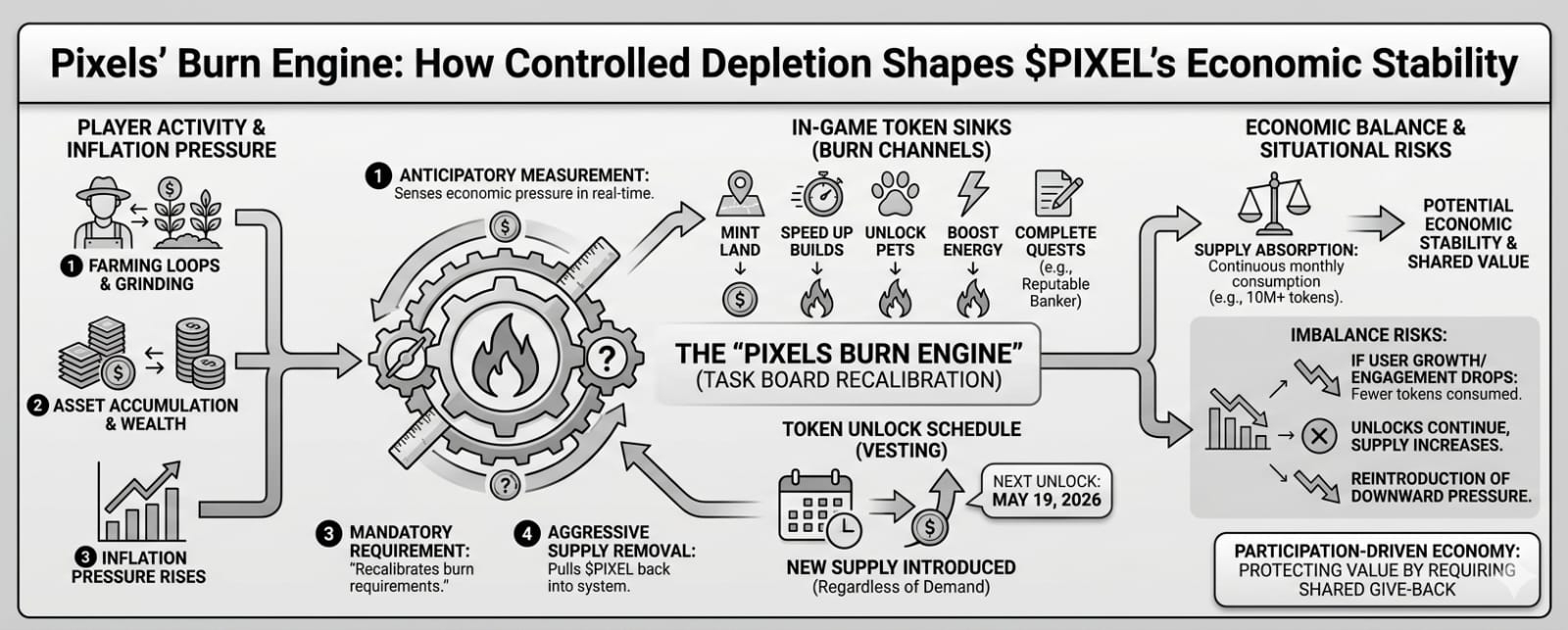
The Task Board wasn’t just assigning quests, it was recalibrating the economy in real time. The inputs (my resources) and outputs (rewards) weren’t static. They were shifting based on something deeper, almost like the game was measuring pressure.
And then I saw it happen.
A brief delay less than a second. Around 0.3 to 0.6 seconds. That was the time it took for the system to adjust burn requirements. The next task suddenly required more scarce inputs. Not randomly. Precisely.
It hit me: this isn’t a reward system. It’s a balancing engine.
And that’s where pixel started to make more sense.
As of April 26, 2026, pixel is trading around $0.008145, with a market cap of about $27.55M and a 24-hour volume of $15.96M. Fully diluted valuation sits near $40.72M, with a total supply of 5 billion tokens and roughly 3.38 billion in circulation. What’s interesting is that supply data varies slightly across aggregators, which already tells you one thing precision matters in how you interpret this economy.
Now here’s the part most people overlook.
Pixels isn’t designed for passive accumulation. It’s designed for active consumption.
The token isn’t just sitting in wallets, it’s constantly being pulled back into the system. Whether it’s minting land, speeding up builds, unlocking pets, boosting energy, or even completing quests like “Reputable Banker,” pixel acts as a required input. Not optional. Required.
I tested this myself. I tried to play “efficiently” minimize spending, maximize storage. But the system subtly pushed back. Progress slowed. Access narrowed. Reputation gains stalled.
That’s when I realized: hoarding in Pixels isn’t optimal, it’s counterproductive.
And the data backs this up.
The game has crossed 1 million daily active users, and recent reports show monthly pixel consumption exceeding 10 million tokens, the highest ever recorded. Earlier, 4.4 million tokens were burned in a 30-day period. That’s not small. That’s a continuous absorption mechanism.
Think of it like this: instead of inflation being managed by limiting production, Pixels allows production but aggressively manages removal.
It’s not stopping players from creating value, it’s ensuring excess doesn’t survive unchecked.
But here’s where things get more complicated.
Token unlocks are still ongoing. According to Tokenomist, about 771 million pixel (15.42% of total supply) is currently unlocked, with more scheduled through 2029. The next unlock hits on May 19, 2026. Allocations are spread across ecosystem rewards (34%), treasury (17%), private investors (14%), team (12.5%), and others.
So the system is doing two things at once:
1. Introducing new supply through vesting
2. Removing supply through in-game consumption
The question is whether the second can consistently outpace the first.
From what I observed inside the game, the burn mechanism isn’t reactive, it’s anticipatory. When inflation pressure rises (more players producing, more assets entering circulation), the system increases the “cost” of progression. Higher-tier resources get pulled in. Tasks become more demanding.
It doesn’t ask players how they feel about it. It just adjusts.
That’s what makes it feel almost mechanical like a thermostat for supply.
But I’m not fully convinced it’s foolproof.
Here’s my skepticism.
If player growth slows, or engagement drops, the burn engine weakens. Less activity means fewer tokens being consumed. Meanwhile, unlock schedules don’t pause. Supply continues to enter the market regardless of in-game demand.
That imbalance could reintroduce downward pressure.
And the price history reflects that risk.
Pixel hit an all-time high of $1.02. Today, it’s down about 99.2%. That’s not just market volatility, that’s a full repricing of expectations. Launch hype, dilution concerns, and execution risk are already baked into the chart.
So where does that leave us?
From my experience, Pixels is one of the few Web3 games that actually treats its token like an economic variable, not just a reward. The burn mechanism isn’t cosmetic, it’s structural.
But structure alone isn’t enough.
Here’s what I’m watching now:
Whether monthly token consumption keeps rising alongside user activity
How effectively the system absorbs upcoming unlocks
Whether new gameplay loops introduce additional burn sinks
And most importantly, whether players continue to accept this “consume to progress” model
Because that’s the real shift here.
We’re moving from ownership-driven economies to participation-driven ones.
And I’m still deciding how I feel about that.
I noticed myself hesitating before spending pixel the last time. Not because I didn’t want the reward but because I realized I wasn’t accumulating anymore. I was feeding a system designed to stay balanced, not to let me win indefinitely.
So I’ll leave you with this:
Are we ready for game economies where burning is not a loss, but a requirement?
And more importantly, do you trust a system that protects value by constantly asking you to give some of it back?

#EthereumFoundationUnstakes$48.9MillionWorthofETH #ShootingIncidentAtWhiteHouseCorrespondentsDinner #TetherFreezes$344MUSDTatUSLawEnforcementRequest #CanTheDeFiIndustryRecoverQuicklyFromAaveExploit? $ZBT $D