Everyone builds a reward system. Nobody builds a loop that makes the reward smarter every time it runs.
That is the difference Between a protocol that stabilizes and one tHat keeps bleeding out no matter how many times it adjusts emissions.
Pixels calls it a flywheel. The word gets used loosely in Web3. Here it mEans something specific a closed economic loop where each cycle produces better data and better data produces more efficient rewards and more efficient rewards attract better games and better games produce richer data. The loop feeds itself.
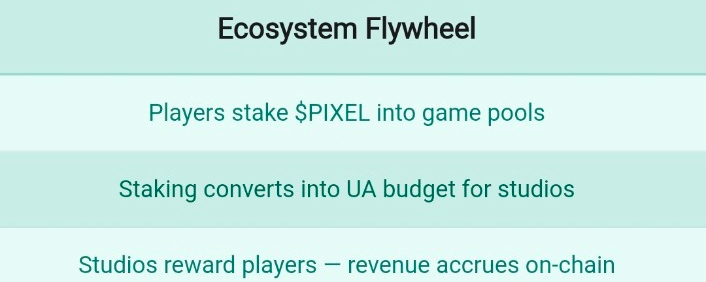
The mechanics are concrete. Players stake $PIXEL into a game pool. That staking balance converts directly into a user acquisition budget for the studio on. chain transparent, no ad exchange taking a rake. Studios use that budget to pull in new players through targeted in. Game rewards instead of FAcebook or TikTok spend.
Those players spend inside the game.
Revenue accrues on chain in the same contract that minted the UA credits. Every purchase quest completion trade and withdrawal gets logged through the Pixels Events API a first. party dataset building in real time across every game in the ecosystem.
This is where most people stop reading.
The data layer is where it actually gets interesting.
Models retrain nightly. Reward budgets shift toward the cohorts and funnel moments producing the strongest lift in retention ARPDAU and RORS. A player who shows strong Day 7 retention signals gets different treatment than one who logged in twice and disappeared. The system is not static. It learns.
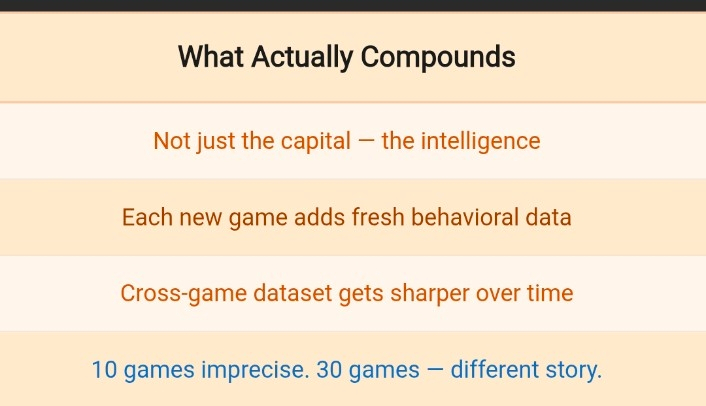
What compounds is not just the capital it is the intelligence. Each new game aDded to the ecosystem enlarges the addressable audience and contributes fresh behavioral data. The cross game dataset becomes more accurate with every title that joins. Targeting that was imprecise at ten games becomes meaningfully sharper at thirty.
The part I keep returning to is the on. chain transparency of the UA economics. New studios can underwrite an acquisition budget before writing a single line of code. The RORS of existing games is visible. The risk profile of Joining is lower than any traditional publishing deal.
That is a genuinely different pitch to game developers. Not trust us the ecosystem is healthy. Here is the data. Here is what the last cohort looked like. Here is your projected RORS at current staking levels.
Whether the models are actually as precise as the whitepaper implies that I cannot verify from the outside. The architecture is sound. The dataset quality depends entirely on how cleanly partner games integrate the Events API.
That dependency is the part worth watching.
If you were a studio evaluating this, what would you need to see in the data before committing?